Apr 14, 2023 | Wildlife
Water moccasins, also known as cottonmouths, are one of 6 venomous snake species found in Georgia. These snakes are often mistaken for non-venomous water snakes (which are illegal to kill in the state of Georgia). Water moccasins are found in most areas of Georgia with the exception of the northern central region. While they often sunbathe on land, logs, or stumps found near water sources, they will also inhabit swamps, backwaters, and slow-moving streams.
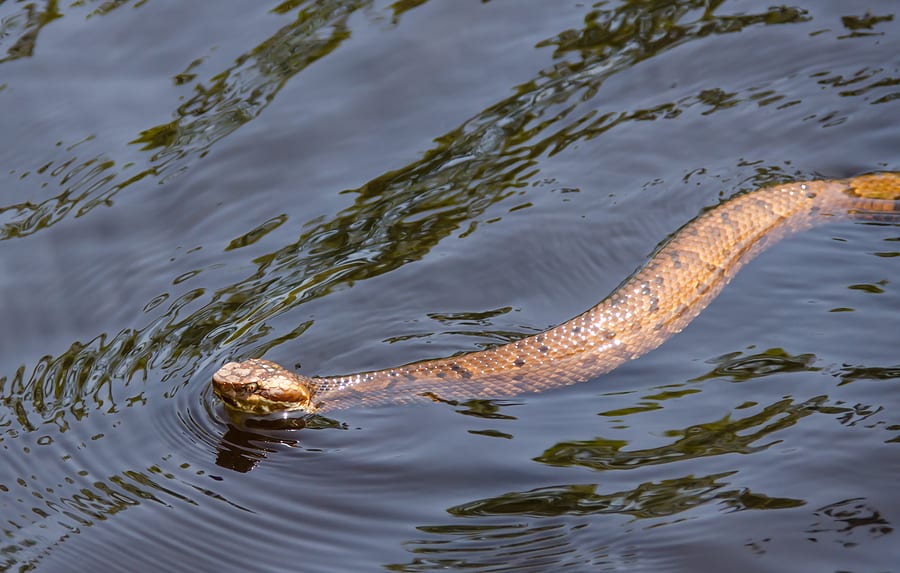
Water moccasins are large, heavy bodied snakes with dull colors and rough scales. They have a single row of these scales under their tails (while water snakes have a double row). They also have elliptical eye pupils and heat sensing pits between their eyes and nostrils. Most have banding on their bodies with wider bands on the sides that narrow and taper near the top. These bands look like hourglasses when looking at them from above. They also have a dark stripe that runs from the back of their eye to the corner of their jaw which distinguishes them from water snakes and other species.
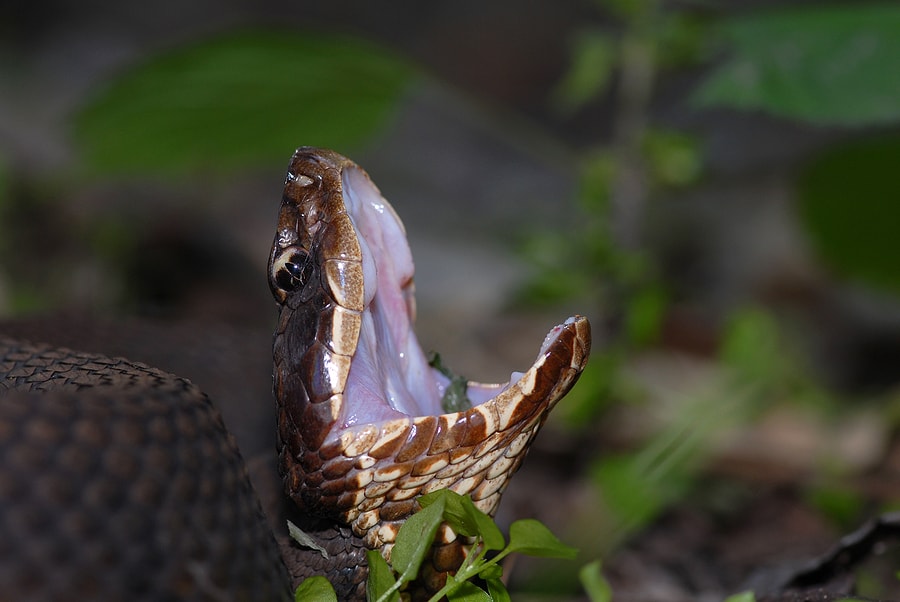
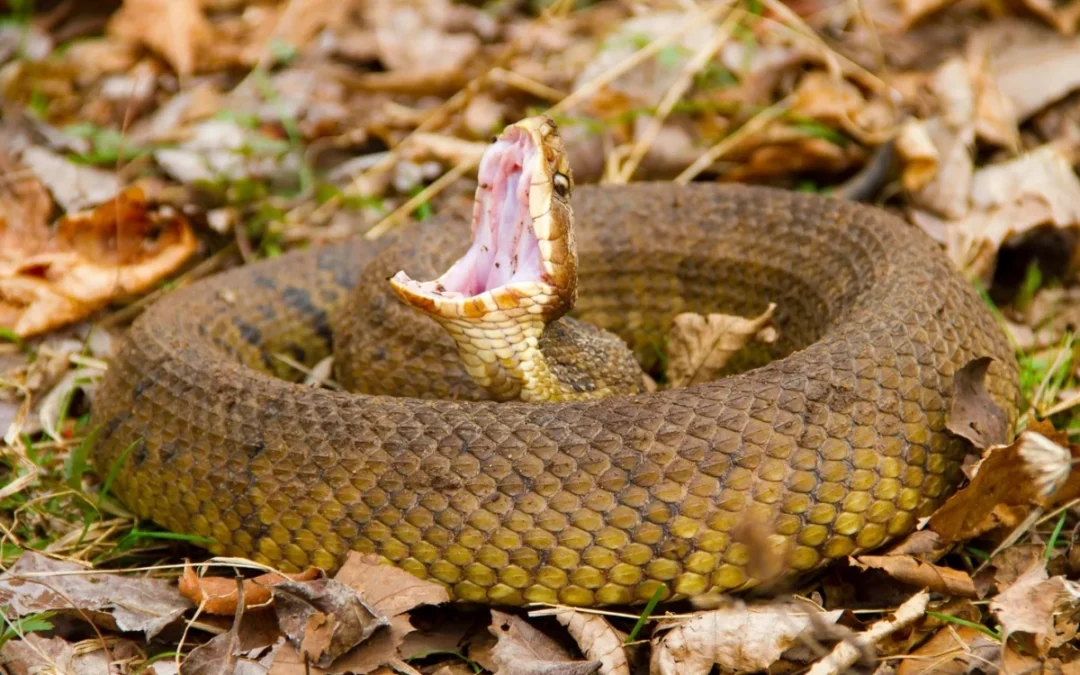
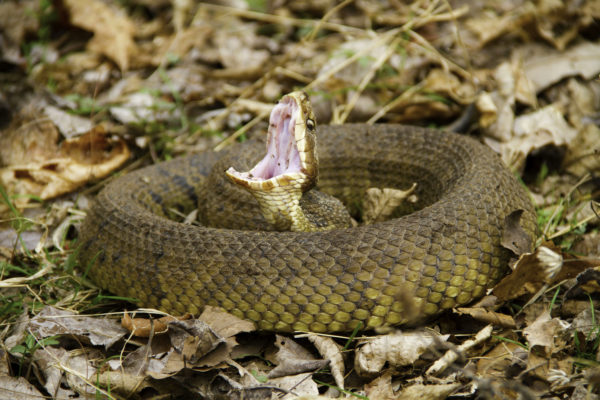
When agitated, water moccasins will vibrate their tails (similar to a rattlesnake rattle) and gape their mouths open, exposing the white coloration inside (hence the name cottonmouth). While these snakes have gotten a reputation for being aggressive, they are actually more likely to flee when encountered.
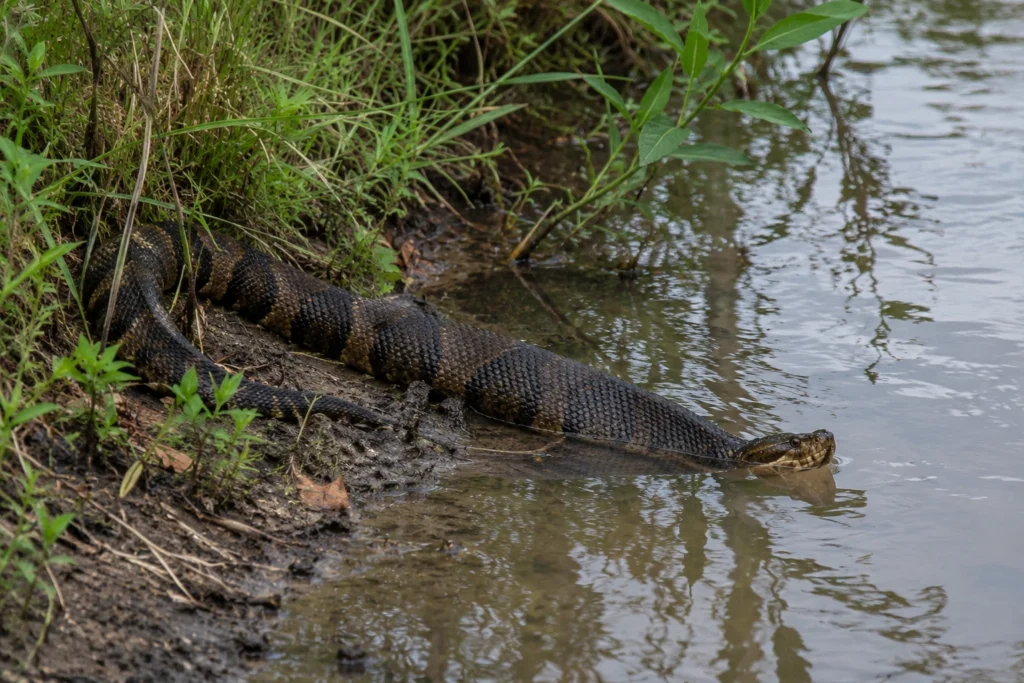
Water moccasins prefer to lay on logs and tree limbs near the water’s edge but will move into the water, as well. They can open their mouths and bite underwater, often hunting for frogs while swimming. The way they swim is also a distinguishing factor for these snakes. Water moccasins swim with their bodies riding on the surface of the water and their heads elevated above the water. They don’t typically submerge underwater, although they can. Water snakes will dive underwater when fleeing from a disturbance.
If you encounter a water moccasin in the wild, don’t panic. Stop moving towards them and back away slowly. Steer clear of them as you make your way away from them. Don’t ever attempt to kill or move a venomous snake on your own. If one makes its way into your home, call a professional wildlife control company for proper snake removal and relocation.
To keep water moccasins from lurking around your home, minimize stacks of wood near your house, get rid of standing water, bush piles, and any other moisture prone cover they can use. They also love to eat frogs so keep populations of these reduced around your property. They love wet hiding places with decaying plants or wood. Keep your home and yard clear and dry.
If you have a problem with snakes, contact your local pest control company for assistance.
You May Also Be Interested In:
What Kind of Fly is That?
How to Enjoy a Bed Bug Free Vacation
How to Handle a Termite Infestation
Should I Kill Centipedes In My House?
Keep Ants Out of Your Home this Spring

Mar 17, 2023 | Wildlife
As the weather warms up, snakes will emerge to take advantage of the warm weather and kick start their mating season. One of the snakes you’ll start to see this spring is the water moccasin. This venomous snake, also known as the cottonmouth, is a semi-aquatic snake found throughout the southeastern United States. The water moccasin is often mistaken for other snakes, so recognizing this snake in the wild is critical.
Water moccasins have large, triangular shaped heads with large jowls (due to their venom glands). Their eyes have a dark line through them and elliptical-shaped pupils. These snakes are large in size, ranging from 24″ to 48″. They have thick, heavy bodies when compared to their length. Their coloration can vary. These snakes can be completely brown or black (usually adults) or brown or yellow with dark crossbands. Adults tend to be darker while juveniles tend to be more brightly colored. They also have dark brown or yellow blotches on their bellies and black on the underside of their tails.
Water moccasins have facial pits they use to sense heat from predators and prey. They got their cottonmouth alias because the inside of their mouths are white in color. They will gape when they feel threatened, exposing this white color in an attempt to scare the threat away.
These snakes are found throughout the southeast, as far north as Virginia. They can be found in almost any freshwater habitat. They are active both during the day and at night, but will commonly hunt at night, especially during the hotter seasons of the year. They eat a variety of prey, including lizards, amphibians, other snakes, small turtles, birds, fish, mammals, and even baby alligators. They mate in the early summer.
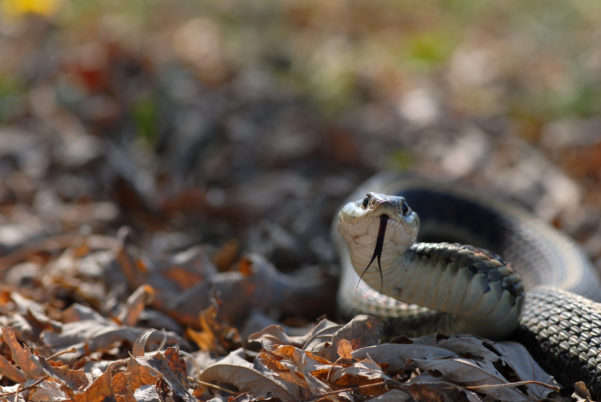
Water moccasins are often mistaken for other nonvenomous water snakes. While the water moccasin has a thick body and short, thick tail, nonvenomous water snakes have more slender bodies and thinner tails. The shape of the head is also important. Water moccasins have large, blocky heads with pronounced necks that are much more narrow than the head. Water snakes, on the other hand, have more slender heads with necks that are more comparable in width to their heads.
While it can be tempting to run away or grab the closest thing you can to kill a snake when you come across it, the best practice is to leave it alone and slowly back away. In the case of a venomous snake, contact your local pest control company who can implement safe snake removal and relocation techniques.
Feb 3, 2023 | Pest Control, Snake Control, Wildlife
By Anna V., Editorial Lead — Pest Education · Last updated: May 2026
If you’ve spotted a dark, thick-bodied snake near a pond, swamp, river, or even a backyard drainage ditch in Georgia, Alabama, Tennessee, or South Carolina, you might be looking at a water moccasin (also called a cottonmouth). At Northwest, we get a sharp uptick in snake calls every spring and summer, and water moccasin sightings are the ones that generate the most concern. The honest reality: water moccasins are venomous and warrant respect, but they’re also widely misidentified, and most water snakes Southeast homeowners actually see are harmless nonvenomous species mistaken for cottonmouths.
Here’s what to know to identify a water moccasin correctly, understand the real (versus mythical) risk, stay safe around water in our region, and know what to do if you or a family member is ever bitten.
Water moccasins are pit vipers native to the Southeast and are found near most permanent water bodies in Georgia and Alabama.
What Is a Water Moccasin?
Water moccasins (Agkistrodon piscivorus) are venomous pit vipers native to the Southeastern U.S. Their range covers most of Georgia and Alabama, extending from southeastern Virginia south to Florida and west to East Texas. They’re semi-aquatic, meaning they’re equally at home in water and on land, and they thrive in warm humid climates.
Two subspecies are present in our service area:
- Northern cottonmouth (Agkistrodon piscivorus piscivorus): The dominant subspecies across Georgia, Alabama, Tennessee, and South Carolina. Darker coloring with less distinct banding as adults.
- Florida cottonmouth (Agkistrodon conanti, recently elevated to its own species): Found in extreme south Georgia and Alabama. Often slightly larger with more distinct facial markings.
Typical habitats include swamps, rivers, lakes, ponds, marshes, drainage ditches, slow-moving creeks, and the overgrown edges of any persistent water body. They’re occasionally found in suburban yards near ponds, retention areas, or wet drainage features.
Water Moccasin Identification
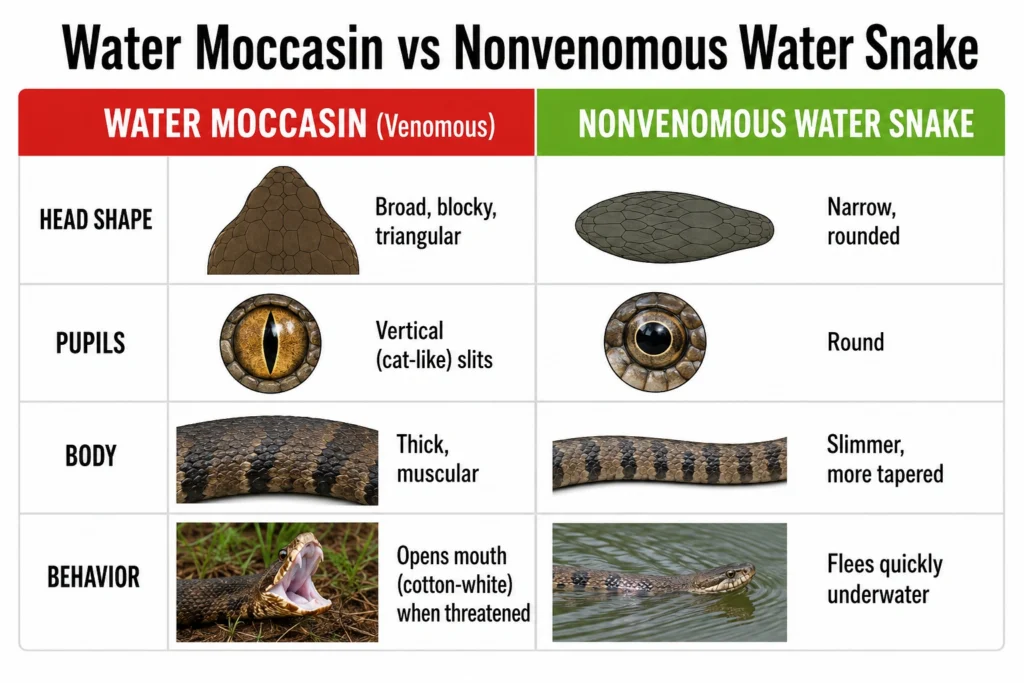
Four traits separate water moccasins from the nonvenomous water snakes they’re often confused with.
Physical Features
- Body shape: Thick, muscular, often visibly heavier than nonvenomous water snakes. Adults typically 2 to 4 feet long, occasionally over 5 feet.
- Color: Adults are usually dark olive, brown, or nearly black. Crossband markings are often faded or barely visible on older snakes. Juveniles are more distinctly banded with bright tail tips that fade with age.
- Head shape: Broad, blocky, distinctly triangular when viewed from above. Much wider than the neck. This is the single most reliable visual identifier.
- Mouth: Bright “cotton-white” mouth lining displayed when threatened (the source of the “cottonmouth” name).
- Pupils: Vertical and cat-like (not round). All pit vipers in the U.S. share this trait.
- Heat-sensing pits: Visible small pits between the eyes and nostrils on each side of the head.
Differences vs Nonvenomous Water Snakes
This is where misidentification causes the most unnecessary fear. Several harmless water snake species in the Southeast (especially the banded water snake, Nerodia fasciata, and the brown water snake, Nerodia taxispilota) are routinely killed because they’re mistaken for cottonmouths. The key differences:
- Head shape: Nonvenomous water snakes have narrow, rounded heads not much wider than the neck. Cottonmouths have wide, blocky, triangular heads.
- Pupils: Nonvenomous water snakes have round pupils. Cottonmouths have vertical slits.
- Body shape: Nonvenomous water snakes are slimmer and more tapered. Cottonmouths are thick and muscular.
- Behavior when threatened: Nonvenomous water snakes typically flee quickly underwater. Cottonmouths often stand their ground, coil defensively, vibrate the tail, and open the mouth to display the white lining.
- Swimming style: Cottonmouths often swim with the head and most of the body visible above the water. Nonvenomous water snakes typically swim with only the head visible.
When in doubt, assume venomous and keep your distance. Identification at a distance is plenty.
Are Water Moccasins Aggressive?
This is one of the most exaggerated reputations in North American wildlife. Water moccasins are defensive, not predatory toward humans. They do not chase people. Studies tracking cottonmouth behavior consistently show they will hold ground when threatened, but they don’t pursue.
The defensive behavior that gets misinterpreted as aggression:
- Standing ground: Unlike many snakes that immediately flee, cottonmouths often stay put when approached. This is conservation of energy, not aggression.
- Open-mouth display: The cotton-white mouth opening is a warning (“I’m here, I’m venomous, back off”), not an attack signal.
- Tail vibration: Rattled tail against leaves can sound similar to a rattlesnake. Same warning function.
- Defensive striking: Will strike if cornered, stepped on, or directly handled. Bites occur almost exclusively in these scenarios.
Give a cottonmouth 6+ feet of distance and step around it, not toward it, and you almost certainly won’t be bitten.
How Dangerous Is a Water Moccasin Bite?
Venom and Medical Risk
Water moccasin venom is hemotoxic, meaning it affects tissue and blood circulation rather than the nervous system. Effects of a bite include:
- Immediate intense pain at the bite site
- Rapid swelling and bruising
- Tissue damage that can progress for hours or days without treatment
- In severe cases: blood-clotting issues, blistering, and tissue necrosis
- Systemic symptoms (nausea, weakness, low blood pressure) in moderate to severe envenomation
Death from a cottonmouth bite is rare in the modern era thanks to antivenom availability, but bites are medical emergencies that require immediate hospital treatment. Tissue damage from untreated bites can be permanent. Approximately 25% of cottonmouth bites are “dry bites” with no venom injected, but you cannot reliably tell at the time of the bite, so always seek emergency care.
First Aid for a Snake Bite
Current medical guidance (per CDC and major emergency medicine organizations) for any suspected venomous snake bite:
- Call 911 immediately. Don’t drive yourself. Don’t wait to see if symptoms develop.
- Keep the affected limb still and below heart level. Movement spreads venom faster through the lymphatic system.
- Remove rings, watches, and tight clothing from the affected limb before swelling sets in.
- Take a photo of the snake if you can do so safely from a distance. Helps medical providers confirm species. Do NOT try to capture or kill the snake.
- Stay calm and minimize movement until help arrives.
What NOT to do (these were old advice and are now known to make outcomes worse):
- Do not cut the bite or try to suck out venom.
- Do not apply a tourniquet.
- Do not apply ice or cold packs.
- Do not give the bite victim alcohol or caffeine.
- Do not try to capture the snake.
For authoritative reference on snake bite first aid, see the CDC’s venomous snake safety guidance.
Where You’re Most Likely to Encounter a Water Moccasin in the Southeast
- Swamp and marsh edges
- Slow-moving creeks and rivers, especially the muddy banks
- Pond and lake shorelines, particularly with overhanging vegetation
- Drainage ditches in rural and suburban areas
- Around boat ramps, docks, fishing piers, and fish-cleaning stations
- Yards with persistent standing water, water features, or proximity to wetlands
- Under or near woodpiles, debris piles, and dense ground cover near water
Water Moccasin Safety Tips for Southeast Homeowners
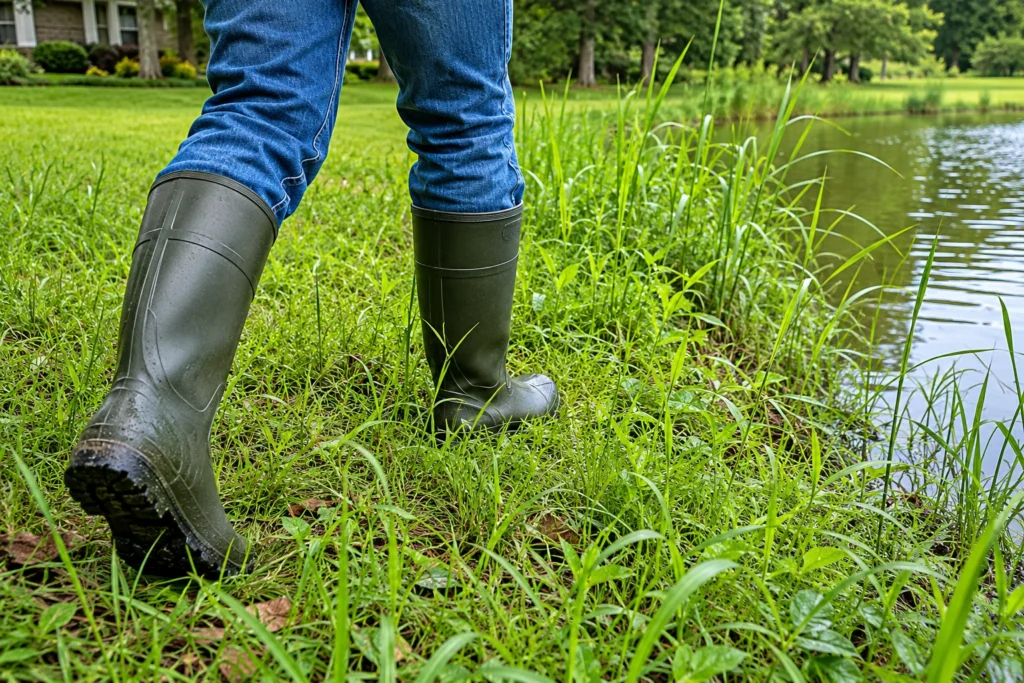
Tall boots, long pants, and visual awareness are the simplest snake-safety baseline for Southeast yards near water.
Avoiding Encounters
- Stay on cleared paths near water rather than walking through tall grass or dense underbrush.
- Avoid wading in murky water where you can’t see the bottom.
- Don’t reach under logs, rocks, or debris near water without looking first.
- Make noise as you walk near water (snakes feel ground vibrations and typically move away).
- Be especially cautious from late spring through early fall when snakes are most active.
- Check before stepping over logs or large rocks near water.
What to Wear Outdoors Near Water
- Tall waterproof boots (knee-high) when working in or near wetlands.
- Long pants tucked into boots.
- Avoid sandals or open-toe shoes near any water body.
- Carry a flashlight after dark and look before each step.
Yard Safety
- Remove brush piles, woodpiles, and debris that provide snake shelter.
- Keep grass trimmed short, especially around any water features.
- Clear vegetation around pond edges and drainage features.
- Eliminate rodent populations that attract snakes as a food source.
- Seal gaps in foundations, sheds, and outbuildings that snakes might enter.
Teaching Kids About Snake Safety
- Teach the rule: “If you see a snake, stop, back up slowly, and tell an adult.”
- Never try to pick up, touch, or kill a snake.
- Identify safe and unsafe play areas (no playing barefoot near ponds, creeks, or tall grass).
- For more general snake prevention strategies, see our home remedies to keep snakes away guide.
Water Moccasin Myths vs Facts
- Myth: Water moccasins chase humans. Fact: They don’t. They stand their ground, but they don’t pursue. Documented research shows zero cases of intentional cottonmouth pursuit of humans.
- Myth: All cottonmouth bites are fatal. Fact: With modern antivenom and prompt medical treatment, fatalities are extremely rare. Tissue damage is the more common serious outcome.
- Myth: You can identify them by color alone. Fact: Adult cottonmouths are often nearly solid dark color, easily confused with several harmless water snakes. Head shape, pupil shape, and behavior are more reliable identifiers.
- Myth: Cottonmouths can bite underwater. Fact: They can, technically, but bites in water are extremely rare. Most defensive behavior happens on land or while basking partially out of water.
- Myth: Killing a snake on your property prevents future encounters. Fact: Other snakes typically move into vacated territory. Habitat modification is far more effective than removal.
When to Call Professional Help
Professional wildlife or snake control is worth calling Northwest about if:
- You’ve confirmed a water moccasin on your property (especially repeat sightings).
- Snake sightings are happening near play areas, patios, pool decks, or other high-traffic zones.
- You need inspection and habitat modification to prevent repeated encounters.
- You’re managing a property with significant water features (ponds, retention areas, drainage ditches).
- Snake activity is accompanied by visible rodent activity (the food source that’s attracting them).
Professional snake services typically include identification, safe removal when needed, habitat modification (removing harborage, addressing rodent populations), and ongoing prevention recommendations. For broader snake prevention strategies, see our snake repellent guide.
(Spotted a water moccasin or seeing recurring snake activity? Schedule a free Northwest inspection and we’ll identify what’s around, address the conditions attracting them, and lay out a prevention plan.)
Frequently Asked Questions About Water Moccasins
Can water moccasins climb trees?
Yes, but rarely. Cottonmouths can climb low branches, especially overhanging water. They’re not arboreal hunters like rat snakes. Most encounters happen at ground level or in water. Snake sightings high in trees are far more likely to be rat snakes or other nonvenomous climbers.
Do water moccasins chase people?
No. This is one of the most persistent and inaccurate myths in Southeastern wildlife folklore. Cottonmouths are defensive, not predatory toward humans. They will hold their ground when threatened, but they don’t pursue. Most perceived “chasing” is actually the snake moving toward water (its escape route), which happens to be in the same direction as the person.
Are all cottonmouths dangerous?
All cottonmouths are venomous and warrant respect. About 25% of defensive bites are “dry bites” with no venom injected, but you can’t reliably tell at the time of a bite. Always treat any suspected cottonmouth bite as a medical emergency and seek immediate hospital care.
How common are water moccasin bites?
Bites are uncommon relative to encounter rates. Most cottonmouth sightings result in zero contact between snake and human. Bites occur almost exclusively in cases where the snake is stepped on, handled, or cornered. In Georgia and Alabama combined, fewer than 100 documented cottonmouth bites occur in a typical year, the vast majority non-fatal with proper medical care.
How do I tell a water moccasin from a harmless water snake?
Four traits: (1) head shape (cottonmouth = wide, blocky, triangular; nonvenomous = narrow, rounded), (2) pupils (cottonmouth = vertical slits; nonvenomous = round), (3) body shape (cottonmouth = thick and muscular; nonvenomous = slimmer), and (4) behavior (cottonmouth = stands ground, opens mouth, vibrates tail; nonvenomous = flees quickly underwater). When in doubt, keep your distance regardless.
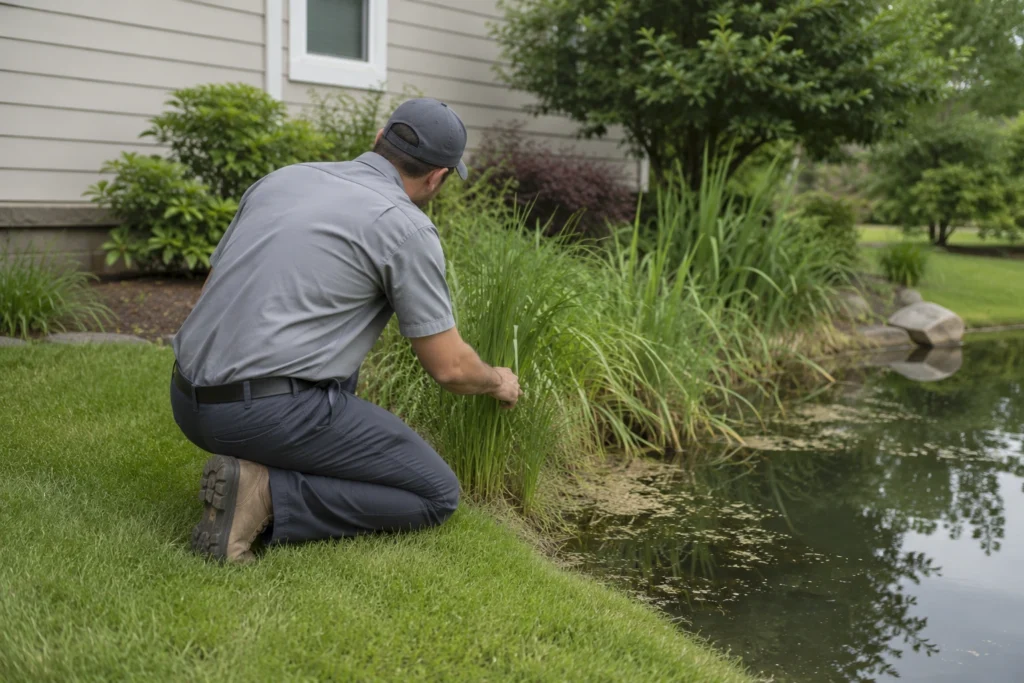
Snake prevention is mostly about removing the conditions that bring them in: harborage, rodent food sources, and overgrown ground cover.
Schedule a Snake & Wildlife Inspection
If you’ve confirmed water moccasin activity, you’re seeing recurring snake sightings, or you have property features (ponds, drainage, dense brush) that attract snakes, Northwest’s team handles identification, habitat modification, and ongoing prevention. Most snake problems are really habitat problems, and habitat changes hold longer than removal alone.
About the Author
Anna V., Editorial Lead — Pest Education leads pest education content for Northwest Exterminating, working with senior technicians and service center managers across our Georgia, Alabama, Tennessee, and South Carolina service areas to translate field expertise into homeowner-friendly guides. The focus: accurate, regionally-specific answers to the pest questions Southeast homeowners are actually searching for.
Nov 21, 2018 | Pest Control
Fall is here! Football has started, bonfires are lit, and the weather is bringing more people outside. Though now is the time for all the Fall fun, you aren’t the only one enjoying this weather. Those snakes that slither through the tall grass and the woods of your backyard also appreciate this time of year! They can be intimidating creatures, but they also shouldn’t draw too much concern from the average person.
In Georgia it is illegal to kill certain snakes, punishable with fines of up to $1000 and/or up to one year in jail. This shouldn’t be an issue for most of us, however, because snakes want to avoid us just as much as we want to avoid them. Did you know that most snakes in Georgia are non-venomous with only six being venomous?
Let’s touch on these 6 venomous species of snakes and how you can tell which is which:
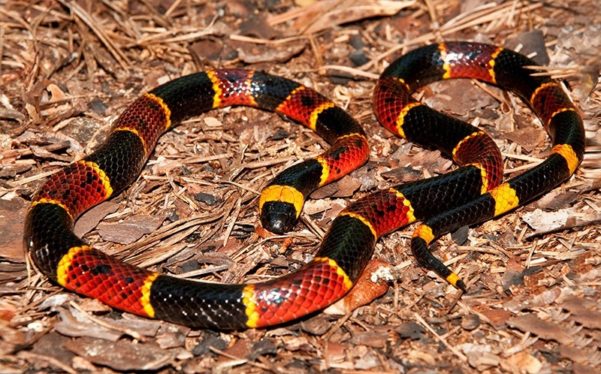
Eastern Coral Snake: This snake is easily recognized. You can tell them apart by the red and black segments on their body separated by yellow rings. Unlike the other snakes on this list, the coral snake has a rounded snout.
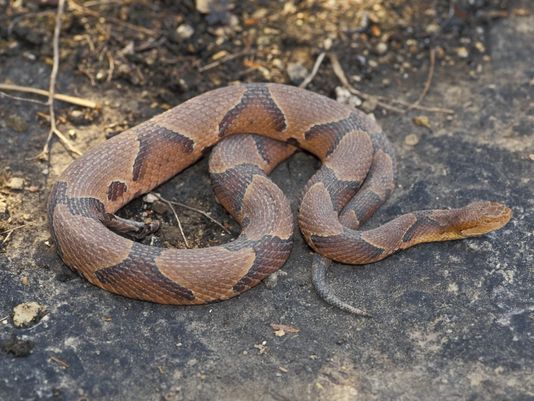
Copperhead: The copperhead usually has a light brown to gray skin color, but they can range from rusty orange to nearly black. You can recognize them easily by the 10 to 21 dark-brown hourglass-shaped crossbands on their body. Look out for their triangular shaped head, as well.
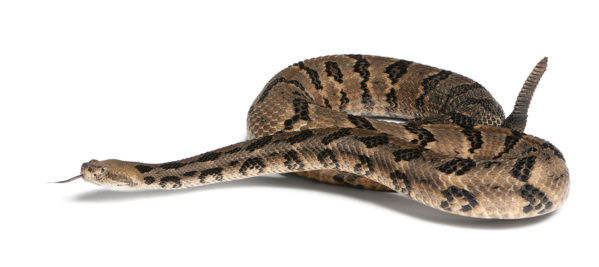
Timber Rattlesnake: They have background skin that can be a variety of different colors, ranging from shades of pink, yellow, gray, brown, or black. It has brown to black V-shaped bands down its body. It has a black tail with a rattle at the tip.
Pigmy Rattlesnake: They are usually gray or tan but can be reddish or black. The pattern on its body resembles blotches or spots that are dark in color. The tip of the tail has a rattle.
Cottonmouth: The cottonmouth has light brown or olive-colored skin with dark bands along their bodies. When they mature they may become very dark, obscuring the bands completely.
Eastern Diamond Rattlesnake: Its body is patterned with a row of diamond-like shapes that are dark brown in color. Each shape is outlined by a yellowish border. The tail has 3 to 10 brown and white bands and a rattle.
Before snakes go into hibernation, there’s a chance you might see one in your yard or while you’re out for a walk. In a situation like that, avoid the snake, and call your local pest control company to relocate it for you. And remember, it doesn’t want to hurt you, so don’t hurt them.
Sep 7, 2017 | Wildlife
Fall will soon be upon us! As the temperatures cool down we want to get outdoors and enjoy the milder weather at the turn of the season. But BEWARE! Snakes are also active during this time of the year. Most snakebites occur between April and October when the weather is still warm and outdoor activities are popular. Fall is breeding and hatching season which makes males more aggressive as they are trying to get the attention of female snakes. Newly hatched snakes are also aggressive as they are trying to avoid predators. Snakes are also preparing for hibernation or brumation (where they don’t actually sleep but instead slow their metabolism to acclimate to the cooler temperatures) which makes them more active during this time of the year. Here are some common snakes you may encounter in southern states and what you can do to keep them away from your home.
COMMON SNAKES IN THE SOUTHEAST:
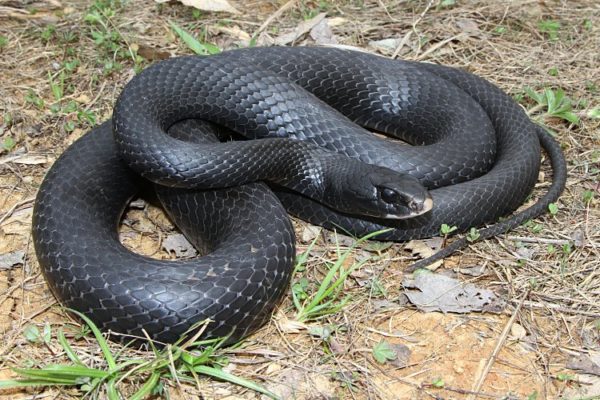
Black racers are large snakes (usually over 5 feet long). They are slender and solid black in color, although some may have a white chin. They are often mistaken for other large, black snakes. Juveniles look completely different, usually gray in color with darker blotches. They tend to flee quickly when threatened. They are found throughout the eastern US. They can be found in any habitat but are more common in old fields, near forest edges, and the edges of wetlands. They are non-venomous but may bite if handled.
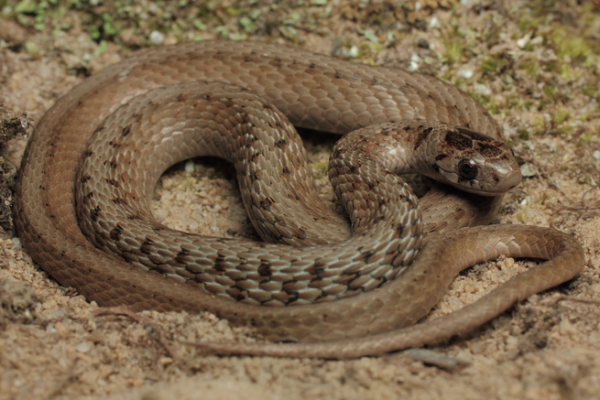
Brown snakes are small (usually only 6-13 inches in length). Most of them are brown in color but they can yellow, reddish, or grayish brown and can have darker spots on their backs. They can be found in wooded areas, near wetlands, and in urban areas. They are not found in areas of high elevation. They like to live under debris in residential areas or any other area with enough groundcover. They are non-venomous but may bite if handled.
Copperheads are large snakes (usually 2-4 feet long). They have a distinctly triangular shaped head. They are tan to brown with darker hourglass shaped bands on their bodies. Juvenile copperheads have a distinct yellow-tipped tail. They are found in semi-protected areas like woods and swamps but may also be found in urban areas. They are found throughout the central and eastern US, with the exception of some parts of South Georgia and the entire state of Florida. They are venomous and may bite if they feel threatened.
Coral snakes are medium sized (1.5 to 2.5 feet long). They are brightly colored red, yellow, and black. If they feel threatened, they will lift up their tail and curl the tip over. Although they spend the majority of their time underground, they can be found in pine and scrub sandhill habitats, hardwood forests and pine flatwoods, and in suburban areas. They are found throughout much of the southern coastal plain, although they are most common in Florida. They are venomous and may bite if they feel threatened.
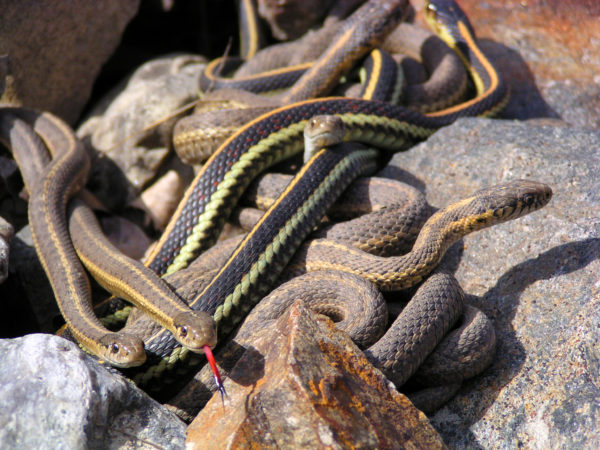
Garter snakes are small to medium sized (1.5 to 4 feet long). They have dark colored bodies with three yellow stripes running vertically. They prefer protected areas such as woods or marshes but are also common in grassy areas and around water. They are very common in suburban areas as long as there is adequate cover for them. They are common throughout the Southeast and most of the US. They are non-venomous but may bite if handled.
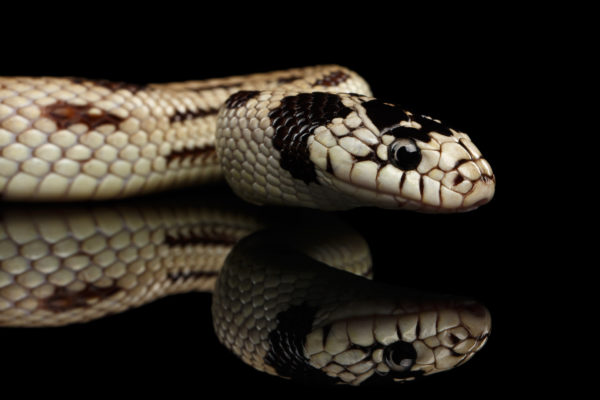
King snakes are large snakes (3-4 feet long). They are a shiny black color with white or yellow bands. They have a rectangular looking head with a short, blunt snout. They are found in protected areas such as woods, overgrown vegetation, and cluttered areas. They are found throughout the southeast US. They are non-venomous but may bite if handled or threatened.
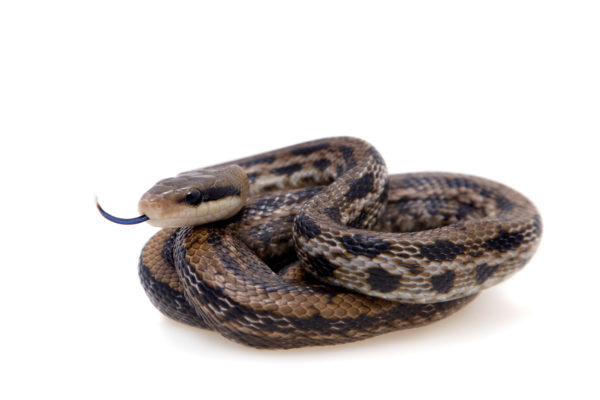
Rat snakes are large snakes (most 3-5 feet long but some longer than 6 feet). Their coloring depends on the region they live in and can be black, yellow with stripes, or gray with darker patches. They are found in semi-protected areas such as woods, overgrown vegetation, swamps, or abandoned and vacant buildings. They are found throughout the southeast US. They may climb for food. They are non-venomous but may bite if handled or threatened.
Water moccasins are also known as cottonmouths. They are large snakes (2-4 feet long). Their color varies from solid brown to yellow with dark crossbands. Juveniles have a yellow-tipped tail. Their head is distinctly triangular. When threatened they have a characteristic display with their head in the middle of their coiled body and their mouth wide open. They are found in freshwater habitats, cypress swamps, river floodplains, and heavily vegetated wetlands. They are found throughout the southeast US but are more common in coastal regions. They are venomous snakes and may bite when threatened.
HOW TO AVOID SNAKES
While it is impossible to prevent snakes, there are things you can do to avoid them and prepare yourself and your family when you are enjoying the outdoors. Check out these 10 tips to avoid snakes:
- COVER YOUR FEET. If you are going to be outdoors in areas that are prone to snakes, don’t wear flip flops or sandals. Wear closed toed shoes, preferably hiking boots and long pants.
- AVOID TALL GRASS. If possible, avoid areas with tall grass when you are outdoors. If you must walk through tall grass, keep your feet and legs protected, keep a vigilant watch around you and make your presence known.
- DO SOME RESEARCH. Check out our snake facts above and try to avoid areas that are likely to have snakes. Do some research ahead of time and find out what snakes are most common in your area, what they look like, and what habitats they live in.
- LOOK UP. Many snakes can climb trees and can move from tree to tree by adjacent branches. Make sure to look up when you are walking in wooded areas and wear a hat if possible. This also applies if you are boating in areas with overhanging trees.
- WALK WITH CONFIDENCE. Snakes respond to vibrations from the ground so they can feel you coming before they can see you. Walk with strong steps to make your presence known. They will often flee before you even see them.
- PAY ATTENTION. Look around. Be aware of your surroundings. Look down when you are walking.
- AVOID HABITATS. Familiarize yourself with habitats common to snakes in your areas and avoid them. Stay away from large rocks, rock and wood piles, areas with heavy overgrowth, or any other area that snakes can use for cover.
- CHECK YOUR CAR. Snakes are known to take cover under cars, especially if you park your car in an area prone to snakes. They seek protection from predators while still having a warm surface to lay on.
- PROTECT YOUR HOME. Seal any cracks and crevices around your home that might allow snakes to come in seeking warmth and food. Remove debris and clutter from your yard and garage. Keep wood piles away from the house. Clear overgrowth from your yard. Remove anything that could potentially be used as cover for snakes.
- USE REPELLENT. There are many commercial snake repellents on the market today, as well as several natural methods of snake repellent. Find the one that works best for you.