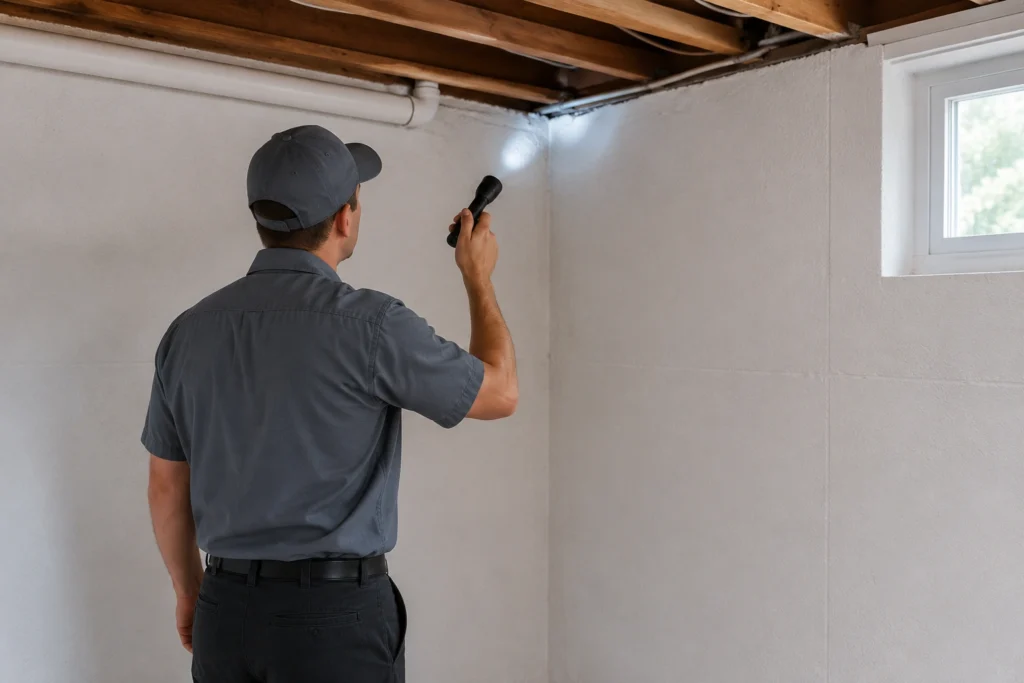
Mar 20, 2026 | Bed Bug, Florida Blogs, Georgia Blogs, Tennessee Blogs
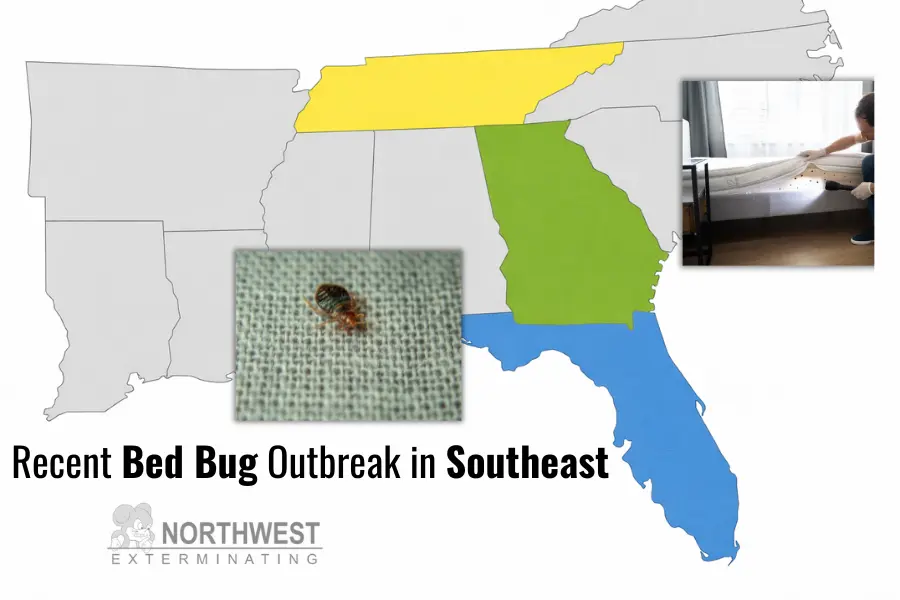
A recent bed bug outbreak in the Southeast has made headlines, as cases continue to rise across states like Georgia, Florida, and Tennessee. Reports show infestations appearing in homes, apartments, hotels, and even public spaces—putting homeowners on high alert.
For many families, this isn’t just an inconvenience—it’s a stressful and disruptive experience. Bed bugs spread quickly, hide extremely well, and can be difficult to eliminate without the right approach. What often starts as a few bites can escalate into a full infestation in a matter of weeks.
If you’re noticing signs—or even just concerned after travel—understanding what’s happening and acting early can make all the difference.
Why Are Bed Bugs Increasing in the Southeast?

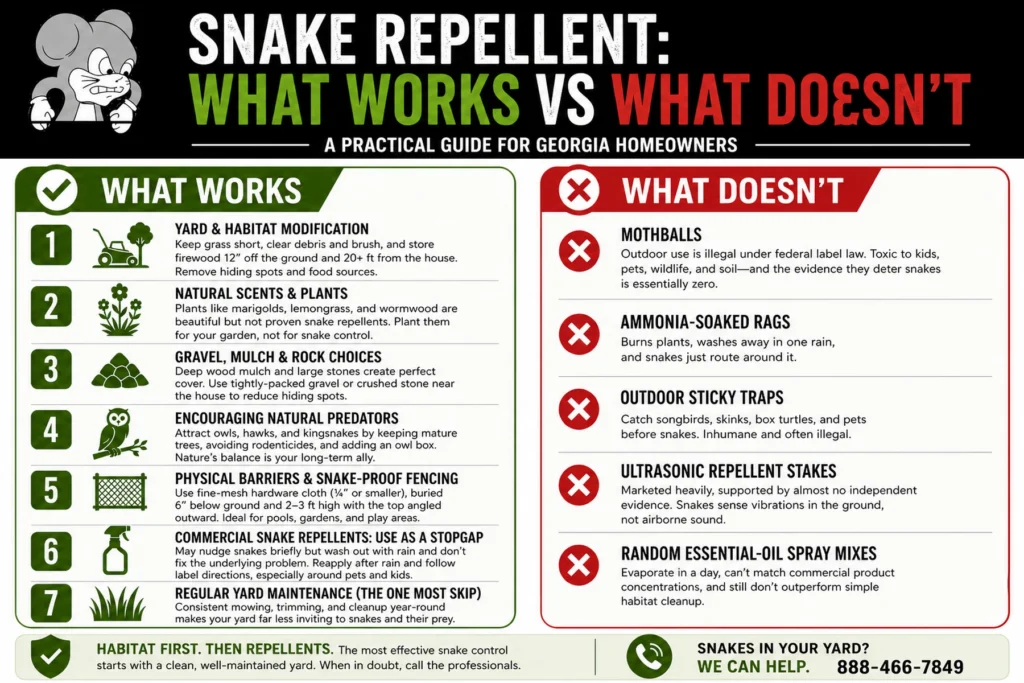
Bed bugs often spread by hitchhiking in luggage, making travel one of the most common ways infestations start.
Luggage is one of the most common ways bed bugs spread. There isn’t a single cause behind the rise in infestations; it’s a combination of environmental and behavioral factors.
Increased Travel and Mobility
With more people traveling for vacations, work, and events, bed bugs are spreading faster than ever. They don’t fly but they are excellent hitchhikers. Luggage, clothing, and even backpacks can carry them from one location to another.
This is a major reason why searches for bed bugs near me have increased significantly in recent months.
Warm Climate Conditions
The Southeast United States provides an ideal environment for bed bugs to thrive. Warmer temperatures allow them to reproduce more quickly, accelerating the bed bug lifecycle and increasing infestation rates.
Urban Living and Shared Spaces
In cities and densely populated areas, bed bugs can easily move between units. Apartments, condos, and hotels are particularly vulnerable. This is why we’re seeing increased reports of bed bugs in Florida and bed bugs in Tennessee, in both residential and commercial settings.
Resistance to Over-the-Counter Treatments
Many homeowners attempt DIY solutions first but bed bugs have developed resistance to many common products. This often leads to partial treatment, allowing infestations to rebound stronger.
How to Identify a Bed Bug Infestation
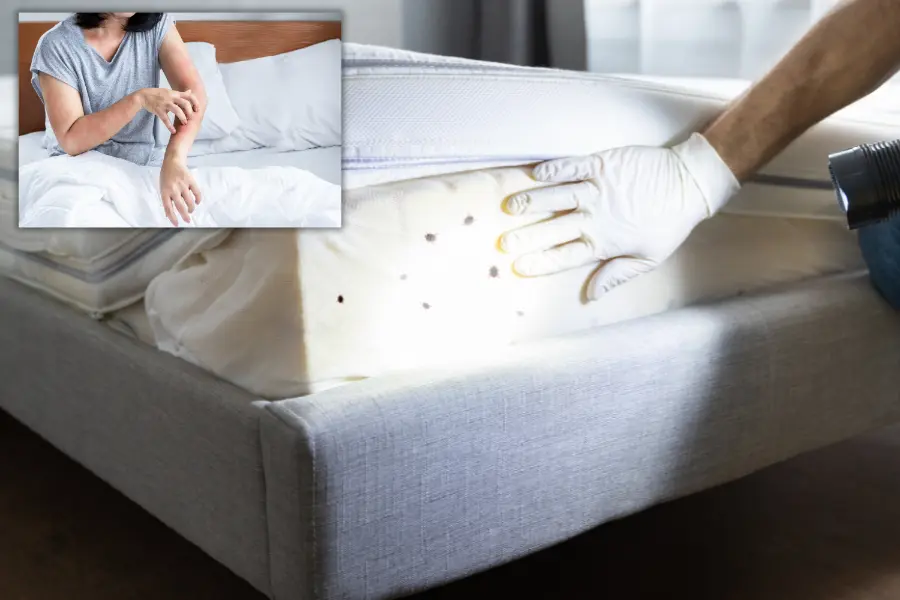
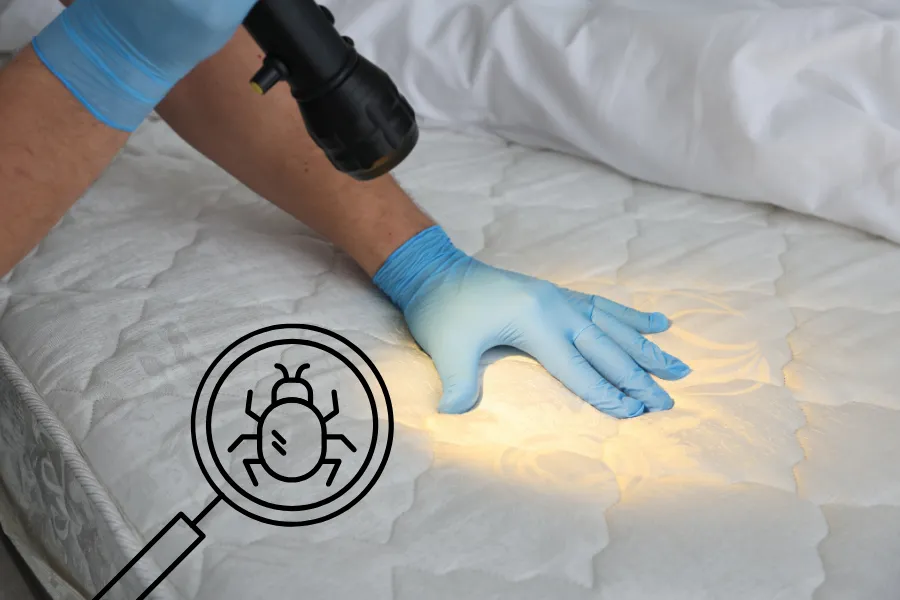
If you notice bites along with bugs or spotting on your mattress, you may be dealing with a bed bug infestation.
If you notice bites along with bugs or spotting on your mattress, you may be dealing with a bed bug infestation.
Early detection is key. The sooner you recognize the signs, the easier it is to control the problem.
Here’s what to look for:
- Red, itchy bites (often in clusters or lines)
- Small blood stains on sheets or pillowcases
- Dark spots (droppings) on mattresses or furniture
- Shed skins or eggshells in cracks and seams
- Musty odor in more severe infestations
Bed bugs typically hide during the day in mattress seams, bed frames, baseboards, and upholstered furniture. A proper bed bug inspection often requires checking areas most homeowners wouldn’t think to look.
How Fast Do Bed Bugs Spread?
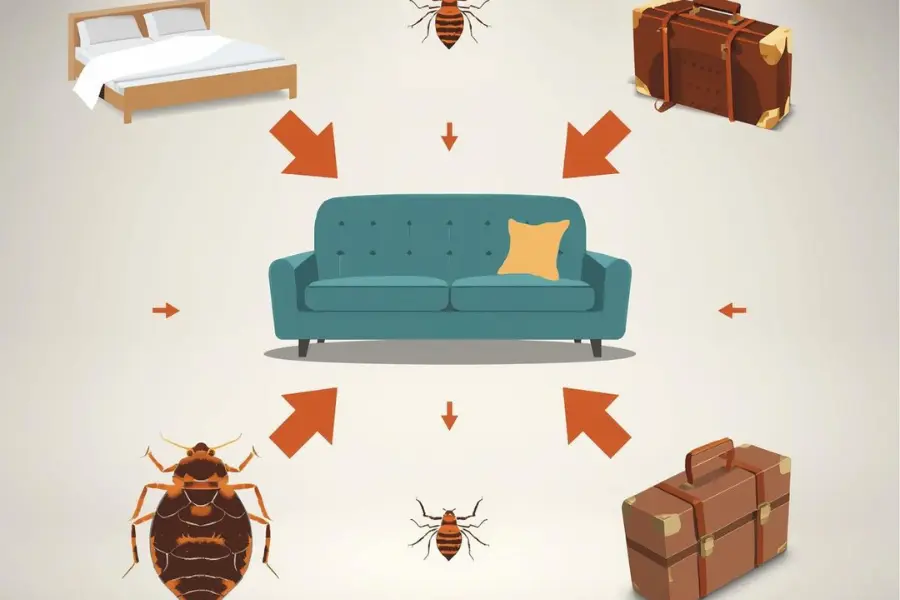
Bed bugs don’t stay in one place—they spread rapidly through furniture, rooms, and personal belongings.One of the biggest misconceptions is that bed bugs spread slowly. In reality, they multiply rapidly.
A single female can lay hundreds of eggs, and under ideal conditions, populations can grow significantly within weeks.
Bed bugs spread by:
- Moving through walls and electrical outlets
- Attaching to clothing, luggage, and furniture
- Traveling between rooms and units
Bed bugs can quickly spread between beds, furniture, and luggage — turning a small issue into a widespread infestation.
This is why early detection is critical. Waiting too long can turn a manageable issue into a widespread infestation.
Why DIY Bed Bug Removal Often Fails
It’s completely understandable — most homeowners want to try solving the problem themselves first. But bed bugs are one of the toughest pests to eliminate without professional help.
Common reasons DIY methods fail:
- Incomplete coverage (missing hidden areas)
- Surviving eggs that hatch later
- Improper application of products
- Resistance to store-bought chemicals
Even when it seems like the problem is gone, infestations often return — leading to frustration and higher long-term costs.
Professional Bed Bug Treatment in the Southeast
Northwest Exterminating technicians provide professional bed bug treatment with trusted, local expertise.When it comes to bed bugs, professional treatment isn’t just helpful, it’s necessary.
A trusted bed bug exterminator will follow a structured inspection process to identify all affected areas and determine the best treatment plan.
Northwest Exterminating technicians provide professional bed bug treatment with trusted, local expertise.
What professional treatment includes:
- Thorough inspection of all hiding spots
- Heat treatments that eliminate all life stages
- Targeted chemical treatment when needed
- Follow-up visits to ensure full eradication
Why Homeowners Choose Northwest Exterminating
At Northwest Exterminating, our professional pest control technicians bring over 75 years of experience handling pest infestations across the Southeast.
We’ve worked with:
- Single-family homes
- Apartment complexes
- Hotels and hospitality properties
- Other commercial spaces
Our team is trained to identify infestations quickly and apply family-friendly, effective treatments tailored to your home and situation.
As a leader in residential pest control, Northwest combines local expertise with proven treatment methods, helping homeowners regain peace of mind fast.
How to Prevent Bed Bugs (Practical Tips)
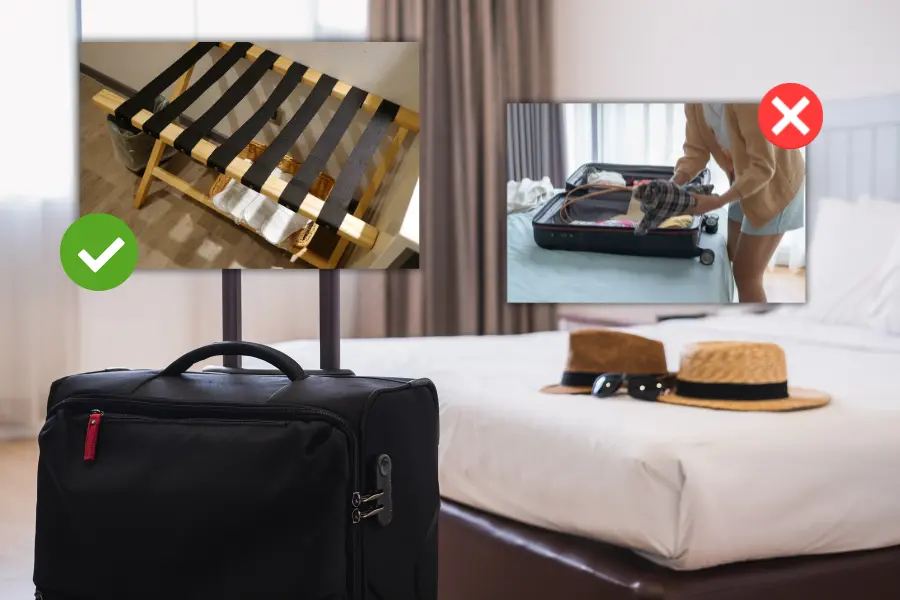
Simple travel habits like inspecting beds and using luggage racks can significantly reduce the risk of bed bugs.
While no method is 100% foolproof, there are ways to significantly reduce your risk.
Travel Smart
- Inspect hotel mattresses and headboards
- Keep luggage elevated off the floor
- Wash and dry clothes on high heat after returning
At Home
- Regularly inspect bedding and furniture
- Vacuum frequently, especially around sleeping areas
- Reduce clutter where bed bugs can hide
Be Cautious with Furniture
Avoid bringing in secondhand furniture without inspecting it carefully.
Real-World Insight: What We’re Seeing Locally
Serving Georgia, Florida, and Tennessee, Northwest Exterminating is helping homeowners respond to the growing bed bug outbreak across the Southeast.
In recent months, our team has seen an increase in bed bug calls across Georgia and surrounding areas, particularly after travel-heavy seasons.
Many homeowners we work with initially thought they were dealing with mosquito bites or minor skin irritation. By the time they realized it was bed bugs, the infestation had already spread.
FAQ: Bed Bugs in the Southeast
Are bed bugs common in the Southeast?
Yes, especially in warmer climates with high travel activity. Cities in Georgia, Florida, and Tennessee are seeing increased reports.
How do I know if I have bed bugs?
Look for bites, stains, droppings, and visible bugs. A professional inspection is the most reliable way to confirm.
Can bed bugs spread from house to house?
Yes, especially in apartments or shared housing environments.
What is the fastest way to get rid of bed bugs?
Professional bed bug removal service is the fastest and most effective solution.
When should I call an exterminator?
As soon as you notice signs. Early treatment prevents larger infestations.
Bed bugs are on the rise across the Southeast and they’re not going away anytime soon. The combination of travel, climate, and population density is creating the perfect environment for infestations to spread. The key is acting early.
If you suspect bed bugs, don’t wait. A professional inspection can save you time, money, and stress — and help you avoid a much larger problem.
Concerned you have bed bugs? We’re here to help. Schedule a free bed bug inspection with Northwest Exterminating today.
`FAQ Schema`
Feb 16, 2024 | Georgia Blogs, Pest Control
By Anna V., Editorial Lead — Pest Education · Last updated: May 2026
Few household pests collect as many bad facts as the daddy long legs spider. The “world’s most venomous spider but can’t bite you” story has been around forever. The “it’s actually a fly, not a spider” theory has its own corner of the internet. At Northwest, we field these questions every spring from Georgia and Alabama homeowners spotting long-legged spiders in basements, garages, and ceiling corners. The truth is much less dramatic and much more useful: the daddy long legs spider is a real spider (eight legs, two body parts, makes silk), it’s almost entirely harmless to humans and pets, and it actually helps keep other household pests in check.
Here’s what a daddy long legs spider actually is, how to tell it apart from the bug it gets confused with most often (the crane fly), and what to do when you find one in the house.
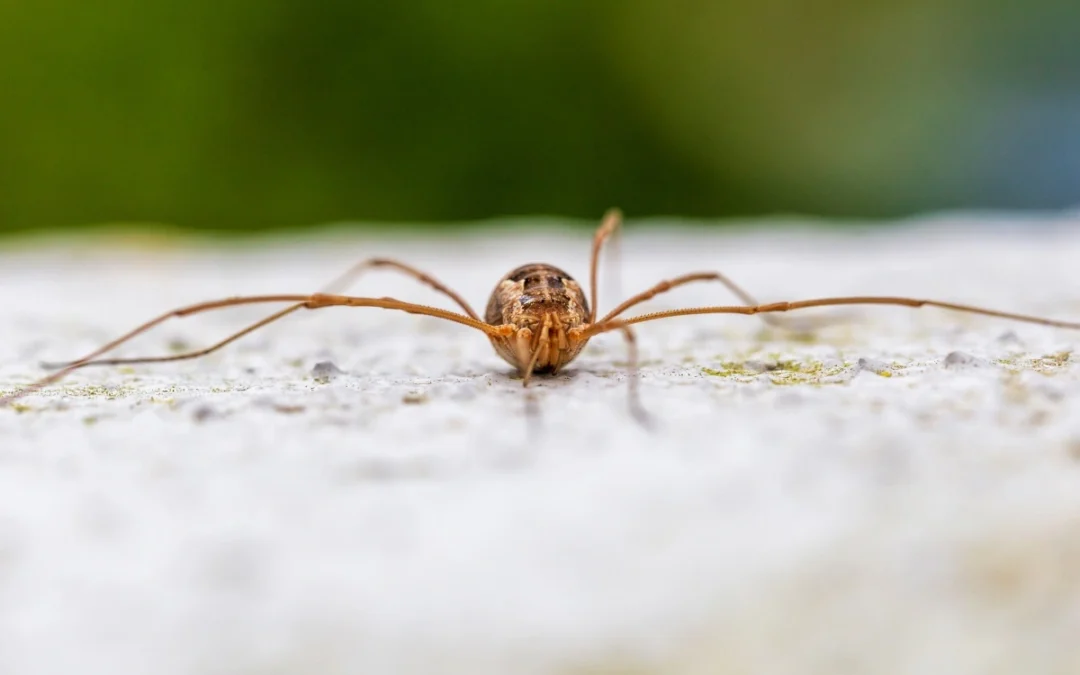
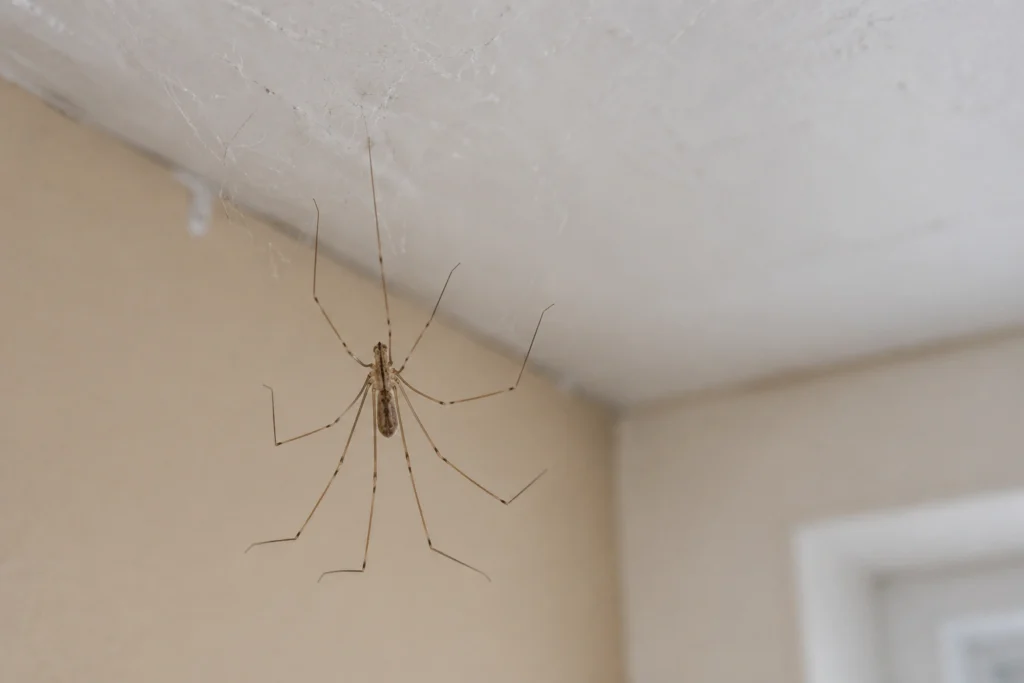
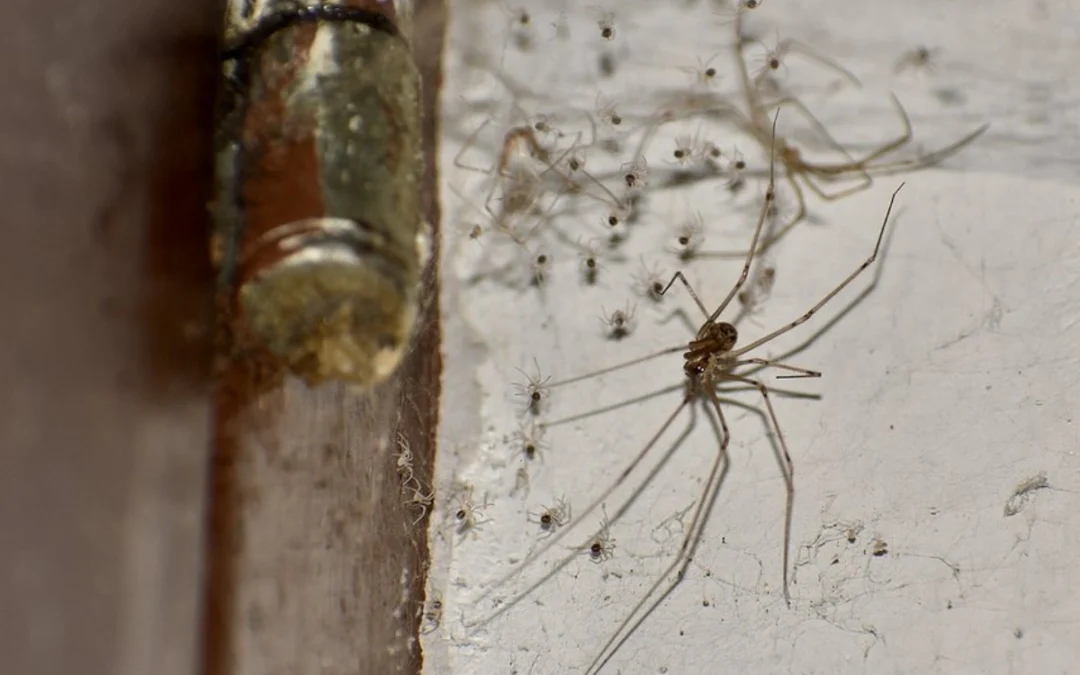
The daddy long legs you see indoors is almost always a Pholcidae spider, not a fly.
What Is a Daddy Long Legs Spider?
The term “daddy long legs” gets applied to three different creatures depending on where in the country you grew up. In the Southeast, when someone says they have a daddy long legs in the house, they almost always mean a cellar spider (family Pholcidae). These are real spiders: eight legs, two clear body segments (cephalothorax and abdomen), silk-producing spinnerets, the works.
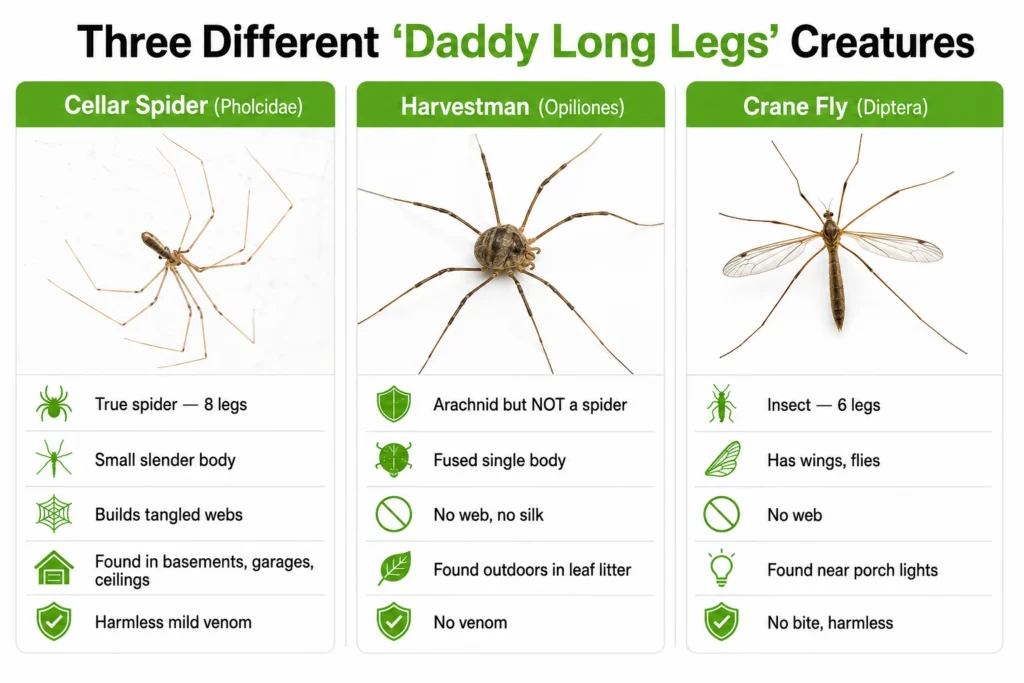
The other two creatures sometimes called “daddy long legs” are:
- Harvestmen (order Opiliones) — arachnids, but not actually spiders. One fused body segment, no silk, no venom. Typically outdoors.
- Crane flies (order Diptera) — actual insects with six legs and wings. They look like enormous mosquitoes and show up around porch lights. They don’t bite. They don’t sting. They aren’t spiders at all.
For homeowners spotting one indoors, the answer is almost always option one: a Pholcidae spider. If you want the full myth-busting overview of all three creatures and why the name gets so confused, see our guide to granddaddy long legs myths vs facts.
Daddy Long Legs Spider vs Crane Fly & Other Lookalikes
The single most common identification mistake we see homeowners make is calling a crane fly a spider. They have very different bodies once you know what to look for.
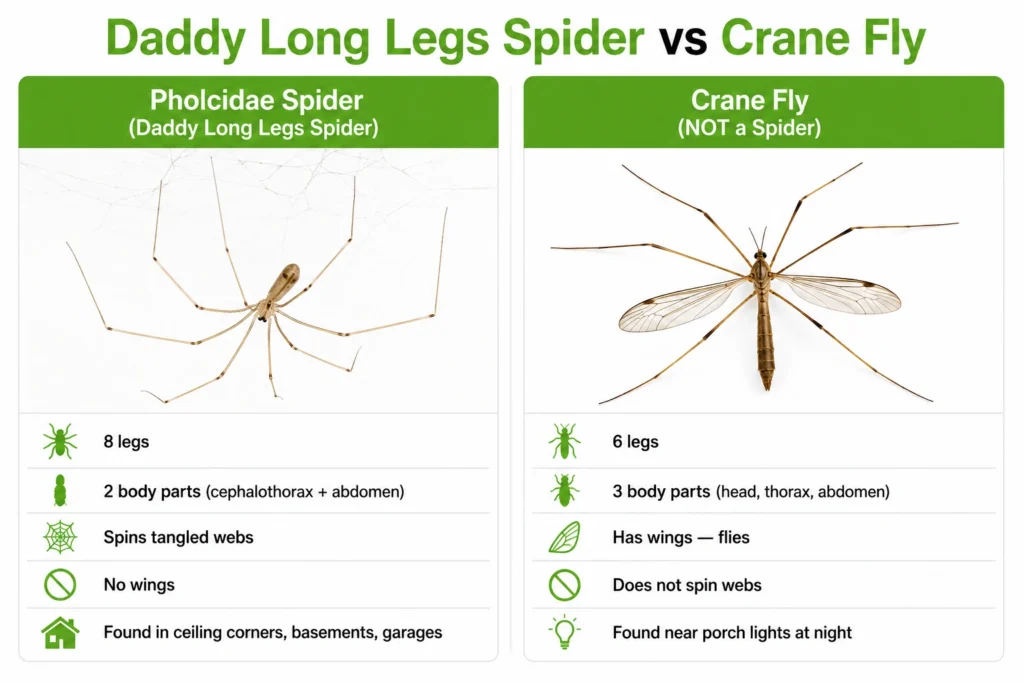
Eight legs and two body parts mean spider. Six legs and wings mean crane fly.
Spider vs Insect Anatomy
The fastest way to tell them apart is to count legs and body segments:
- Spiders have 8 legs, 2 body parts, no antennae, and produce silk.
- Insects (including crane flies) have 6 legs, 3 body parts, antennae, and do not produce silk.
If you can see a small tangled web nearby, you’re looking at a spider. If the creature has wings, you’re looking at an insect.
Visual Cues at a Glance
Daddy long legs spiders hang upside down in messy, irregular webs strung across ceiling corners and the angles where walls meet shelving units. They move with a distinctive “bouncing” motion when their web is disturbed (it’s a defense behavior). Crane flies, by contrast, are usually seen flying clumsily around porch lights, resting on exterior walls, or sometimes blundering into the kitchen through an open door. They don’t sit in webs because they don’t make them.
Are Daddy Long Legs Spiders Dangerous?
This is the question we get most often. The short answer: no.
The “world’s most venomous spider but their fangs can’t pierce human skin” story is almost completely false. Two pieces of it are true: Pholcidae spiders do produce a small amount of venom (they use it to subdue prey), and their chelicerae (mouthparts) are indeed quite small. But the venom itself is not exceptionally potent, especially not to humans. The few documented Pholcidae bites on humans show only minor, brief irritation — less than a mosquito bite, in most cases. There is no medical record of a serious human reaction.
Three plain facts about daddy long legs spider safety:
- They almost never bite humans. Bites only occur if the spider is physically pressed against skin (caught under clothing, trapped against a hand).
- Their venom is not dangerous. The “world’s most venomous” claim is internet folklore with no scientific basis.
- They actively help with other pests. Pholcidae spiders eat mosquitoes, gnats, flies, moths, and even other spiders. A small population in a garage or basement is essentially free natural pest control.
The University of Georgia Extension’s guide to common household spiders confirms the same: Pholcidae are among the most harmless spiders you’ll encounter indoors in the Southeast.
Daddy Long Legs Spider Behavior & Habitat
Where you find a daddy long legs spider in your Georgia or Alabama home tells you a lot about how it got there and how to handle it.
Where They Live Indoors
Daddy long legs spiders are drawn to undisturbed corners and dim, slightly humid spaces. The most common indoor locations:
- Ceiling corners of basements, garages, and crawl spaces
- Under stairs, in laundry rooms, and around hot water heaters
- Inside sheds, detached garages, and outbuildings
- Behind rarely-moved furniture and stored boxes
What They Eat
Pholcidae spiders are predators. Their diet inside a house includes:
- Mosquitoes, gnats, fungus gnats
- House flies and fruit flies
- Moths and small beetles
- Other spiders, including larger species like wolf spiders (they’re surprisingly aggressive predators of bigger spiders)
This last point is worth pausing on. A daddy long legs spider in your garage is actively reducing the population of more concerning spiders nearby. We’ve seen homes with persistent wolf spider sightings clear up after homeowners stopped knocking down Pholcidae webs.
Daddy Long Legs Spider in Your Home: When You See Them and Why
Indoor daddy long legs sightings spike at two predictable times of year in the Southeast:
- Early fall (September through November), when outdoor temperatures drop and the insects spiders feed on start moving indoors looking for shelter. The spiders follow.
- Late summer (July through August), when peak indoor insect populations attract more spiders into rooms with the worst pest pressure (kitchens with fruit flies, bathrooms with drain flies, basements with fungus gnats).
If you’re suddenly seeing more daddy long legs than usual, the message is almost always: there’s another pest issue inside that’s drawing them. Address the small flies, mosquitoes, or fungus gnats and the spider numbers drop on their own.
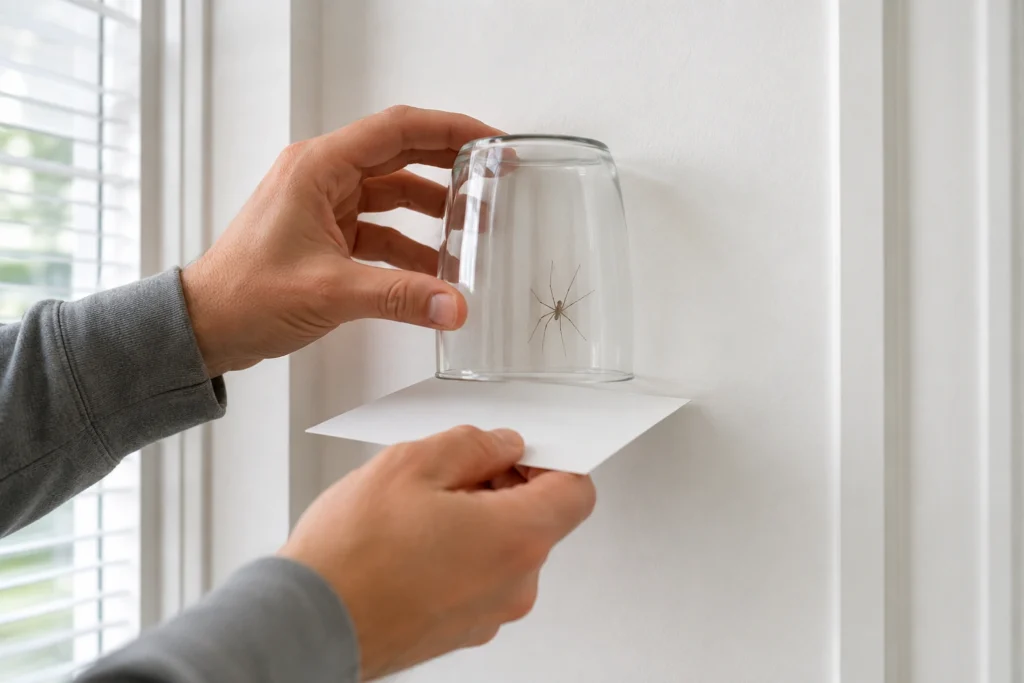
A cup and piece of cardboard handles most indoor sightings without anyone getting hurt.
How to Manage or Remove Daddy Long Legs Spiders
Most homeowners want a daddy long legs spider gone for one of two reasons: the webs look bad, or there are a lot of them in one room. Neither is dangerous, but both are addressable.
Prevention
- Seal entry points. Cracks around windows, gaps in foundation, openings around utility lines, torn weatherstripping. Spiders walk in through the same gaps as ants and roaches.
- Cut indoor insect populations. Drain flies, fruit flies, gnats, mosquitoes, and moths are the food source. Less food, fewer spiders.
- Reduce clutter in basements, garages, and storage areas. Spiders need stable, undisturbed surfaces to build webs.
- Manage humidity. Pholcidae prefer slightly damp environments. A dehumidifier in a wet basement reduces their preferred conditions.
- Move outdoor lights away from entry doors. Porch lights pull insects toward the house. Insects pull spiders.
Humane Removal
For one or two spiders, the simplest method is the cup-and-cardboard relocation. Slide a glass cup over the spider, slide cardboard underneath, carry it outside, release. Vacuum cleaner attachments work too if you’d rather not handle the spider directly. For visible webs, a long-handled duster or vacuum hose attachment clears them in seconds without harming the surrounding paint.
When Professional Help Makes Sense
Call for professional pest control if:
- You’re seeing more than 10 to 15 daddy long legs spiders in a single room consistently.
- Webs reappear within 24 to 48 hours of being cleared.
- You’re also seeing other pests (small flies, moths, mosquitoes) indoors, which means the underlying food source needs treatment.
- You want a clean exclusion plan that addresses entry points along with current activity.
(Spiders keep coming back faster than you can clear them? Request a free Northwest inspection and we’ll find the actual source.)
Daddy Long Legs Spiders vs Other Common Household Spiders
If you’re trying to figure out exactly which spider you’ve got, the most important distinction is between daddy long legs spiders (harmless, helpful) and the few spider species that actually warrant concern in the Southeast.
- Daddy long legs spider (Pholcidae) — small body, very long thin legs, tangled corner webs. Harmless.
- Cellar spider — technically the same as a daddy long legs spider in most cases. See our detailed cellar spider vs daddy long legs comparison.
- Wolf spider — large, hairy body, ground-dwelling, doesn’t make webs. Not dangerous but startling.
- Orb weaver — large symmetrical webs (the classic Halloween web shape). Outdoor species, mostly harmless.
- Brown recluse — uncommon but present in parts of the Southeast. Small brown body with a violin-shaped marking on the back. Bite is medically significant. If you’re not sure, call us.
- Black widow — jet-black body, red hourglass on the underside. Bite is medically significant. Less common indoors than outdoors.
Frequently Asked Questions About Daddy Long Legs Spiders
Do daddy long legs spiders spin webs?
Yes. Pholcidae spiders produce loose, irregular, tangled webs in ceiling corners, the angles between walls and floors, and the upper corners of basements and garages. The web is the easiest way to confirm you’re looking at a spider and not a crane fly (which has no web).
What do daddy long legs spiders eat?
They eat small flying insects (mosquitoes, fruit flies, gnats, moths) and surprisingly often, other spiders. A small population in a garage or basement is effectively free pest control for the kinds of bugs you don’t want.
Can daddy long legs spiders bite humans?
Bites are extraordinarily rare and typically only occur if the spider is trapped against skin. Symptoms are mild — usually less than a mosquito bite — and the persistent rumor that their venom is “the most dangerous in the world” is not supported by any scientific evidence.
Are daddy long legs spiders helpful?
Yes. They actively reduce other indoor pest populations, including more concerning spider species like wolf spiders. Most pest professionals (including ours) tell homeowners to leave one or two alone in the garage or basement as a form of natural pest control.
How do I get rid of daddy long legs spiders if I want them gone?
Seal entry points around windows and foundation, address the indoor insect populations they feed on, cut clutter in storage areas, and relocate visible spiders with a cup-and-cardboard method. If they keep returning quickly, there’s usually a moisture or food-source issue worth a professional inspection.
When spiders keep returning, the issue is usually whatever they’re eating.
Stop Worrying About Daddy Long Legs Spiders
If you’re seeing daddy long legs spiders and you’d rather not, the good news is they’re one of the easiest spider issues to solve. They’re harmless, they respond to environmental changes, and they’re often a signal that another (more fixable) pest issue is going on indoors. Northwest’s team has been clearing spider problems out of Georgia and Alabama homes for decades, and most of what we do for spider calls is actually addressing the food source they’re feeding on.
About the Author
Anna Vaccaro, Editorial Lead — Pest Education leads pest education content for Northwest Exterminating, working with senior technicians and service center managers across our Georgia, Alabama, Tennessee, and South Carolina service areas to translate field expertise into homeowner-friendly guides. The focus: accurate, regionally-specific answers to the pest questions Southeast homeowners are actually searching for.
Oct 16, 2023 | Georgia Blogs, Pest Control
By Anna V., Editorial Lead — Pest Education · Last updated: May 2026
“Is that a cellar spider or a daddy long legs?” is one of the most common questions we get on Northwest spider inspections, and the honest answer is: it’s almost always both at the same time. The term “daddy long legs” is a regional nickname that gets applied to three different creatures depending on where you grew up. The cellar spider (family Pholcidae) is the one most Georgia and Alabama homeowners actually see indoors, and in the Southeast, “cellar spider” and “daddy long legs” usually refer to the exact same spider.
Here’s what a cellar spider actually is, how to tell it apart from the other two creatures sometimes called “daddy long legs,” whether you need to worry about them, and what to do when they keep showing up in your basement, garage, or ceiling corners.
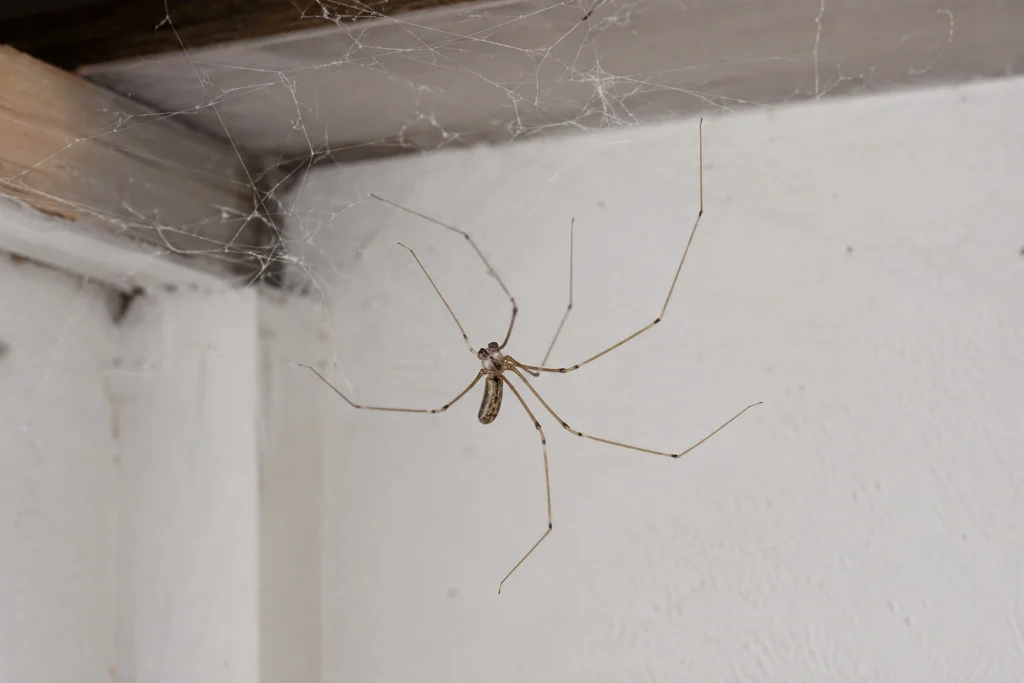
The cellar spider is what most Southeast homeowners actually mean when they say “daddy long legs.”
What Is a Cellar Spider?
Cellar spiders belong to the family Pholcidae. They have small, cylindrical bodies (typically under half an inch long), but their legs are remarkably long, sometimes spanning two to three inches when fully extended. They’re light tan to gray in color, mostly translucent in some areas, and they hang upside down in loose, tangled webs that look more like a tangle of fishing line than a typical spider web.
Despite their slightly creepy appearance, cellar spiders are skilled predators that help control other household pests. They feed on mosquitoes, fruit flies, gnats, moths, and even other spiders, including larger species like wolf spiders. In a Georgia or Alabama home, a small population in the basement or garage often does more good than harm.
Cellar Spider Identification
Three features make cellar spiders easy to identify once you know what to look for.
Appearance
Small, cylindrical body (about a quarter to half an inch long) with eight extremely long, thin legs. Body color ranges from pale tan to light gray. Adult females are usually slightly larger than males. Both sexes have a distinctive habit of vibrating their entire body in a fast circular motion when their web is disturbed — a defense behavior that makes them harder for predators to grab.
Webs
Cellar spider webs are unmistakable once you’ve seen one. They’re loose, tangled, and irregular — not the neat geometric shapes orb weavers create. Webs are almost always strung across ceiling corners, the angles between walls and shelves, or in undisturbed spots behind furniture and stored boxes. The webs aren’t sticky in the traditional sense, but the tangled structure traps prey by entanglement.
Size
Body length: about 5 to 13 millimeters (under half an inch). Leg span: typically 2 to 3 inches when the spider is fully extended. The dramatic difference between tiny body and very long legs is the visual feature most homeowners remember.
Cellar Spider vs Daddy Long Legs: The Differences That Actually Matter
“Daddy long legs” gets applied to three different creatures. Only one is a cellar spider. Here’s the comparison.
Three different creatures, one nickname. Only one is a true cellar spider.
| Feature |
Cellar Spider |
Harvestman |
Crane Fly |
| Classification |
True spider (Pholcidae) |
Arachnid, not a spider (Opiliones) |
Insect (Diptera) |
| Body shape |
Small, slender, two body segments |
Single fused body segment |
Elongated insect body with wings |
| Legs |
8, very long and thin |
8, long |
6, fragile |
| Web? |
Yes, tangled corner webs |
No, no silk |
No, no silk |
| Venom |
Mild, harmless to humans |
None |
None |
| Where you find it |
Indoor corners, basements, garages |
Outdoor leaf litter, stone walls |
Around porch lights at night |
For the full myth-busting overview of how the name “daddy long legs” got attached to three different creatures, see our granddaddy long legs guide. For more on the daddy long legs spider specifically and why it’s so often confused with a crane fly, see our daddy long legs spider guide.
Are Cellar Spiders Dangerous?
The short answer: no. The longer answer addresses the persistent internet rumor that cellar spiders are the world’s most venomous spider but physically can’t bite humans.
That story is almost entirely false. Cellar spiders do produce a small amount of venom to subdue prey, but the venom is not particularly potent, especially not to humans. The few documented Pholcidae bites on humans show only mild, brief irritation — less than a typical mosquito bite. There is no medical record of a serious human reaction. The University of Georgia Extension’s guide to common household spiders classifies Pholcidae as harmless.
For families in Atlanta, Athens, Savannah, Macon, or any of our other Georgia service areas: cellar spiders are a nuisance at worst. The webs look bad, and a heavy population suggests there’s another pest issue indoors, but the spiders themselves are not a threat to people or pets.
Why Cellar Spiders Appear in Homes
If you’re suddenly seeing more cellar spiders in your basement, garage, or ceiling corners, three things tend to be happening:
- Indoor insect populations have grown. Cellar spiders follow their food. Fruit flies in the kitchen, fungus gnats around houseplants, drain flies in bathrooms, mosquitoes inside through open doors — any of these attract Pholcidae.
- Moisture or humidity has increased. Cellar spiders prefer slightly damp environments. Basements after heavy rain, crawl spaces with ventilation issues, and bathrooms with poor airflow are common hotspots.
- Seasonal shift indoors. Late summer through early fall in Georgia and Alabama drives both insects and spiders into homes looking for stable shelter. Activity peaks in September and October.
Cellar Spider Webs: What They Look Like
Cellar spider webs are the easiest way to confirm a sighting. Unlike orb weavers (which build the classic symmetrical “spider web” most people picture), cellar spiders create messy, irregular tangles of silk strung loosely across corners.
Characteristics of cellar spider webs:
- Tangled and irregular, not geometric
- Located in ceiling corners, the angles between walls and shelves, and upper corners of garages and basements
- Often coated in dust over time, making them appear gray or fuzzy
- Can accumulate small dead insects (the spider’s prey) entangled within
- Reappear within 24 to 48 hours of being removed if the spider population is still active
How to Prevent & Control Cellar Spiders
Cellar spiders respond well to environmental changes. Most homeowner control efforts work, given a little patience.
DIY Prevention
- Reduce humidity in basements and crawl spaces. Run a dehumidifier. Fix any plumbing leaks. Address ventilation issues. Drier spaces are less attractive to cellar spiders.
- Seal cracks and entry points. Caulk around windows, foundation cracks, gaps in trim, openings around utility lines. Cellar spiders walk in through the same gaps as other small pests.
- Cut indoor insect populations. Address fruit flies, gnats, mosquitoes, and drain flies. Less food means fewer spiders.
- Reduce clutter. Stable, undisturbed surfaces let spiders build webs unimpeded. Cardboard storage in basements is especially attractive. Plastic bins are less so.
- Clear visible webs regularly. A vacuum hose attachment or long-handled duster handles webs in seconds. Persistent web removal often discourages spiders from rebuilding in the same spots.
When to Call a Professional
For most Georgia and Alabama homeowners, a few cellar spiders in the basement don’t warrant a service call. Consider professional pest control if:
- You’re seeing more than 10 to 15 cellar spiders in a single area consistently.
- Webs reappear faster than you can clear them.
- You’re also noticing other indoor pest activity (small flies, mosquitoes, gnats, moths) — addressing those usually solves the spider issue too.
- You want a full exclusion plan that prevents return activity.
Cellar spiders prefer slightly damp, undisturbed corners, common in older Southeast basements and crawl spaces.
Cellar Spiders in Georgia and the Southeast
Cellar spider activity in Georgia, Alabama, Tennessee, and South Carolina follows a predictable seasonal pattern. Activity is highest in late summer and early fall (August through October), when indoor insect populations peak and outdoor temperatures push pests indoors.
Regional factors that increase cellar spider sightings in Southeast homes:
- Humid summers. Cellar spiders favor slightly damp environments, and Southeast humidity creates ideal conditions in basements and crawl spaces.
- Older home construction. Atlanta, Athens, Savannah, and Birmingham all have significant inventories of older homes with foundation cracks, unfinished basements, and crawl spaces that provide easy entry and ideal shelter.
- Heavy spring and summer rain. Flooded outdoor harborages push both spiders and the insects they feed on indoors.
- Year-round insect activity. Mild Southeast winters mean indoor insect populations don’t fully die back in cold months the way they do further north. Spiders that follow them stay active too.
Frequently Asked Questions About Cellar Spiders
Do cellar spiders bite humans?
Bites are extremely rare and typically only happen if the spider is physically trapped against skin. Symptoms, when they occur, are mild — usually less than a mosquito bite. There is no medical record of a serious human reaction to a cellar spider bite.
Are cellar spiders venomous?
They produce a small amount of venom to subdue prey, but the venom is not dangerous to humans. The persistent rumor that cellar spiders are the most venomous spider in the world is internet folklore with no scientific basis.
How do I know if I have a cellar spider infestation?
Look for tangled, irregular webs in ceiling corners, basements, garages, and around stored items. Regular sightings of small, long-legged spiders hanging upside down in webs are a clear indicator. Webs that reappear within a day or two of being cleared suggest an active population worth addressing.
Do cellar spiders eat other pests?
Yes. Cellar spiders feed on mosquitoes, fruit flies, fungus gnats, moths, and other spiders, including larger species. A small population in a garage or basement is effectively free natural pest control for the insects you don’t want.
How do I get rid of cellar spiders for good?
Reduce indoor humidity, seal entry points around windows and foundation, address the indoor insect populations they feed on, cut clutter in storage areas, and clear visible webs regularly. If they keep returning quickly, there’s almost always an underlying moisture or food-source issue worth a professional inspection.
When cellar spiders keep returning, the underlying issue is usually moisture or another pest they’re feeding on.
Stop Worrying About Cellar Spiders
If you’re seeing cellar spiders in your basement, garage, or ceiling corners and you’d rather not, the good news is they respond well to environmental changes. They’re harmless, they signal another (more fixable) pest or moisture issue 90% of the time, and most cellar spider problems clear up when the underlying conditions change. Northwest’s team has been clearing spider problems out of Georgia and Alabama homes for decades, and the most effective fix is usually addressing whatever the spiders are eating.
About the Author
Anna Vaccaro, Editorial Lead — Pest Education leads pest education content for Northwest Exterminating, working with senior technicians and service center managers across our Georgia, Alabama, Tennessee, and South Carolina service areas to translate field expertise into homeowner-friendly guides. The focus: accurate, regionally-specific answers to the pest questions Southeast homeowners are actually searching for.
Aug 17, 2023 | Alabama Blogs, Georgia Blogs, Pest Control
By Anna V., Editorial Lead — Pest Education · Last updated: May 2026
If you’d rather keep spiders out of your house without spraying chemicals everywhere, you have real options. At Northwest, we get asked about natural spider repellent methods constantly, especially from homeowners with kids, pets, or asthma in the household. The honest version most homeowners don’t hear: most “natural” spider repellents work somewhat, briefly. The methods that hold up long-term are the ones that change the conditions spiders need to survive indoors, not the ones that try to scare them away with scent.
Here are the natural spider repellent methods worth your time, the DIY sprays that actually do something, and the prevention work that does most of the heavy lifting in a Georgia or Alabama home.
A peppermint and tea tree oil spray is the most common natural repellent and the most effective when used consistently.
Why Use Natural Spider Repellents?
Natural spider repellents have real advantages over conventional pesticides for many Southeast homeowners:
- Chemical-free options. Avoid synthetic pesticide residue indoors, which matters more in homes with kids, pets, or anyone with respiratory sensitivities.
- Safer for pets. Most ingredients (with a few exceptions noted below) won’t harm dogs, cats, or smaller pets if accidentally encountered.
- Eco-friendly. Less impact on beneficial insects, pollinators, and local ecosystems.
- Easier on indoor air quality. No off-gassing of synthetic compounds.
The honest caveat: natural repellents work best for prevention and for managing small, occasional spider activity. They rarely eliminate an established indoor population on their own. For larger infestations or venomous species like black widows or brown widows (see our spiders in Georgia guide for identification), professional pest control is the safer and more effective path.
Common Natural Spider Repellents (and How Well They Actually Work)
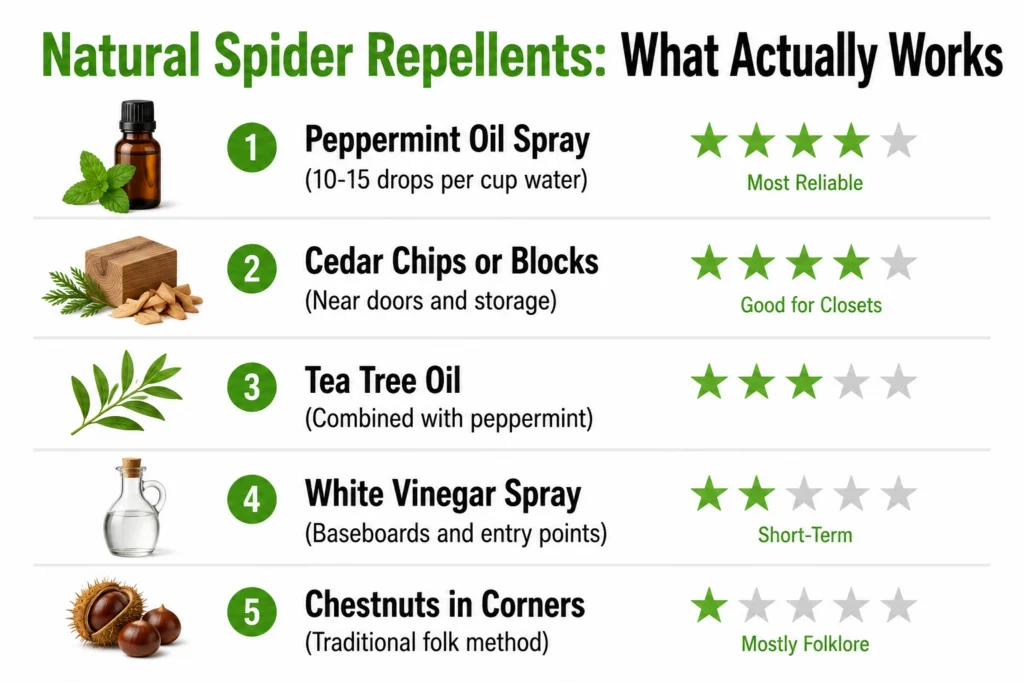
Essential oils and cedar do most of the work. Chestnuts are mostly folklore.
Essential Oils (the Most Effective Natural Option)
Several essential oils show real research-supported spider-repellent activity. The compounds in these oils interfere with spider chemoreception (their ability to navigate using chemical signals), which discourages them from establishing in treated areas.
- Peppermint oil. The most well-studied natural spider repellent. Mix 10 to 15 drops per cup of water in a spray bottle. Apply to corners, windowsills, entry points, and baseboards weekly. Strong scent dissipates within 5 to 7 days, so consistency matters.
- Tea tree oil. Combine with peppermint for a stronger combined effect. Mix 5 to 10 drops per cup of water. Has the bonus of mild antibacterial properties.
- Citrus oil (lemon or orange). Spider-repelling effect is moderate. Some homeowners prefer the scent. Apply same way as peppermint.
- Eucalyptus oil. Repels several arthropod groups including spiders. Use 8 to 12 drops per cup of water.
- Cedarwood oil. Different from cedar chips (below) but works on a similar principle. Spray version is more targeted than physical cedar.
Pet safety note: Tea tree and eucalyptus oils can be toxic to cats and small dogs if ingested directly or applied to skin. Diluted spray on baseboards is generally safe once dry, but don’t spray directly on pets or where they regularly lick. Peppermint and citrus oils are safer pet options.
Household Items
- White vinegar. Mix equal parts water and white vinegar in a spray bottle. Apply along baseboards, in corners, and around entry points. Acetic acid is mildly off-putting to spiders. Effect is short-term (24 to 48 hours per application) and the vinegar smell is noticeable to humans too.
- Cedar chips or blocks. Cedarwood naturally contains compounds that repel many arthropods. Place chips or blocks in closets, near doorways, in storage bins, and in basement corners. Effective for several months per application. Refresh by lightly sanding the surface every 3 to 4 months to release new aromatic compounds.
- Chestnuts. A traditional folk method: placing fresh chestnuts in basement corners and near windows. The active compound (chestnut tannins) does show some spider-repellent activity in laboratory testing, but real-world effectiveness in a home is modest at best. Treat as a supplement to other methods, not a primary strategy.
- Diatomaceous earth (food-grade). Not strictly a “repellent”. It kills spiders that crawl through it by damaging their exoskeleton and causing dehydration. Apply a light dusting along baseboards and at entry points. Reapply after vacuuming or moisture exposure.
DIY Spider Repellent Spray Recipe
The most reliable natural spider repellent recipe we recommend:
- 2 cups of water
- 15 drops of peppermint essential oil
- 10 drops of tea tree essential oil
- 1 teaspoon of dish soap (helps the oils mix with water)
Combine in a glass spray bottle (essential oils degrade plastic over time). Shake well before each use. Apply to spider-prone areas weekly: window frames, door thresholds, baseboards, ceiling corners in basements and garages, and around outdoor entry points.
Adjust for sensitivities: drop the tea tree oil if you have cats. Substitute eucalyptus or citrus oil for variety. Don’t apply directly to fabric, finished wood, or painted surfaces without testing in an inconspicuous spot first.
Home Maintenance Tips to Prevent Spiders
The most effective natural spider control isn’t a repellent. It’s prevention. Three categories of home maintenance work harder than any spray.
Reduce Clutter and Hiding Spots
Spiders need stable, undisturbed surfaces to build webs or hide. Reduce that and the population drops:
- Clear storage areas in basements, attics, garages, and closets.
- Move stored items off the floor onto shelves.
- Transfer cardboard storage to plastic bins (cardboard absorbs moisture and provides ideal spider harborage).
- Regularly vacuum corners, under furniture, and along baseboards.
- Don’t let firewood, lumber, or yard debris accumulate near the foundation.
Seal Entry Points
- Caulk cracks around windows, doors, and foundation.
- Install or replace door sweeps and weatherstripping (especially garage side doors).
- Screen crawl space vents with galvanized 1/4-inch hardware cloth.
- Seal gaps around utility line penetrations with steel wool packed into the gap, then caulk over.
Control Outdoor Lighting
This is one of the most underrated spider-prevention tactics. Bright porch and exterior lights attract flying insects, which attract spiders to feed on them. Two changes that reduce indoor spider pressure significantly:
- Switch white LED bulbs to warm-toned LED (2700K to 3000K) or yellow “bug light” bulbs. They attract far fewer flying insects.
- Move outdoor lighting away from primary entry doors when possible. Mount lights on poles in the yard rather than next to the front door.
Seasonal Considerations for Spider Prevention
Spider activity in Georgia, Alabama, Tennessee, and South Carolina peaks in three windows. Plan natural repellent applications around them.
- Spring (April through May): Spider populations rebuild after winter. Apply repellents weekly during this window. Focus on outdoor entry points.
- Late summer (August): Peak indoor and outdoor population. Most spider sightings happen here. Apply repellents 2 times per week.
- Early fall (September through October): Outdoor spiders migrate toward warmer indoor spaces. Reinforce entry-point sealing and outdoor perimeter sprays.
Winter (December through February) is the low-activity window. Use it for entry-point sealing and structural prevention work.
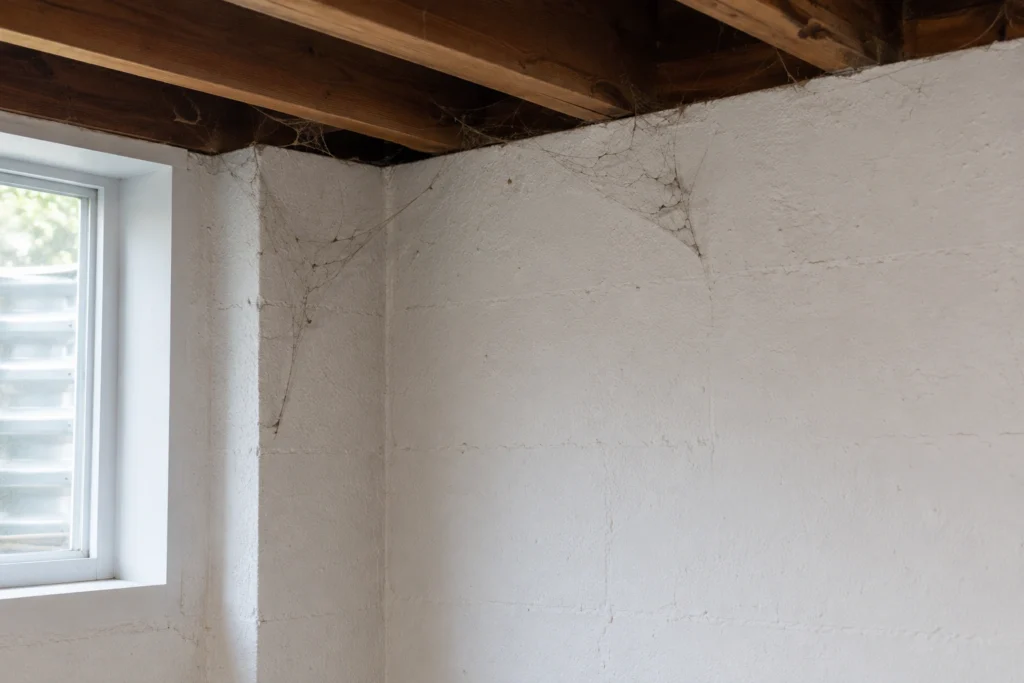
Once webs are visible in multiple corners, natural repellents alone usually aren’t enough.
When Natural Methods Aren’t Enough
Natural spider repellents handle small, occasional spider activity well. They’re not enough for:
- Large or persistent indoor populations. Multiple webs in multiple rooms, spider sightings 3+ times per week, or visible egg sacs suggest an established population that needs targeted treatment.
- Confirmed venomous species. Black widows, brown widows, or any spider you can’t identify and suspect may be medically significant. Don’t use DIY methods near these spiders. Call professionals.
- Recurring problems in living spaces. Spiders in bedrooms, kids’ rooms, or kitchens warrant a faster, more reliable approach.
- Underlying pest issues. If you’re seeing spiders along with other indoor pest activity (small flies, gnats, mosquitoes), the spiders are downstream of a larger problem that needs addressing.
Professional pest control combines exclusion (sealing entry points), targeted treatment at active harborage spots, and addressing whatever’s drawing spiders indoors. The EPA’s Integrated Pest Management (IPM) principles describe the same approach: start with the least-toxic preventive measures (which is exactly what natural repellents are), escalate to targeted treatments when prevention isn’t enough, and address the underlying conditions rather than just the visible pests.
(Tried natural methods and still seeing spiders? Request a free Northwest inspection and we’ll identify what’s around and find the entry points.)
Frequently Asked Questions About Natural Spider Repellents
Do natural spider repellents really work?
Yes, with realistic expectations. Essential oils (especially peppermint, tea tree, and citrus), cedar, and white vinegar all show measurable spider-repellent activity when applied consistently. They work best for prevention and small-scale activity. They rarely clear an established indoor population on their own.
Are essential oils safe for pets?
Some are, some aren’t. Peppermint and citrus oils are generally safe for dogs and cats in dilute sprays applied to surfaces (not directly on the pet). Tea tree and eucalyptus oils can be toxic to cats and small dogs if ingested or applied to skin. Always dilute properly, apply to surfaces (not pets), and let dry before allowing pets in the area. Consult a vet for specific concerns.
How often should I apply natural spider sprays?
Weekly is the general baseline. Apply more frequently during peak spider activity windows (April-May, August, September-October) and after any major cleaning that removes the previous application. Spray formulas typically lose effectiveness within 5 to 7 days as the essential oils evaporate.
Can I prevent spiders indoors year-round?
Yes, with consistent maintenance. Year-round prevention combines weekly natural repellent application during active seasons, ongoing clutter reduction in basements and storage areas, entry-point sealing as a one-time structural improvement, and warm-tone outdoor lighting to reduce insect attraction. Most homes can keep spider activity to occasional sightings rather than ongoing problems with this combined approach.
What’s the most effective natural spider repellent?
A peppermint and tea tree oil spray (15 drops peppermint + 10 drops tea tree per 2 cups water + 1 tsp dish soap) applied weekly to entry points and corners. Combined with cedar blocks in closets and storage areas, this combo handles most residential spider prevention without any chemicals.
When natural repellents aren’t enough, professional treatment addresses entry points and underlying conditions DIY can’t reach.
Try Natural First. Call When You Need Backup.
Natural spider repellents are a smart starting point for most Georgia and Alabama homeowners. They’re safer, cheaper, and effective for prevention. When natural methods aren’t enough (or when you’ve spotted a venomous species), Northwest’s team handles the full spider control workflow with targeted treatment, exclusion, and addressing the underlying conditions that bring spiders in.
About the Author
Anna V., Editorial Lead — Pest Education leads pest education content for Northwest Exterminating, working with senior technicians and service center managers across our Georgia, Alabama, Tennessee, and South Carolina service areas to translate field expertise into homeowner-friendly guides. The focus: accurate, regionally-specific answers to the pest questions Southeast homeowners are actually searching for.
Jul 21, 2022 | Georgia Blogs, Pest Control, Snake Control, Wildlife
By Anna Vaccaro, Editorial Lead — Pest Education · Last updated: April 2026
If you’ve spotted a snake coiled near your back steps or sliding through the mulch by your flower bed, the first question is almost always the same: How do I make sure that doesn’t happen again? At Northwest, we get asked about snake repellent almost every day during warm-weather months in Georgia, and the answer surprises most homeowners. Most sprays, powders, and home-remedy scents don’t do much. What does work is changing your yard so snakes stop choosing it in the first place.
Video Transcript
Snakes are usually after just two things. Food and a safe place to hide. If your yard offers either, they may stick around longer than you’d like. The good news, a few simple steps can make a big difference. First, reduce food and moisture. Keeping rodents and insects under control helps, and fixing leaks or standing water is key. Snakes are drawn to damp areas. Second, remove hiding spots. Trim grass, clear brush, and leaf piles. Elevate firewood and fill in old holes around your yard. Third, use natural deterrence. Plants like maragolds and lemongrass or scents like clove and cinnamon oil can help make your space less inviting. When you’re ready to call a professional for a peaceful home, feel free to reach out to our team at Northwest Exterminating.
This guide walks you through exactly that. We’ll break down what a real snake repellent strategy looks like in the Southeast, the seven natural methods that actually move the needle, the myths to skip, and how to know when a sighting means it’s time to call a pro.
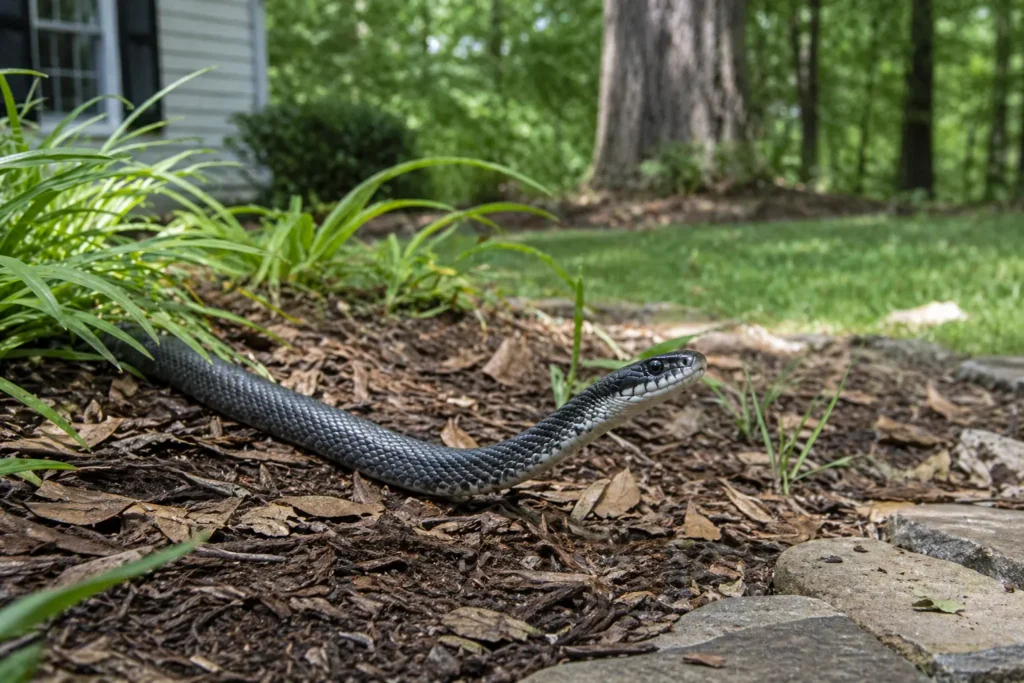
Most snakes you see in a Georgia yard are non-venomous and quietly help control rodents.
Can You Actually Repel Snakes Naturally?
Short answer: sort of. You can make your property a much less attractive place for a snake to hang out, but you can’t spray a scent line that a snake won’t cross. Here’s why that matters.
Snakes navigate the world with a specialized organ in the roof of their mouth called the Jacobson’s organ. It reads chemical cues in the air. That’s very different from how a mammal smells, and it’s the reason most of the “strong scent” tricks you see online underperform. A snake doesn’t process cinnamon oil or garlic the way we do. If there’s a rodent to chase or a warm crawl space to hide in on the other side of that scent, the snake keeps going.
The most effective natural snake repellent isn’t a product. It’s a habitat change. Take away food, shelter, and moisture, and snakes move on.
7 Natural Snake Repellent Methods That Actually Work
These are the seven moves that consistently reduce snake activity around Southeast homes. Use them together, not one at a time. Snake prevention works by stacking small changes.
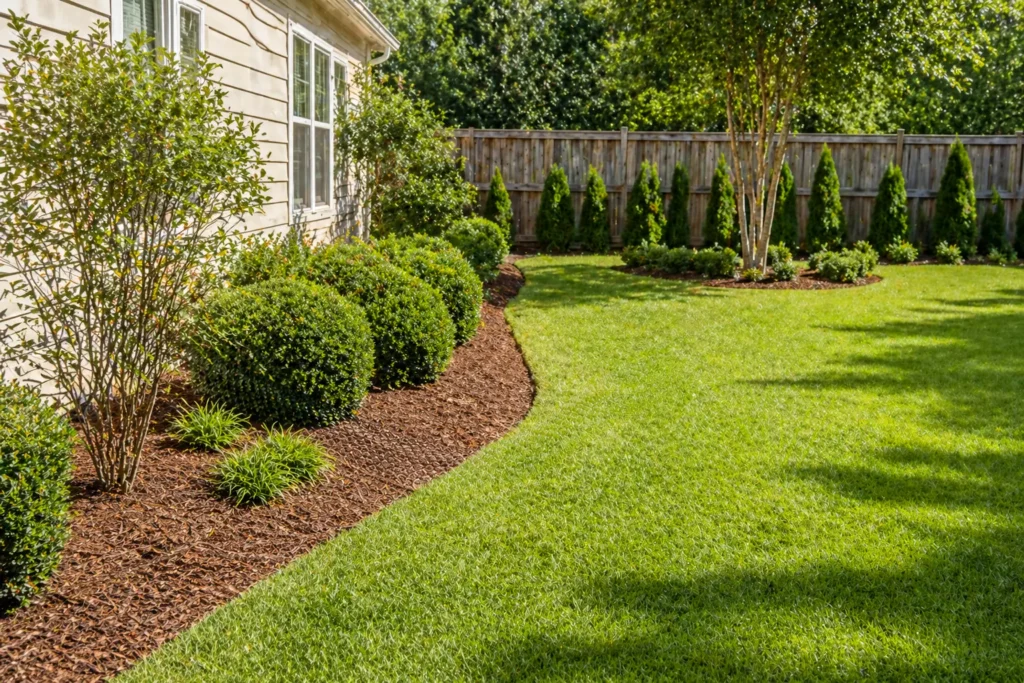
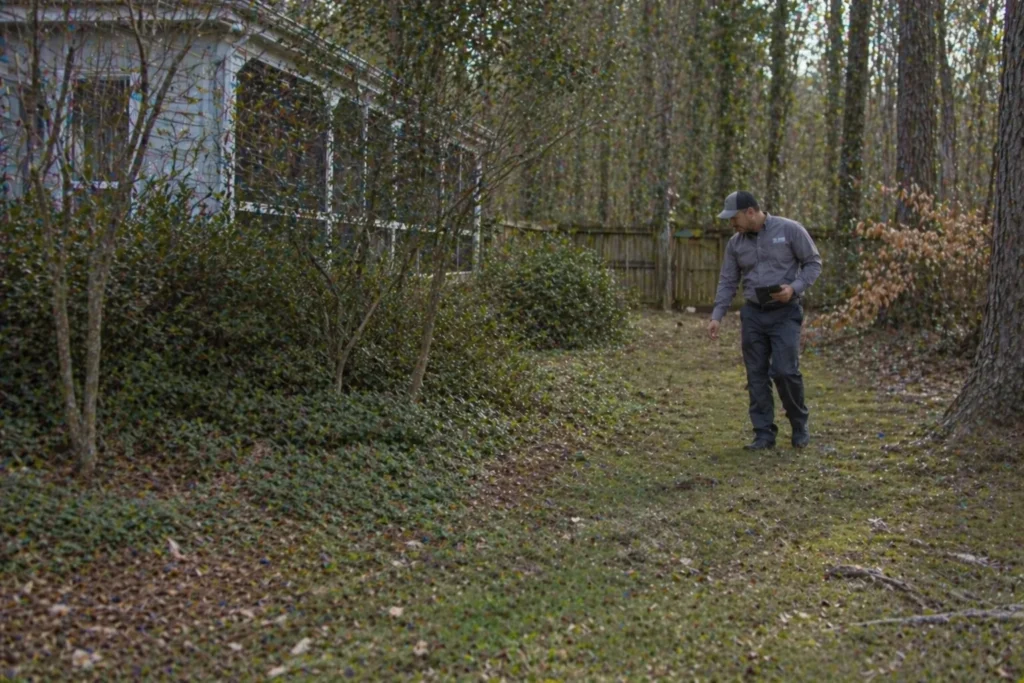
The yards we treat for repeat snake problems almost always share one thing: too many places for snakes to hide.
1. Yard & Habitat Modification
Snakes show up because something else is there first, usually rodents, frogs, or big insects. Cut off the buffet and the snakes stop visiting. Keep your grass short so snakes can’t cross the yard unnoticed. Clear tall grass along fence lines, brush piles, fallen branches, and leaf debris. Store firewood on a rack at least 12 inches off the ground and at least 20 feet from the house. Every pile of stuff in a Georgia yard is potential snake real estate.
2. Natural Scents & Plants
You’ve probably read that marigolds, lemongrass, or wormwood keep snakes out of a yard. They make a pretty border, but don’t count on them as a standalone snake repellent. Independent research on scent-based plant repellents is thin, and a snake that’s locked onto a mouse isn’t going to be turned back by a flower bed. Plant them for the garden, not for the reptile protection.
3. Gravel, Mulch & Rock Choices
Thick wood mulch and big decorative stones are exactly what snakes love: damp, dark, warm, and easy to slip under. If you’ve had repeat sightings along a bed line, swap the deep wood mulch closest to the house for tightly-packed gravel or crushed stone. The sharp, irregular surface is uncomfortable for snakes to cross and offers nowhere to burrow.
4. Encouraging Natural Predators
Owls, hawks, and kingsnakes are the original snake control crew in the Southeast. You can’t install them, exactly, but you can make your property more hospitable to them: keep mature trees, avoid broad-spectrum rodenticides that poison the food chain, and consider a simple owl box on the back of the property. This won’t clear an active snake problem overnight, but over a season it tips the balance.
Owls, hawks, and kingsnakes are the original snake-control crew in the Southeast.
5. Physical Barriers and Snake-Proof Fencing
If you live backed up to a field, creek, or wooded lot, which is a very common setup in the Georgia and Alabama suburbs we serve, a physical barrier is one of the few methods that physically stops a snake. Snake-proof fencing uses fine-mesh galvanized hardware cloth (quarter-inch or smaller), buried at least 6 inches below grade and rising 2 to 3 feet up, with the top angled outward. It’s not right for an entire property line, but it’s excellent around a pool deck, a play area, or a garden gate.
6. Commercial Snake Repellents: Do They Work?
Walk into any hardware store and you’ll see granular and liquid snake repellents on the shelf. Most use cinnamon oil, clove oil, sulfur, or naphthalene derivatives. The research on them is mixed at best. They can nudge a snake off a specific path for a short window of a few days after application, but they wash out with rain, fade in heat, and do nothing to address the reason the snake came in the first place. If you use one, treat it as a stopgap around a problem area, reapply after every rain, and read the label carefully if you have pets or small kids.
7. Regular Yard Maintenance (The One Most People Skip)
The yards we see with recurring snake problems almost always share one thing: they look great once a month and neglected for the three weeks in between. Snake repellent is really a maintenance habit. Walk the property every couple of weeks in spring and summer. Trim back anything touching the foundation. Pick up fallen fruit under pecan or fig trees (rodents follow fruit; snakes follow rodents). Check for new burrows along the fence line. Ten minutes of weekly attention beats a hundred dollars of repellent.
(If snakes keep showing up after you’ve tightened up the yard, it’s usually a sign something bigger is going on underneath, often rodents in a crawl space or moisture you can’t see. Schedule a free Northwest inspection and we’ll walk the property with you.)
What Doesn’t Work — Snake Repellent Myths to Skip
A few “classic” home remedies for keeping snakes away are worse than ineffective. Some are illegal, unsafe for pets, or actively bad for your soil. Save your weekend.
- Mothballs. Outdoor use of mothballs as a snake repellent is actually against federal label law. Naphthalene and paradichlorobenzene are toxic to kids, pets, wildlife, and soil, and the evidence they deter snakes is essentially zero.
- Ammonia-soaked rags. Burns plants, washes away in one rain, and snakes just route around it.
- Outdoor sticky traps. They catch songbirds, skinks, box turtles, and sometimes the family cat before they catch a single snake. Inhumane and often illegal.
- Ultrasonic repellent stakes. Marketed hard, supported by almost no independent evidence. Snakes rely on vibration through the ground, not airborne sound.
- Random essential-oil spray mixes. Evaporate in a day, can’t match the concentration a commercial product uses, and still don’t outperform simple habitat cleanup.
Habitat changes outperform every commercial snake repellent on the market.
Snake Prevention Tips for Homes & Yards
A good snake repellent plan for your home isn’t just yard work. It’s also sealing the house itself. Two-thirds of the “snake in the garage” or “snake in the laundry room” calls we get trace back to the same kinds of openings that let rodents in.
- Walk the foundation and seal gaps around utility penetrations, dryer vents, and brick weep holes with hardware cloth. Never use expanding foam alone, because snakes push right through it.
- Screen every crawl space vent with galvanized ¼-inch mesh. Replace any torn screens. This alone will stop most garage and crawl-space snake sightings.
- Re-caulk door thresholds and replace worn weatherstripping, especially on garage side doors and basement hatches.
- Fix leaky outdoor faucets, redirect gutter runoff away from the foundation, and don’t over-water the lawn. Moisture pulls in frogs and insects, which pull in snakes.
- Treat rodent control as snake control. If you have mice in the crawl space, snakes are just the next chapter. Take care of the rodent problem with professional rodent control and the snake issue often resolves itself.
When to Call a Professional for Snake Control
Most snakes in Georgia and Alabama yards are harmless, and actually beneficial. A black racer or garter snake eating the mice by your shed is doing you a favor. But there are three situations where it’s time to stop DIY-ing and pick up the phone:
- Venomous species on the property. The Southeast is home to Copperheads, Cottonmouths (Water Moccasins), Timber Rattlesnakes, Pigmy Rattlers, and along the coast, Eastern Diamondbacks and Coral Snakes. If you can’t confidently identify what you’re seeing, back up and call.
- A snake inside the house. Inside the living space, garage, crawl space, or attic is never a “just wait it out” situation. It means an entry point that needs finding and sealing.
- Repeat sightings in the same spot. More than two sightings in the same part of the yard within a season means there’s a harborage or food source you haven’t found yet. That’s what a professional inspection is for.
Snakes in the Southeast — What You’re Likely Seeing
Knowing what lives in a typical Georgia or Alabama yard takes a lot of the panic out of a sighting. The vast majority of what we encounter is non-venomous. The UGA Extension guide to Snakes of Georgia is the best free resource for identifying any snake you see on the property.
- Eastern Rat Snake (Black Rat Snake). Long, black, often climbs into shrubs or attics chasing rodents. Non-venomous and one of the best natural rodent controls you can have.
- Black Racer. Slender, fast, jet-black. Harmless to humans, feeds on insects, lizards, and small rodents.
- Garter Snake. Small, striped, very common near gardens and water features.
- Kingsnake. Non-venomous, and remarkably, it actually eats venomous snakes. Leave it alone if you can.
- Copperhead (venomous). Tan and dark-brown hourglass banding. Hides beautifully in pine straw and leaf litter, which is the cause of most venomous bites in the region. Call a pro.
- Cottonmouth / Water Moccasin (venomous). Thick-bodied, found near water. Will stand its ground. Call a pro.
Peak activity in the Southeast runs April through October, with two noticeable spikes: early spring (emerging from brumation) and late summer (looking for food before the cooler months).
Frequently Asked Questions About Snake Repellent
Do snake repellents really work?
Commercial snake repellents offer limited, short-term help at best, and most scent-based home remedies don’t work at all. The most reliable “repellent” is removing what attracts snakes in the first place: rodents, tall grass, standing water, and hiding places around the foundation.
What scent keeps snakes away?
Snakes may avoid strong-smelling compounds like cinnamon oil, clove oil, and cedarwood in close range, but these won’t stop a snake that’s tracking prey. Use scents as a supplement to habitat cleanup, never as the whole plan.
Are snake repellents safe for pets?
It depends on the active ingredient. Many granular snake repellents use essential oils with reasonable safety profiles, but always check the label. Do not use mothballs or ammonia as a snake repellent. Both are genuinely toxic to dogs, cats, and children.
How do I keep snakes out of my yard permanently?
There’s no one-time fix. Long-term snake control in a Southeast yard comes from stacking three things: consistent yard maintenance, rodent control inside and around the home, and physical snake-proof fencing around the areas you most want protected (play areas, pool decks, garden entries).
When should I call professional snake control?
Call right away for any venomous snake, any snake inside the home, or repeat sightings in the same part of the yard. Northwest Exterminating handles inspection, humane removal, exclusion, and the underlying rodent and moisture issues that drive most snake problems.
Northwest’s wildlife team handles the entry points and rodent issues that drive most snake problems.
Ready to Keep Snakes Out of Your Yard for Good?
If you’ve seen a snake on your property more than once this season, the odds are good there’s a rodent or moisture issue feeding the problem. Our team has been clearing snake problems out of Georgia and Alabama homes for decades, and we handle the thing that caused it, not just the snake you saw.
About the Author
Anna Vaccaro, Editorial Lead — Pest Education leads pest education content for Northwest Exterminating, working with senior technicians and service center managers across our Georgia, Alabama, Tennessee, and South Carolina service areas to translate field expertise into homeowner-friendly guides. The focus: accurate, regionally-specific answers to the pest questions Southeast homeowners are actually searching for.
Apr 17, 2020 | Alabama Blogs, DIY, DIY Wildlife Prevention, Georgia Blogs, Wildlife
By Anna V., Editorial Lead — Pest Education · Last updated: May 2026
If birds have taken over your roofline, started nesting in your dryer vent, or covered your back deck in droppings, you’re probably searching for a bird deterrent that actually works. At Northwest, we get bird control calls year-round across our Georgia and Alabama service area, but they spike sharply from late March through July when nesting season hits its peak. The honest version most homeowners don’t hear: most DIY bird deterrents work briefly, then stop working as birds adapt. The few that work long-term are usually the unglamorous ones (sealed vents, physical barriers, removed food sources), not the gimmicky owl decoys and ultrasonic gadgets sold on Amazon.
Here are the five DIY bird deterrents with the strongest track record in Southeast homes, what to expect from each, and the gimmicks worth skipping entirely.
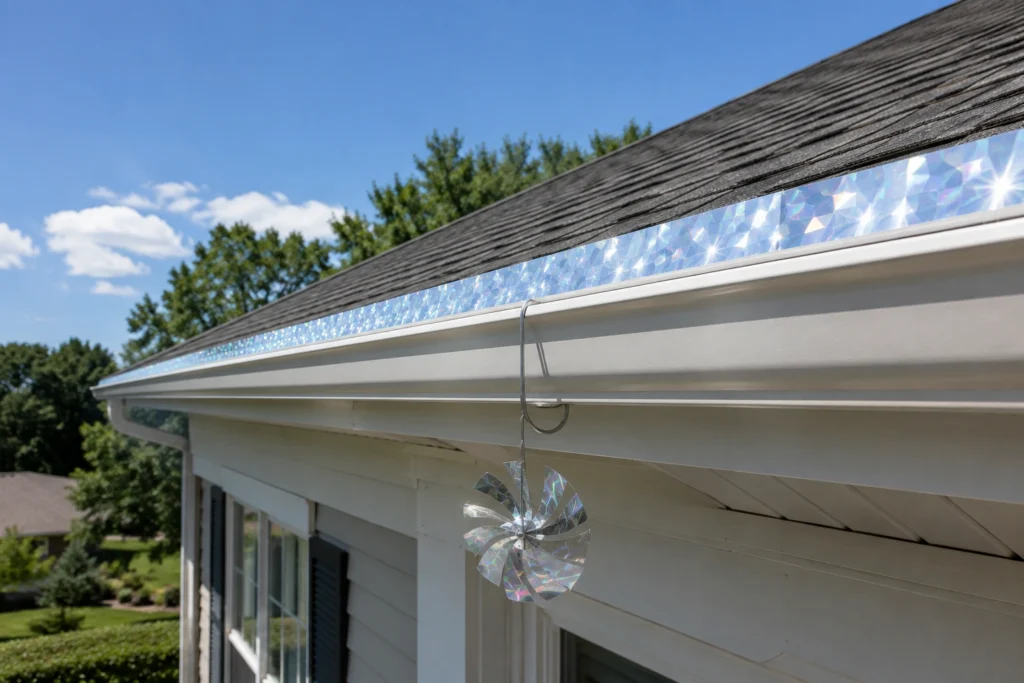
Visual deterrents work for a while, then stop. Rotation is the difference between weeks and months of effectiveness.
Why Bird Deterrents Matter
Bird activity around a Southeast home isn’t just an annoyance. Persistent bird problems lead to:
- Droppings. Bird droppings are acidic and stain paint, siding, decking, and concrete. Cleanup is constant, and accumulated droppings can damage surfaces permanently.
- Nesting in vents and gutters. Dryer vents, bathroom vents, gable vents, and gutter corners are favorite nesting spots. Nests block airflow, create fire risk (especially in dryer vents), and trap moisture.
- Noise. Pigeons, sparrows, and starlings start their day before dawn. Nesting season runs March through August in Georgia and Alabama.
- Structural damage. Roof damage from nesting materials, clogged gutters that overflow and rot fascia boards, and acid damage to paint from droppings.
- Health and sanitation concerns. Bird droppings can carry pathogens including histoplasmosis and salmonella. Most healthy adults aren’t at significant risk, but people with respiratory issues should avoid disturbing dried droppings without proper protection.
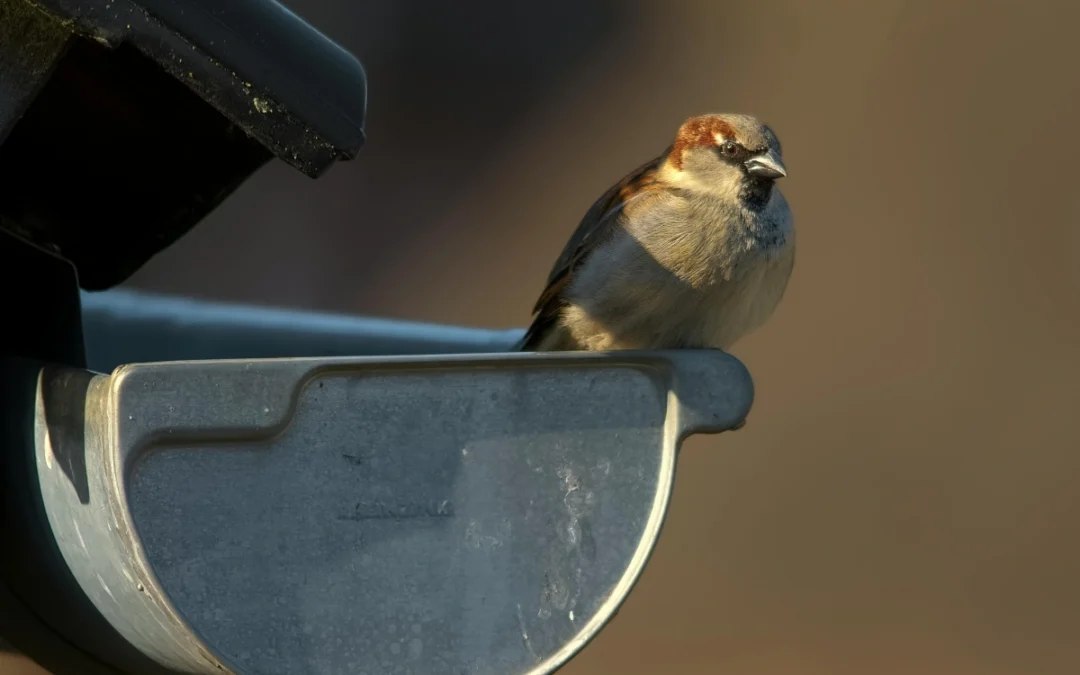
The species causing most of the bird-control calls we run are house sparrows, European starlings, and rock pigeons. All three are non-native and not protected under federal migratory bird law, which matters when you start considering removal options (more on that below).
Do DIY Bird Deterrents Really Work?
Yes and no. Most DIY bird deterrents produce short-term results, then lose effectiveness as birds figure out they’re not actually threats. The deterrents that hold up long-term are the ones that don’t depend on birds being fooled: physical barriers and habitat changes.
Two important caveats before you start any DIY bird control:
Federal law protects most native bird species. The Migratory Bird Treaty Act of 1918 protects more than 1,000 native species, and it’s illegal to disturb their active nests, eggs, or young without specific permits. The three most common nuisance species in the Southeast (house sparrows, European starlings, rock pigeons) are non-native and not protected, but several species you may encounter (swallows, woodpeckers, robins, mockingbirds, blue jays) are protected. If you’re not sure what species you’re dealing with, pause and identify before doing anything.
Active nests with eggs or young require special handling. Even for non-protected species, the humane and recommended approach is to wait until the nest is empty before removing it. Active nest removal during breeding season is one of the situations where calling a professional is often the right move.
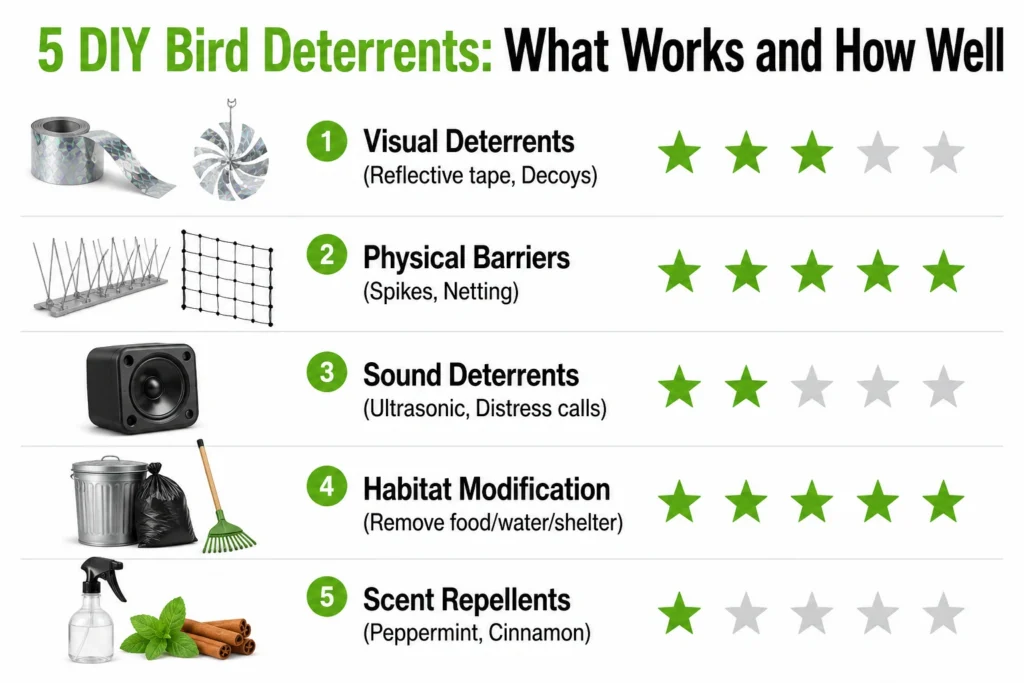
5 Effective DIY Bird Deterrents
Physical barriers and habitat changes do most of the heavy lifting. The other three are short-term tools.
1. Visual Deterrents (Reflective + Predator Decoys)
Reflective bird tape, hanging spinners, and predator decoys (plastic owls, hawks) all work on the same principle: scare birds with movement, light flashes, or the appearance of a predator. They work briefly, especially for new arrivals. The catch is habituation. Within two to four weeks, birds figure out the owl doesn’t move and the tape doesn’t actually threaten them.
Best practice: rotate visual deterrents weekly. Move the owl decoy to a new spot, replace reflective tape, swap the spinner for a different design. The rotation is what extends effectiveness from “a few weeks” to “all season.” Static visual deterrents left in one place stop working fast.
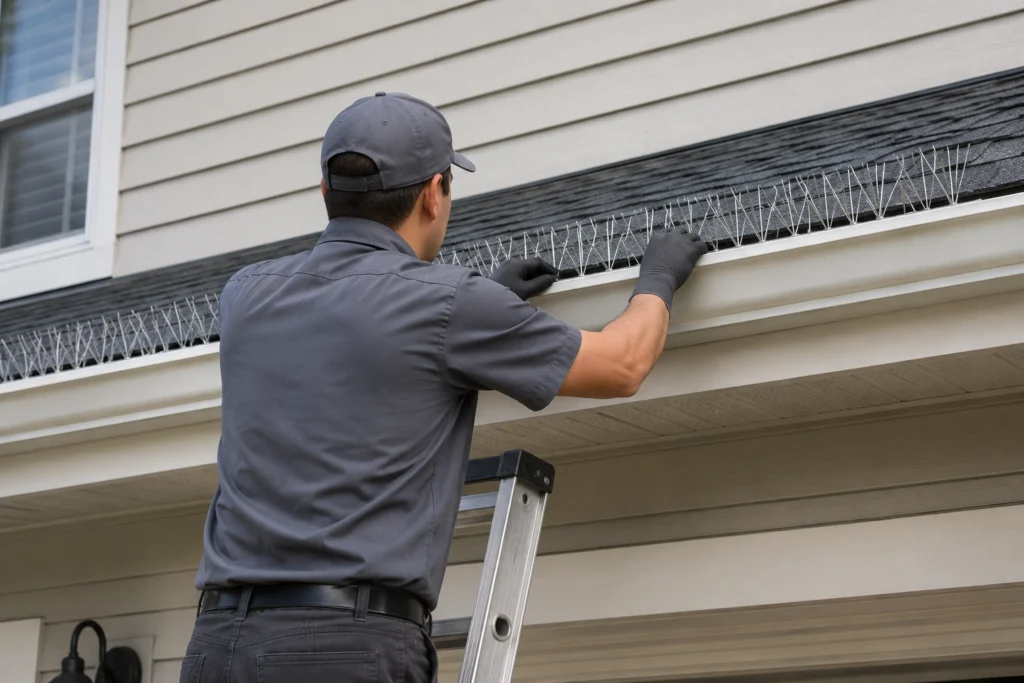
2. Physical Barriers (Spikes + Netting)
The single most effective long-term bird deterrent is making the landing spot physically unusable. Bird spikes installed along ledges, gutter edges, and rooflines prevent landing entirely. Bird netting stretched across eaves, soffit openings, or under solar panels blocks nesting access without harming birds.
Where physical barriers shine in Southeast homes:
- Gutter edges (favorite pigeon and starling landing spots)
- Eave overhangs (common sparrow nesting locations)
- Solar panel undersides (a big issue in newer Georgia construction)
- HVAC equipment housings and mini-split heads
- Window AC unit tops
- Gable vents and attic vents (with proper mesh, not just bird netting)
Bird spikes and netting installed correctly can last 10+ years and require near-zero maintenance. The catch: installation matters. Poor installation creates gaps birds exploit, and once a bird gets through, the whole barrier loses credibility.
3. Sound Deterrents (Ultrasonic + Distress Calls)
Ultrasonic devices and recorded distress calls (audible to birds, played on speakers) can disrupt new arrivals and slow nesting attempts. The research on ultrasonic devices specifically is mixed. Most independent testing shows limited effectiveness for birds, despite aggressive marketing claims. Audible distress calls work better but have an obvious downside in residential settings: they’re loud, and your neighbors will notice.
Sound deterrents are most useful in open commercial settings (parking lots, warehouse rooflines, agricultural buildings). They’re rarely the right choice for a single-family home in a Georgia or Alabama neighborhood.
4. Habitat Modification (the Most Overlooked Method)
The most underrated bird deterrent strategy isn’t a product. It’s removing the things drawing birds to your property in the first place. Birds keep showing up because the conditions are good. Change the conditions and most of them move on.
- Eliminate food sources. Bird feeders that overflow, pet food bowls left outside, accessible trash, fallen fruit under pecan or fig trees, breadcrumbs after outdoor meals. Any of these will pull birds in and keep them returning.
- Cut off water access. Standing water in birdbaths, clogged gutters that pool water, irrigation puddles, and uncovered pools all draw birds. Mosquitoes too, which then draws other pests.
- Trim trees and shrubs back from the house. A three-foot clear zone around the foundation and roofline reduces nesting opportunities and travel routes onto the house.
- Clean gutters regularly. A clogged gutter with debris is a five-star nesting site for sparrows and starlings.
- Seal entry points. Gaps in soffits, broken or missing vent covers, open chimneys without caps. The same exclusion work that keeps rodents out keeps birds out too.
Habitat modification is the only DIY method that addresses why birds came in the first place rather than just shooing them away. It’s also the only one that compounds: each year you maintain it, the cumulative effect grows.
5. Scent Repellents (Honest Effectiveness)
Peppermint oil, cinnamon, methyl anthranilate (the active compound in commercial bird repellents like grape extract sprays), and other scent-based products show modest, short-term effects in field testing. The catch: outdoor scents fade within days, wash out with rain, and require constant reapplication. They’re not a standalone solution.
Where scent repellents can earn their place: as a supplement to physical barriers in spots where you can’t install spikes or netting. Otherwise, treat them as the lowest-tier option.
The yards we treat for repeat bird problems almost always have an exposed food source, a water source, or open nesting cavities.
What Doesn’t Work (Bird Deterrent Myths to Skip)
A few “classic” bird deterrent ideas circulate widely but don’t hold up.
- Fake owls left in one place. Birds figure them out in days. Without rotation, they’re inert.
- Random DIY sprays. Vinegar, dish soap, garlic water, cayenne pepper, and similar mixes don’t have research support for bird control. They wash out fast and damage plants in the meantime.
- Wind chimes alone. Birds adapt to consistent sounds within a week. Wind chimes are pleasant. They’re not deterrents.
- Single-method approaches. Any one DIY deterrent works briefly. Combining two or three (e.g., physical barriers + habitat modification + rotating visual deterrents) is where homeowners see lasting results.
Humane Bird Exclusion: The Long-Term Approach
The most effective bird control isn’t a product. It’s exclusion, which means making your property physically unable to host birds in the spots they want to nest. Exclusion combines:
- Sealing every gap in vents, soffits, and rooflines with appropriate mesh or hardware cloth
- Installing bird spikes on landing surfaces
- Adding bird netting under solar panels and over open eaves
- Capping chimneys with bird-proof caps
- Modifying the surrounding habitat to remove food, water, and shelter
Exclusion done right typically lasts 10 years or more with minimal maintenance. It’s also the only approach that fully complies with the Migratory Bird Treaty Act, because it prevents nesting before it starts rather than removing active nests later.
When to Call a Professional for Bird Control
DIY bird deterrents handle small, early-stage bird problems well. Call Northwest for bird control if:
- Birds keep returning to the same spot despite your DIY efforts.
- Nests are in hard-to-reach or hazardous areas (high roofs, gable vents, solar panels).
- You’re dealing with large flocks (more than 10 birds at a time) or commercial properties.
- You suspect protected species are involved.
- An active nest needs removal mid-season.
- You want long-term exclusion done correctly the first time.
(Birds keep returning after you’ve tried DIY? Request a free Northwest bird control inspection and we’ll identify the species, find the entry points, and lay out a long-term exclusion plan.)
Bird Control in the Southeast
Birds in Georgia, Alabama, Tennessee, and South Carolina behave a little differently than in cooler parts of the country. Three regional factors increase bird pressure on Southeast homes:
- Longer nesting season. Warm spring weather arrives early and lingers into fall. House sparrows can produce three to four broods per year here, compared to two in colder regions.
- Year-round resident populations. Rock pigeons and house sparrows don’t migrate. They’re a problem every month of the year, not just in summer.
- Construction patterns. Open soffits, gable vents, and unscreened crawl space vents are common in older Atlanta, Birmingham, Savannah, and Macon homes. Each is a bird entry point.
The good news: the same exclusion approach that solves bird problems also solves rodent problems and helps with snake prevention. For more on how those pest categories connect, see our snake repellent guide on the rodent-snake-bird sealing connection. For the broader question of getting rid of birds already established on your home, see our companion guide on how to get rid of birds around your home.
Frequently Asked Questions About Bird Deterrents
What bird deterrent works best?
Physical barriers (bird spikes and netting) are the most effective long-term solution because they don’t depend on birds being fooled. Combined with habitat modification (removing food, water, and shelter), they handle most residential bird problems for years with minimal maintenance.
Are bird deterrents harmful to birds?
Most modern bird deterrents are designed to be humane and non-lethal. Bird spikes, netting, sound, scent, and visual deterrents discourage birds without injuring them. Avoid sticky gels or glue traps marketed for birds. They can trap and injure or kill birds and are illegal to use against protected species.
Do birds come back after deterrents are installed?
They can, especially if deterrents aren’t maintained or rotated. Static deterrents (a single fake owl, reflective tape that never moves) lose effectiveness within weeks. Combining multiple methods and rotating visual deterrents weekly extends results dramatically.
Are birds protected by law?
Yes, most native bird species are protected under the federal Migratory Bird Treaty Act, which makes it illegal to disturb their nests, eggs, or young without specific permits. The three most common nuisance species in the Southeast (house sparrows, European starlings, rock pigeons) are non-native and not protected. If you’re unsure what species you’re dealing with, identify the bird before removing nests.
How long does it take to get rid of birds with DIY deterrents?
If you start at the early-arrival stage (a few birds scouting, no active nests), DIY deterrents can resolve the issue in one to two weeks. If birds have already established nests, expect a longer timeline (often a full nesting season) before you can fully exclude them. Active nests of protected species cannot be removed mid-season; you’ll need to wait for the young to fledge before sealing the area.
Professional exclusion lasts years. DIY deterrents that get rotated and maintained can match it for smaller problems.
Ready to Stop the Bird Problem at the Source?
If you’ve tried a DIY bird deterrent or two and the birds keep coming back, the problem isn’t the deterrent. It’s the conditions around your home that keep drawing birds in. Northwest’s wildlife team handles the full bird-control workflow: species identification, exclusion installation, habitat assessment, and follow-up to make sure birds don’t find a new spot to set up shop.
About the Author
Anna V., Editorial Lead — Pest Education leads pest education content for Northwest Exterminating, working with senior technicians and service center managers across our Georgia, Alabama, Tennessee, and South Carolina service areas to translate field expertise into homeowner-friendly guides. The focus: accurate, regionally-specific answers to the pest questions Southeast homeowners are actually searching for.
Mar 20, 2020 | Alabama Blogs, Georgia Blogs, Pest Control, Wildlife
By Anna V., Editorial Lead — Pest Education · Last updated: May 2026
When a homeowner in Georgia or Alabama calls Northwest about a rodent problem, our first question is almost always: mouse or rat? The two get lumped together in everyday conversation, but they behave differently, leave behind very different evidence, and require different treatment approaches. Misidentifying which species you have is one of the most common reasons DIY rodent control fails. A trap baited and placed for a mouse will sit untouched while a rat sniffs it and moves on. A rat-sized opening sealed against mice still lets the much smaller mice walk right in.
Here’s how to tell a mouse from a rat at a glance, what each one’s droppings, gnaw marks, and behavior look like in a Southeast home, and when the difference between them changes how you treat the problem.
Size is the fastest clue. A mouse fits in a tablespoon. A rat doesn’t.
What’s the Difference Between a Mouse and a Rat?
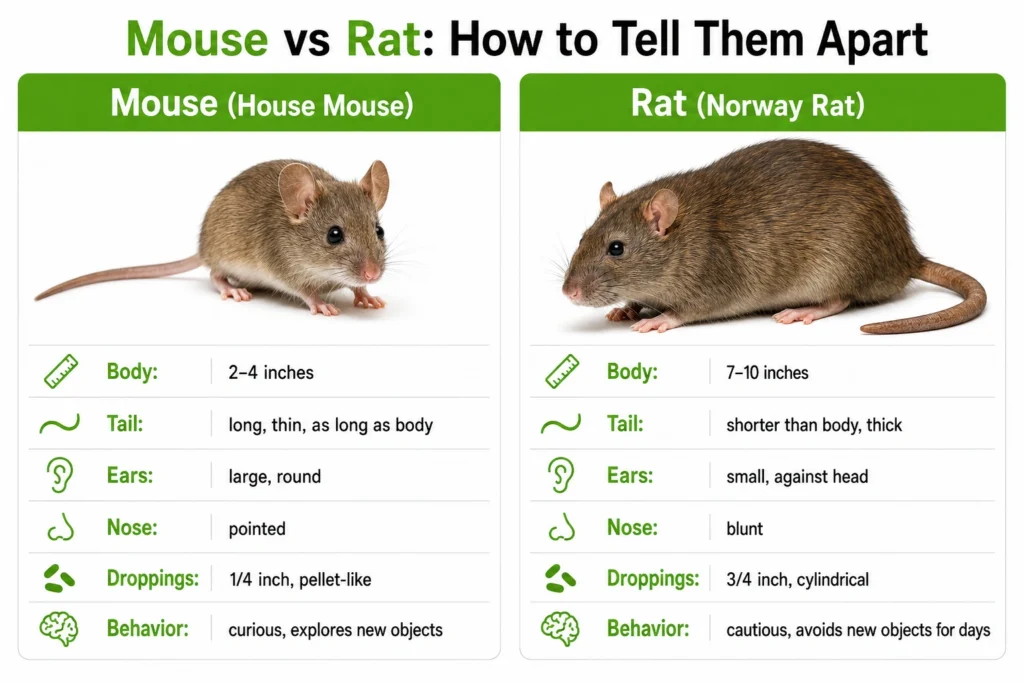
The physical differences between a mouse and a rat are obvious once you’ve seen them side by side. The challenge is that most homeowners only see one of them, briefly, in low light, before it disappears behind the refrigerator. Here’s what to look for if you only get a glimpse.
Mice (house mouse, deer mouse) are small. Adult body length is typically 2 to 4 inches, not counting the tail, which is about as long as the body. They have slender bodies, pointed noses, and large round ears that look oversized for their head. Their fur is usually light brown or gray. They’re curious by nature and tend to explore new objects in their territory within hours.
Rats (Norway rat, roof rat) are substantially larger. Adult body length runs 7 to 10 inches, with a tail that’s shorter than the body. They have thicker, heavier bodies, blunt noses, and proportionally smaller ears tucked against the head. Norway rats (the most common in Georgia and Alabama) are brown or gray with shaggier fur. Roof rats are darker, sleeker, and more agile climbers. Both are cautious by nature and will avoid new objects in their territory for days before approaching — a behavior pest pros call “neophobia.”
That neophobia is the single biggest reason rat traps fail when homeowners set them. Mice walk into traps within hours. Rats will avoid them for a week.
Mouse vs Rat Identification Guide
Size, tail, and droppings are the three identifiers most homeowners can use without seeing the rodent itself.
Quick Comparison Table
| Feature |
Mouse |
Rat |
| Body length |
2 to 4 inches |
7 to 10 inches |
| Tail |
Long and thin, about as long as body |
Shorter than body, thick and scaly |
| Ears |
Large and rounded, look oversized |
Small, held closer to the head |
| Nose |
Pointed, narrow |
Blunt, broader |
| Droppings |
1/8 to 1/4 inch, pellet-like |
1/2 to 3/4 inch, cylindrical |
| Behavior |
Curious, investigates new objects |
Cautious, avoids new objects for days |
| Where they nest |
Indoors, in walls, cabinets, attics |
Outdoors in burrows; indoors in basements, crawl spaces |
| Reproduction |
5 to 10 litters per year, faster cycle |
2 to 5 litters per year, larger litters |
Common Species in the Southeast
In Georgia, Alabama, Tennessee, and South Carolina, the rodents you’re most likely to encounter inside a home are:
- House mouse (Mus musculus) — the most common indoor rodent across the entire Southeast.
- Deer mouse (Peromyscus maniculatus) — more common in rural and wooded areas. Notable because it’s a primary carrier of hantavirus.
- Norway rat (Rattus norvegicus) — also called the brown rat or sewer rat. Common in older urban neighborhoods of Atlanta, Birmingham, Savannah, and Macon.
- Roof rat (Rattus rattus) — also called the black rat. More common along the coast and in warmer parts of the service area. Strong climber, often found in attics.
Signs You Have a Mouse or a Rat
If you haven’t actually seen the rodent yet, the signs they leave behind will tell you which species you’re dealing with. Here’s what to look for and how to read it.
Droppings (the most reliable indicator)
Mouse droppings are tiny, dark, and shaped like grains of rice with pointed ends. They’re typically 1/8 to 1/4 inch long. A single mouse can leave 50 to 75 droppings a day, so you’ll find them scattered widely — along baseboards, inside cabinets, in pantry corners, on the back of countertops.
Rat droppings are much larger, 1/2 to 3/4 inch long, dark, and shaped like a thick capsule with blunt or pointed ends (depending on species). You’ll find them in concentrated piles near nesting sites or along regular travel paths — usually in basements, crawl spaces, near food storage, or along walls.
Size alone is the easiest tell. If the droppings are smaller than a grain of rice, you have mice. If they’re larger than a coffee bean, you have rats.
Gnaw Marks
Mice leave small, scratchy bite marks on food packaging, the corners of cardboard boxes, and the edges of wooden trim. The marks are usually clean and close together, made by their tiny incisors.
Rats chew through harder materials and leave much larger, rougher marks. Rats can chew through soft wood, insulation, drywall, lead pipes, aluminum siding, and most plastic. Damaged electrical wiring, holes the size of a quarter or larger in baseboards or insulation, and torn-open food storage containers all suggest rats rather than mice.
Mouse damage looks like fine scratches. Rat damage looks like something chewed a hole.
Nesting Material
Mice build small, well-organized nests using shredded paper, fabric, insulation, and dryer lint. Nests are typically hidden in wall voids, behind appliances, inside cabinets, in attic insulation, or in stored boxes. Each nest is the size of a softball or smaller.
Rats build larger, messier nests using similar materials but on a different scale. Norway rat nests are often outdoors in burrows under decks, sheds, or vegetation. Roof rat nests are usually in attics or upper wall voids. Both species’ indoor nests are noticeably larger than a mouse’s, ranging from softball-sized to football-sized.
Sounds and Smells
Mice make light scurrying and scratching sounds, often heard at night in walls or above ceilings. Rats make heavier, slower, more obvious sounds, sometimes including thumps as they jump between surfaces. Both species produce a musky urine smell when populations grow, with rats producing a much stronger odor due to their larger body size and concentrated activity.
Damage Caused by Mice vs Rats
The damage pattern in your home is a strong species indicator and an important factor in how urgent treatment is.
Mice cause modest structural damage in most situations. They chew through food packaging, gnaw on baseboards and wooden trim, and damage stored items. The biggest mouse risk is food contamination and the secondary pest problem of indoor flea or mite populations that can travel with them.
Rats cause significant structural damage when populations establish. They chew through electrical wiring (creating real fire risk), tear through insulation, gnaw on plumbing, and damage HVAC ductwork. The repair costs for rat damage routinely run into thousands of dollars. Rats also pose more serious disease transmission risk than mice.
Health Risks: Mouse vs Rat
Both species carry diseases, but rats present a broader and more severe health risk profile. The CDC’s rodent disease guidance documents both species as vectors for pathogens.
Diseases associated with mice include hantavirus (especially from deer mice), salmonella contamination of food surfaces, and allergens that trigger asthma in sensitive individuals.
Diseases associated with rats include leptospirosis (transmitted through contact with rat urine), rat-bite fever, salmonella, and historically the bubonic plague (still present at low levels in some U.S. populations). Rats also carry fleas that can transmit additional pathogens.
The practical takeaway: any rodent presence indoors warrants attention, but a confirmed rat sighting is more urgent than a mouse sighting from a health-risk standpoint.
Behavior & Habitat Differences in Southeast Homes
Where each species nests in a Georgia or Alabama home tells you a lot about how they got in and how to address them.
Mice nest indoors year-round. They prefer wall voids, attic insulation, behind appliances, inside stored boxes, and in cluttered storage spaces. A mouse only needs a hole the diameter of a dime to get inside, which means tiny gaps around utility line penetrations, foundation cracks, and worn weatherstripping are all entry points.
Rats typically nest outdoors and travel indoors for food. Norway rats burrow in yards, under decks and sheds, and along foundations. Roof rats nest in attics, palm trees (in coastal areas), and shed rafters. A rat needs a hole the diameter of a quarter to get inside. Larger entry points, garage door gaps, and unsealed crawl space access doors are the typical routes.
Seasonal pattern in the Southeast: rodent indoor activity peaks from late October through March, as outdoor food sources dwindle and rodents seek warmth and shelter. Mice are active year-round indoors; rats become more visible in cooler months.
Mouse vs Rat Control & Prevention
Once you know which species you’re dealing with, the treatment approach changes meaningfully.
DIY Prevention (works for both)
- Seal all entry points larger than 1/4 inch with steel wool and caulk (mice can’t gnaw through steel wool).
- Store food in airtight containers (glass or hard plastic, not bags).
- Take out trash daily, especially in warm months.
- Eliminate clutter in basements, attics, and garages.
- Fix any water leaks; rodents need water too.
- Trim vegetation back from the foundation and roofline.
Treatment That Actually Works
For mice, snap traps baited with peanut butter and placed perpendicular to walls catch most populations within a few days. Mice walk into them readily because of their curiosity.
For rats, the approach is slower and more deliberate. Set traps but don’t bait them for the first 5 to 7 days. Let rats get used to the new object in their environment first, then bait. Place traps along walls where droppings show heavy activity. This works around their neophobia.
For both species, bait stations with rodenticide can be effective but introduce risks: dead rodents in wall voids cause severe odor problems, secondary poisoning of pets and wildlife is a real concern, and rats often die in inaccessible spots. We generally recommend trapping over baiting for residential rodent control.
When to Call a Professional
Call Northwest for professional rodent control if:
- You’ve identified rats specifically (not just mice). Rats benefit from professional trapping experience.
- Sightings have continued for more than two weeks despite DIY traps.
- You’ve found droppings in multiple rooms or on multiple floors, suggesting an established population.
- You’re seeing rodents during the day, which often indicates a large hidden population.
- You want a full entry-point seal-up, not just trapping.
(Not sure if you have mice or rats? Request a free Northwest inspection and we’ll identify the species, locate entry points, and lay out the right treatment plan.)
One Last Thing: Rodents Drive Other Pest Problems
A mouse or rat problem rarely stays a mouse or rat problem for long. Rodents bring fleas and mites indoors, draw snakes that hunt them (a major reason snake sightings spike when rodent populations are high; see our snake repellent guide for more), and create the kind of warm, food-rich environments other pests follow. Rodent control is often the first step in solving secondary pest problems too.
For more on what happens when you have both species at once, see our companion guide on whether rats and mice can infest your home at the same time.
Frequently Asked Questions About Mouse vs Rat Identification
How can I tell if I have a mouse or a rat?
The fastest tell is droppings size. Mouse droppings are tiny (1/8 to 1/4 inch) and rice-shaped. Rat droppings are much larger (1/2 to 3/4 inch) and capsule-shaped. Gnaw marks are also a strong indicator: small scratchy marks suggest mice, while larger chewed holes suggest rats.
Are rats more dangerous than mice?
Generally yes. Rats cause more structural damage (chewed wiring, plumbing, insulation), carry a broader range of diseases, and produce stronger health-risk concerns through their droppings, urine, and the fleas they often carry. Both species warrant treatment, but rat problems should be addressed faster.
Do mice or rats spread disease?
Both spread disease, but rats are vectors for more pathogens. Mice can transmit hantavirus (especially deer mice), salmonella, and allergens that trigger asthma. Rats can transmit leptospirosis, rat-bite fever, salmonella, and several pathogens carried by the fleas that often travel with them.
What time of year are rodents most active in the Southeast?
Indoor rodent activity in Georgia, Alabama, Tennessee, and South Carolina peaks from late October through March as outdoor food sources dwindle and rodents seek warmth indoors. Mice are active year-round indoors. Rats become noticeably more visible in cooler months.
Can mice and rats live in the same house at the same time?
Yes, but they typically don’t share the same nesting space. Rats generally exclude mice from areas where rat populations are dense. In homes large enough or with enough resources, you can find both species in different parts of the structure. For a deeper look at co-infestation, see our companion guide on rats and mice infesting the same home.
Identifying the species is the first step. Sealing the entry points is what keeps them out long term.
Schedule a Rodent Inspection
If you’ve found droppings, heard scratching in the walls, or actually seen something dart across the floor, the smart move is to identify the species and seal the entry points before the population grows. Northwest’s team has been clearing rodent problems out of Georgia, Alabama, Tennessee, and South Carolina homes for decades, and most of what we do for rodent calls is finding the entry points homeowners missed and treating the species that’s actually present.
About the Author
Anna V., Editorial Lead — Pest Education leads pest education content for Northwest Exterminating, working with senior technicians and service center managers across our Georgia, Alabama, Tennessee, and South Carolina service areas to translate field expertise into homeowner-friendly guides. The focus: accurate, regionally-specific answers to the pest questions Southeast homeowners are actually searching for.
Dec 24, 2019 | Georgia Blogs, Pest Control
By Anna V., Editorial Lead — Pest Education · Last updated: May 2026
If you’ve come downstairs to find a column of ants trailing across your counter at 6 AM, you’re in the most common pest situation in the Southeast. At Northwest, ants are the #1 pest call we run year-round across Georgia, Alabama, Tennessee, and South Carolina. The good news: kitchen ant problems are usually solvable, often without professional help if you catch them early. The catch: the wrong DIY approach makes them worse.
Here’s the full playbook on how to get rid of ants in your kitchen, including which species you’re probably dealing with, the DIY methods that actually work (and the ones that just spread the problem), and when it’s time to call in backup.
Common Ant Species Found in Southeast Kitchens
Five species cover almost every kitchen ant call in Georgia and Alabama. Identification matters because two of these (carpenter ants and argentine ants) need different treatment than the others.
Five species cover almost every kitchen ant call in Southeast homes. Carpenter ants are the only ones that damage wood.
Sugar Ants (Tapinoma sessile and similar)
- Size: Very small (1/16 inch), dark brown to black.
- Behavior: Follow trails to sweet foods, especially syrup, honey, fruit, and sugary spills. Active year-round in heated homes.
- Damage potential: Nuisance only. No structural damage.
Odorous House Ants (Tapinoma sessile)
- Size: Small (1/8 inch), uniformly dark brown.
- Behavior: Release a strong rotten-coconut smell when crushed (the most reliable identification marker). Form large trails between nests and food sources. Will eat both sweet and protein-based foods.
- Damage potential: Nuisance only.
Argentine Ants (Linepithema humile)
- Size: Small (1/10 inch), light brown to medium brown.
- Behavior: Form enormous interconnected supercolonies that can span entire neighborhoods. They’re the hardest kitchen ant to fully eliminate because killing one trail doesn’t affect the broader colony. Major presence in coastal and urban Georgia.
- Damage potential: Nuisance only, but persistent.
Pavement Ants (Tetramorium immigrans)
- Size: Small (1/8 inch), dark brown to black.
- Behavior: Nest under sidewalks, driveways, slab foundations, and patios. Forage indoors for grease, sweets, and pet food. Often enter through gaps where slab meets wall.
- Damage potential: Nuisance only.
Carpenter Ants (Camponotus species)
- Size: Large (1/4 to 1/2 inch), usually black, sometimes black-and-red.
- Behavior: Excavate galleries in wood for nesting. Don’t eat wood, but their nesting activity causes structural damage similar to (and often confused with) termites. Most active at night.
- Damage potential: HIGH. Carpenter ants in or near the kitchen warrant immediate professional inspection. They often indicate moisture damage in wall framing, sub-floor, or window frames. For prevention overlap with termite issues, see our termite prevention guide.
Why Ants Invade Kitchens
The kitchen is the most attractive room in your house to ants for three simple reasons:
- Food. Crumbs, spills, open containers, fruit, pet food bowls, and trash. Even microscopic residues are enough to recruit a colony.
- Water. Sinks, leaky pipes under cabinets, condensation around dishwashers, and pet water bowls all attract foraging ants.
- Entry points. Plumbing gaps under sinks, gaps between cabinets and walls, window sills, and door thresholds all provide easy access from outdoor nesting areas.
Once a scout ant finds food, it lays down a pheromone trail back to the colony. Within hours, you can have a hundred workers on the same trail. This is why “I just saw one ant” often becomes “the counter is covered in ants” by the next morning.
Southeast Seasonal Patterns
- Spring (March-May): Colonies wake up and send out scouts. Peak kitchen ant activity begins.
- Summer (June-August): Peak foraging across all species. Argentine ants and odorous house ants are at their most aggressive.
- Fall (September-November): Colonies stockpile food before winter. Trails often shift to protein and grease sources.
- Winter (December-February): Most species dormant outdoors but heated homes can support indoor populations year-round, especially in the deep South.
Signs of an Ant Infestation
Look for:
- Visible trails along counters, baseboards, or wall edges.
- Repeated sightings near the same food or water source (sink, pet bowl, sugar jar).
- Small piles of dirt or debris near baseboards or window sills (nest excavation).
- Discarded wings near windows or doors after a rain (winged reproductive ants leaving the nest).
- For carpenter ants specifically: small piles of sawdust-like debris (“frass”) near wood structures.
How to Get Rid of Ants in Your Kitchen: DIY Methods That Work
Three categories of work, in order of priority. Skipping straight to spray-and-pray almost always backfires.
Step 1: Cut Off the Food Source
Until you starve the trail, no amount of treatment will hold:
- Wipe down counters with a vinegar-water solution (50/50) immediately after spotting a trail. This breaks the pheromone trail.
- Move all open food to sealed containers or the refrigerator.
- Empty trash daily and rinse the can.
- Clean spills under the toaster, behind the coffee maker, and under the refrigerator.
- Pick up pet food bowls between feedings (a major argentine ant attractant).
- Fix any leaking pipes under the sink.
Step 2: Use Bait, Not Spray
This is the most important rule in kitchen ant control: do not spray visible ants with repellent insecticides. It kills the visible workers but warns the colony, which then splits and spreads. Bait works because the worker carries the active ingredient back to the colony and the queen.
- Borax-and-sugar bait. Mix 1 tablespoon of borax with 3 tablespoons of sugar and enough water to make a syrup. Place small drops on cardboard or in bottle caps near the trail. Workers carry it back to the colony. Effective within 3 to 7 days.
- Commercial gel baits. Terro Liquid Ant Baits and Advion gel are well-reviewed for kitchen ants. Place per package directions near trails and entry points.
- Patience. You’ll see MORE ants on the bait initially, which is the desired outcome. Resist the urge to spray. Trail activity drops sharply once the colony is poisoned.
Step 3: Natural Repellents and Trail Disruption
Use these alongside bait, not instead of it:
- Vinegar spray. 50/50 white vinegar and water breaks pheromone trails and discourages re-entry.
- Peppermint or tea tree oil spray. 10 drops per cup of water sprayed at entry points (window sills, door thresholds, under-sink areas).
- Diatomaceous earth (food-grade). Light dusting along baseboards and under sinks. Damages the ants’ exoskeletons. Reapply after vacuuming.
- Cinnamon or coffee grounds. Both are mild repellents that work for short-term trail disruption.
Preventing Future Ant Problems
Long-term ant prevention is mostly about removing the conditions that attract them in the first place.
Prevention is straightforward and covers most species:
- Seal entry points. Caulk gaps around plumbing under the sink, around window frames, and where cabinets meet walls.
- Food storage discipline. Airtight containers for pantry items, sealed bags for snacks, fruit in the refrigerator if ants are active.
- Moisture control. Fix leaks fast. Wipe down sinks at night. Don’t leave standing water in the dish drainer.
- Outdoor maintenance. Trim shrubs and tree branches back from the house (ants use them as bridges). Keep mulch and firewood 20+ feet from the foundation. Repair damaged caulking around exterior windows and doors.
- Year-round vigilance. Most Southeast homes need ongoing prevention rather than one-time treatment. A monthly check of high-risk areas (under sinks, behind appliances) catches new activity early.
When to Call Professional Ant Control
Call Northwest if:
- You’ve spotted carpenter ants (large black ants, especially with sawdust-like frass nearby).
- DIY methods haven’t reduced activity within 2 to 3 weeks.
- You’re dealing with argentine ant supercolonies that keep returning despite consistent bait use.
- Trails are coming from multiple entry points (suggests a large or complex nest network).
- You’re seeing other pest activity simultaneously, which often indicates broader exclusion gaps.
Professional ant control combines species identification, targeted baits matched to the species’ food preferences, perimeter treatment to address outdoor nests, and structural exclusion. UGA Extension’s household pest management guide is the best free reference for the region.
(Ants coming back no matter what you do? Schedule a free Northwest inspection and we’ll identify the species, find the nest, and treat at the source.)
Frequently Asked Questions About Kitchen Ants
How do I identify the type of ant in my kitchen?
Look at size, color, smell when crushed, and what they’re going after. Tiny dark ants on sweets are usually sugar ants. Slightly larger ants that smell like rotten coconut when crushed are odorous house ants. Light brown ants in massive trails are argentine ants. Larger black ants (1/4 inch or more), especially near wood damage or with sawdust nearby, are carpenter ants and warrant professional inspection.
Can ants cause damage to my home?
Most kitchen ants (sugar, odorous house, argentine, pavement) are nuisance pests only. They don’t damage structures or spread serious disease. Carpenter ants are the exception. They excavate wood for nesting and can cause significant structural damage over time, especially in moisture-compromised framing or window frames. Carpenter ants always warrant professional evaluation.
How long does it take to eliminate an ant infestation?
Small bait-based eliminations: typically 7 to 14 days for visible trail activity to drop. Argentine ant supercolonies and well-established carpenter ant nests: 4 to 8 weeks of consistent treatment, often with professional help. The biggest mistake homeowners make is spraying repellents that scatter the colony, which can extend the timeline significantly.
Are natural remedies effective?
Vinegar spray, peppermint oil, and diatomaceous earth are effective for trail disruption and prevention. They’re less effective for eliminating an established colony. The most effective DIY approach combines borax-and-sugar bait (or commercial gel baits) for elimination plus natural repellents for ongoing prevention. Bait without prevention usually means the ants come back.
Why won’t the ants stop coming back?
Three usual reasons: (1) the colony nest is outdoors and continues sending new scouts, (2) you sprayed repellents that caused the colony to split into multiple smaller nests, or (3) you’re dealing with argentine ants, which form supercolonies that span entire neighborhoods. Persistent return cases typically need professional perimeter treatment plus structural exclusion.
Professional ant control combines species ID, source treatment, and exclusion so the colony doesn’t reroute.
Ready for a Professional Kitchen Ant Inspection?
If kitchen ants are a recurring problem, you’ve spotted carpenter ants, or DIY methods haven’t worked, Northwest’s team can handle species identification, source treatment, and exclusion in one visit. Most kitchen ant issues clear up faster than homeowners expect once the nest is properly targeted.
About the Author
Anna V., Editorial Lead — Pest Education leads pest education content for Northwest Exterminating, working with senior technicians and service center managers across our Georgia, Alabama, Tennessee, and South Carolina service areas to translate field expertise into homeowner-friendly guides. The focus: accurate, regionally-specific answers to the pest questions Southeast homeowners are actually searching for.
Dec 20, 2019 | Alabama Blogs, Georgia Blogs, Termite Control
By Anna V., Editorial Lead — Pest Education · Last updated: May 2026
Termites cause an estimated $5 billion in property damage across the U.S. every year, and the Southeast accounts for a disproportionate share because of our warm, humid climate. At Northwest, we inspect for termites year-round across Georgia, Alabama, Tennessee, and South Carolina, and the pattern we see over and over is the same: homeowners assume they’re either lucky or unlucky when it comes to termites. They’re neither. Termite damage is largely preventable, and the homes that get hit hardest almost always have one or more risk factors that could have been addressed years earlier.
Here’s the full termite prevention playbook for Southeast homes, including the conditions that attract termites, the DIY steps that actually move the needle, when professional treatment is worth it, and how often you should be inspecting.
Mud tubes on a foundation wall are the most reliable early warning sign of subterranean termite activity.
Why Termite Prevention Is Essential in the Southeast
Three facts make termite prevention non-optional for Southeast homeowners:
- Eastern subterranean termites are present in every county of Georgia and Alabama. They’re not a “what if,” they’re a “when.” The question for most homes isn’t whether termites are nearby, it’s whether your house has the conditions that let them in.
- Damage is usually invisible until it’s significant. Termites work inside wood from the interior outward. By the time you can see visible damage on a wall, sub-floor, or window frame, you’re typically looking at thousands of dollars in repair on top of treatment.
- Most homeowner insurance does not cover termite damage. Repair costs come out of your pocket. Average treatment + repair for a moderate infestation in the Southeast runs $3,000 to $8,000.
Common entry points: wood-to-soil contact around the foundation, cracks in slab foundations or concrete blocks, expansion joints, leaky pipes or excessive moisture, mulch or firewood piled against exterior walls, and gaps where utility lines penetrate the foundation.
Identifying Termite Risk Factors on Your Property
Four risk factors account for most Southeast termite calls. Fix these and you remove the conditions termites need.
Four conditions account for the majority of termite activity in Southeast homes. If you have one or more of these, you’re at elevated risk regardless of what neighbors are seeing.
1. Moisture and Water Issues
Subterranean termites need consistent moisture to survive. Anything that creates a damp microclimate near or under your home raises the risk:
- Leaky exterior faucets, hose bibs, or irrigation lines
- Clogged or missing gutters that dump water at the foundation
- Landscaping graded toward the house rather than away from it
- Air conditioner condensate lines that discharge near the foundation
- Plumbing leaks under sinks, in crawl spaces, or in slab penetrations
2. Wood-to-Soil Contact
Wherever wood touches soil directly, you’ve given termites a no-effort entry path:
- Wooden deck posts set directly in the ground without concrete footers
- Wooden fence posts touching the house
- Wood siding that extends below grade level
- Trellises or arbors attached to the house with the base in soil or mulch
- Wooden steps or porch supports without termite shields
3. Clutter and Yard Debris
Debris near the foundation provides food, shelter, and a launching point for termite colonies:
- Firewood stacked against the house or within 20 feet of the foundation
- Cardboard boxes, lumber, or pallets stored next to the house
- Leaf piles and yard waste against exterior walls
- Old tree stumps within 20 feet of the foundation (subterranean termites love decaying stumps)
4. Landscaping Decisions
Mulch is great for gardens but problematic near foundations:
- Maintain a 2- to 3-foot gap between mulch and the foundation
- Use pea gravel or river rock in the 2-foot zone immediately adjacent to the foundation
- Trim shrubs back from exterior walls (dense vegetation traps moisture and hides mud tubes)
- Avoid heavy irrigation right at the foundation
DIY Termite Prevention Tips
Most prevention work is structural and seasonal. Done right, these steps significantly lower your risk without specialized equipment.
Regular Inspections
Walk your property twice a year (spring and fall) and look for:
- Mud tubes (pencil-thick brown tunnels) running up foundation walls or in crawl spaces
- Wood that sounds hollow when tapped or has blistering paint
- Small piles of what looks like sawdust or fine pellets near wood structures (frass from drywood termites or carpenter ants)
- Discarded wings near windows or doors after a warm rainy day (termite swarmer evidence)
- Sagging or warped flooring that wasn’t there before
Moisture Control
- Clean gutters twice a year and install gutter guards if you have heavy tree cover
- Add downspout extensions to direct water 4+ feet from the foundation
- Run a dehumidifier in basements and conditioned crawl spaces (target 50% RH or below)
- Fix any plumbing leak within 48 hours
- Re-grade landscaping if water pools near the foundation after rain
Remove Wood and Debris Near the Home
- Move firewood to a rack at least 20 feet from the house and elevated off the ground
- Remove old tree stumps within 20 feet of the foundation
- Store lumber, cardboard, and yard tools off the ground in a shed or garage
- Rake fallen leaves away from foundation walls
Natural Deterrents (Supplementary Only)
These don’t replace professional treatment for active infestations but can complement prevention:
- Orange oil or neem oil treatments on exposed exterior wood
- Diatomaceous earth along the foundation perimeter (works on a range of pests including some termites)
- Borate-based wood preservatives on accessible structural wood (decks, fences)
Professional Termite Prevention Methods
For Southeast homes, professional termite prevention is the highest-ROI structural investment most homeowners make. It’s also the only thing that meaningfully protects against a heavy subterranean termite year.
Chemical Barrier (Liquid Termiticide) Treatments
Pest control technicians trench around the foundation and apply a long-lasting termiticide (typically fipronil or imidacloprid) into the soil. This creates a continuous chemical barrier that subterranean termites can’t cross to reach the structure. Modern non-repellent termiticides are particularly effective because the termites don’t detect them and carry the active ingredient back to the colony, often eliminating it. Typical protection lasts 5 to 10 years.
Termite Bait Systems
In-ground bait stations placed around the foundation contain cellulose attractive to subterranean termites. Foraging termites find the bait, share it with the colony through grooming and food exchange, and the active ingredient (typically hexaflumuron or chlorfluazuron) disrupts molting and eliminates the colony. Sentricon and similar systems require ongoing monitoring (typically quarterly or annually) and offer long-term colony elimination rather than just a barrier.
Inspection and Monitoring Services
Professional inspections detect early signs homeowners miss: subterranean mud tubes in inaccessible crawl spaces, drywood damage inside wall voids, moisture issues that create termite-favorable microclimates. Annual inspections are the minimum recommendation for Southeast homes. Twice yearly is more appropriate for homes with risk factors or in heavily wooded areas.
When to Call a Professional Immediately
- Mud tubes on the foundation, in crawl spaces, or inside the home
- Discarded swarmer wings near windows or doors
- Hollow-sounding or visibly damaged wood
- Frass (fine wood-colored pellets) near wood structures
- Sagging floors or doors that suddenly don’t close properly
- You’re buying a home in the Southeast (a pre-purchase termite inspection is essentially required by every reputable lender)
Carpenter Ants vs Termites: Don’t Confuse Them
Carpenter ants and termites both damage wood, but they’re different pests with different treatments. Homeowners often confuse the two:
- Termites eat wood for nutrition. Damage looks smooth and follows the wood grain. Bodies are pale/cream-colored with straight antennae and equal-length wings (in swarmers). They build mud tubes.
- Carpenter ants excavate wood for nesting (they don’t eat it). Damage looks like clean tunnels with sawdust-like frass nearby. Bodies are dark, segmented, with bent antennae and wings of unequal length. No mud tubes.
Both warrant professional treatment, but the methods differ. If you’re unsure which you’re dealing with, see our ants in the kitchen guide for carpenter ant identification details.
Seasonal and Regional Considerations
A foundation with proper drainage, mulch clearance, and no wood-to-soil contact is the structural baseline for termite prevention.
Termite activity follows distinct seasonal patterns in the Southeast:
- Late winter through spring (February-May): Peak swarming season. Subterranean termite swarmers emerge after warm rains, mate, and start new colonies. Most homeowner discoveries happen during this window.
- Summer (June-August): Colonies are at maximum foraging activity. Damage progresses fastest during these months.
- Fall (September-November): Reduced swarming but continued foraging. Good time for prevention work because next year’s swarmers haven’t emerged yet.
- Winter (December-February): Slowed but not dormant in the deep South. Indoor heated environments can keep populations active year-round.
Schedule professional inspections in late winter (January-February) so you catch any new activity before peak swarming season.
Termite Prevention Cost vs Damage Cost
A perspective on the math:
- Annual termite inspection: $75 to $200
- Initial liquid termiticide treatment (typical Southeast home): $1,200 to $2,500
- Bait system installation: $1,500 to $3,000, plus $300 to $600 annual monitoring
- Average damage repair from moderate infestation: $3,000 to $8,000
- Severe damage repair (structural beams, sub-floors): $10,000 to $25,000+
Prevention almost always costs less than treatment + repair, often by a factor of 5 to 10x. For a deeper authoritative reference, UGA Extension’s subterranean termite management guide covers the biology and treatment options in technical detail.
(Worried about termites or due for an inspection? Schedule a free Northwest inspection and we’ll assess your risk factors and recommend the right protection level.)
Frequently Asked Questions About Termite Prevention
Can termites be prevented entirely?
No method is 100% foolproof, but the combination of structural prevention (sealing entry points, controlling moisture, maintaining wood-to-soil separation), professional barrier or bait treatment, and regular inspections reduces risk by an enormous margin. Properly protected Southeast homes are very rarely the ones we see with serious termite damage.
How often should I have a termite inspection?
Annual inspections are the minimum for Southeast homes. Twice yearly (spring and fall) is more appropriate for homes with elevated risk factors (heavily wooded lots, moisture issues, older construction, history of prior termite activity). Pre-purchase termite inspections are essentially required when buying or selling a home in our region.
Are DIY prevention methods effective?
Yes for risk reduction, no as a complete substitute for professional treatment. DIY moisture control, debris removal, wood-to-soil separation, and structural maintenance significantly lower the conditions termites need to establish. Professional treatment (liquid barrier or bait system) is what actually protects against active subterranean colonies that exist in your soil regardless of what you do at the surface.
What’s the best way to protect a new home?
New construction in the Southeast benefits enormously from pre-construction termiticide application (the slab and footings are treated before concrete is poured) or physical barrier installation. Ongoing annual inspections and proper landscaping maintenance preserve that protection. Many Southeast builders include the initial treatment, but the long-term maintenance is on the homeowner.
What does a termite inspection actually involve?
A thorough inspection covers the foundation perimeter (interior and exterior), crawl spaces, basements, accessible attic space, plumbing penetrations, exterior wood structures (decks, porches, fences attached to the home), and any moisture issues. Inspectors look for active mud tubes, damaged wood, frass, discarded wings, and conducive conditions. A typical inspection takes 45 to 90 minutes depending on home size.
Most termite damage starts in places homeowners can’t easily see.
Schedule a Termite Inspection Today
If you haven’t had a termite inspection in over a year, you’re seeing any of the warning signs above, or you’re buying a home in the Southeast, Northwest’s team handles the full termite workflow: inspection, treatment selection, application, and ongoing monitoring. Most termite protection programs pay for themselves many times over in avoided damage.
About the Author
Anna V., Editorial Lead — Pest Education leads pest education content for Northwest Exterminating, working with senior technicians and service center managers across our Georgia, Alabama, Tennessee, and South Carolina service areas to translate field expertise into homeowner-friendly guides. The focus: accurate, regionally-specific answers to the pest questions Southeast homeowners are actually searching for.