Jul 21, 2025 | Snake Control
Tennessee’s picturesque landscapes are a joy to live in, filled with rolling hills, lush greenery, and thriving wildlife. But with all this natural beauty comes one thing every homeowner dreads encountering too close to home: snakes. While most snakes you’ll find here are harmless and even beneficial as natural pest controllers, you probably don’t want them turning your home into their habitat. Fortunately, there are simple, effective ways to keep snakes out of your living spaces. Follow these practical tips to snake-proof your Tennessee home and enjoy peace of mind.
How To Snake-Proof Your Tennessee Home
Seal the Gaps
Snakes are experts at finding their way inside through even the smallest openings. Cracks as narrow as a quarter inch can become their point of entry, so it’s crucial to inspect your home and seal gaps thoroughly.
How to Snake-Proof Your Home’s Exterior
- Inspect Exterior Walls and Foundations: Conduct a detailed walk-around, looking closely at cracks in the foundation, walls, and even utility line entry points.
- Use Caulk or Weatherproof Sealants: For small gaps and cracks, seal them up with caulk or silicone-based products to create a pest-proof seal.
- Install Door Sweeps: If light shines through beneath your doors, that’s likely a big enough space for a snake. Install rubber door sweeps under exterior doors to block their path.
- Cover Vents with Screens: Many homes have attic vents and crawlspace openings. Use fine-mesh wire screens to cover these areas while keeping ventilation intact.
Securing these entry points doesn’t just deter snakes; it also prevents insects and rodents from getting inside.
Tidy Up the Yard
Your yard can unintentionally invite snakes if it offers prime hiding spots. Snakes are drawn to areas where they can safely rest and hunt prey. Keeping your outdoor space tidy goes a long way toward making your property unappealing to these slithering creatures.
Yard Maintenance Tips
- Keep Grass Trimmed: Tall grass gives snakes plenty of cover to move around unseen. Mow your lawn frequently, especially near your home’s foundation and fences.
- Clear Woodpiles and Debris: Firewood and leaf piles are warm, sheltered spots snakes love to hide in. Store firewood at least 12 inches off the ground and keep it far from the house. Remove leaves, rocks, and other debris regularly.
- Trim Plants and Bushes: Dense shrubbery close to your home can create a perfect hiding place. Maintain a well-trimmed yard and ensure there’s a clear gap between plants and your home’s walls.
- Avoid Ground-Level Clutter: Tarps, discarded materials, or even outdoor toys lying around make for inviting snake shelters. Stow items neatly in sheds or off the ground.
A clutter-free and well-maintained yard sends a clear message to snakes that they won’t find a cozy home here.
Steps to Deter Prey
- Rodent Control: Snakes love to feast on mice and rats. Look for signs of rodent activity (gnaw marks, droppings) and eliminate infestations promptly using traps or professional rodent control services.
- Secure Trash Bins: Rats and other pests scavenging through open garbage can attract snakes. Use tightly sealed lids on trash bins.
- Avoid Leaving Pet Food Outdoors: Pet kibble left outside overnight can attract both rodents and snakes. Feed pets indoors or pick up food bowls promptly.
- Eliminate Standing Water: Stagnant water in gutters, flowerpots, or birdbaths attracts both insects and amphibians, which snakes prey on. Regularly empty or fix areas where water collects.
Reducing the food supply makes your property far less appealing for hungry snakes.
Secure Sheds, Garages, and Crawlspaces
Cool, dark spaces like garages, sheds, and crawlspaces are highly attractive to snakes. Without proper precautions, these areas can become their go-to hideaways.
Tips to Snake-Proof Storage Areas
- Close Gaps Around Doors: Like your home’s main doors, garage and shed doors can have gaps underneath. Install new weather-sealing strips to block them.
- Screen Openings: Cover crawlspace vents, attic openings, and other access points with durable wire mesh screens to keep larger pests out while retaining airflow.
- Declutter Storage Areas: Avoid clutter in sheds and garages. If items are stored on the floor, consider using shelves to keep them elevated and reduce hiding places.
- Keep Doors Shut: Make it a habit to close garage or shed doors when not in use. Leaving them open, even briefly, can invite snakes to slip inside unnoticed.
Regular inspections of these areas can help catch any issues before they escalate.
Keep Snakes Out—and Peace of Mind In
Snake-proofing your Tennessee home doesn’t have to be overwhelming. Simple steps like sealing entry points, clearing yard clutter, removing food sources, and securing storage areas can make a big difference. And if snakes keep showing up, calling a wildlife services or pest control company near you can give you the expert support—and peace of mind—you need.

Feb 3, 2023 | Pest Control, Snake Control, Wildlife
By Anna V., Editorial Lead — Pest Education · Last updated: May 2026
If you’ve spotted a dark, thick-bodied snake near a pond, swamp, river, or even a backyard drainage ditch in Georgia, Alabama, Tennessee, or South Carolina, you might be looking at a water moccasin (also called a cottonmouth). At Northwest, we get a sharp uptick in snake calls every spring and summer, and water moccasin sightings are the ones that generate the most concern. The honest reality: water moccasins are venomous and warrant respect, but they’re also widely misidentified, and most water snakes Southeast homeowners actually see are harmless nonvenomous species mistaken for cottonmouths.
Here’s what to know to identify a water moccasin correctly, understand the real (versus mythical) risk, stay safe around water in our region, and know what to do if you or a family member is ever bitten.
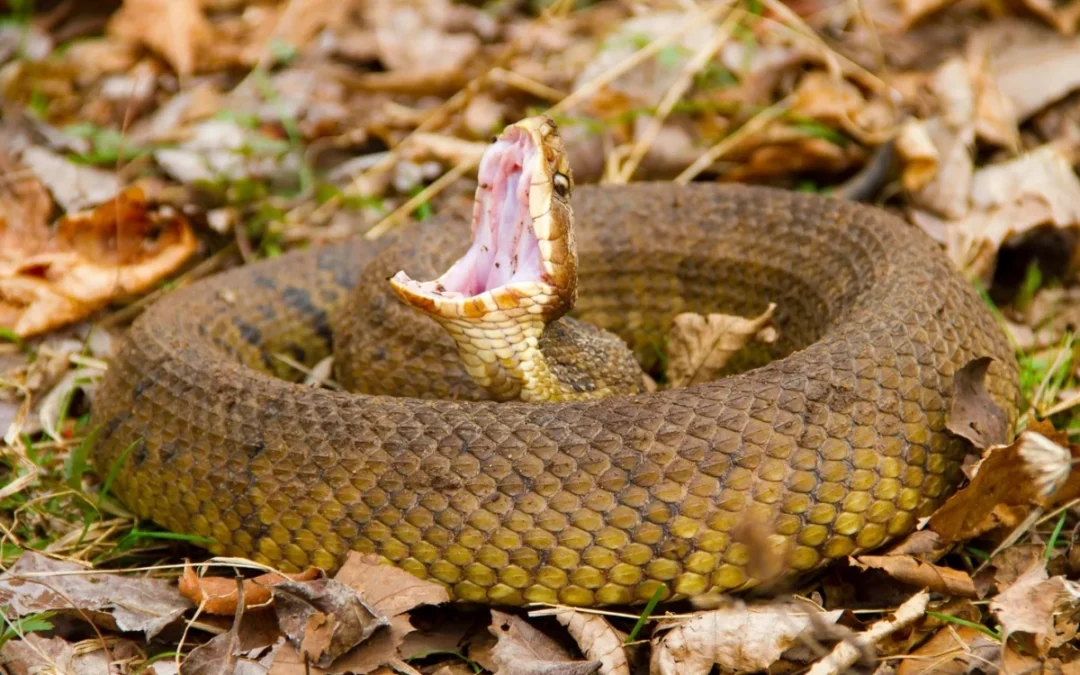
Water moccasins are pit vipers native to the Southeast and are found near most permanent water bodies in Georgia and Alabama.
What Is a Water Moccasin?
Water moccasins (Agkistrodon piscivorus) are venomous pit vipers native to the Southeastern U.S. Their range covers most of Georgia and Alabama, extending from southeastern Virginia south to Florida and west to East Texas. They’re semi-aquatic, meaning they’re equally at home in water and on land, and they thrive in warm humid climates.
Two subspecies are present in our service area:
- Northern cottonmouth (Agkistrodon piscivorus piscivorus): The dominant subspecies across Georgia, Alabama, Tennessee, and South Carolina. Darker coloring with less distinct banding as adults.
- Florida cottonmouth (Agkistrodon conanti, recently elevated to its own species): Found in extreme south Georgia and Alabama. Often slightly larger with more distinct facial markings.
Typical habitats include swamps, rivers, lakes, ponds, marshes, drainage ditches, slow-moving creeks, and the overgrown edges of any persistent water body. They’re occasionally found in suburban yards near ponds, retention areas, or wet drainage features.
Water Moccasin Identification
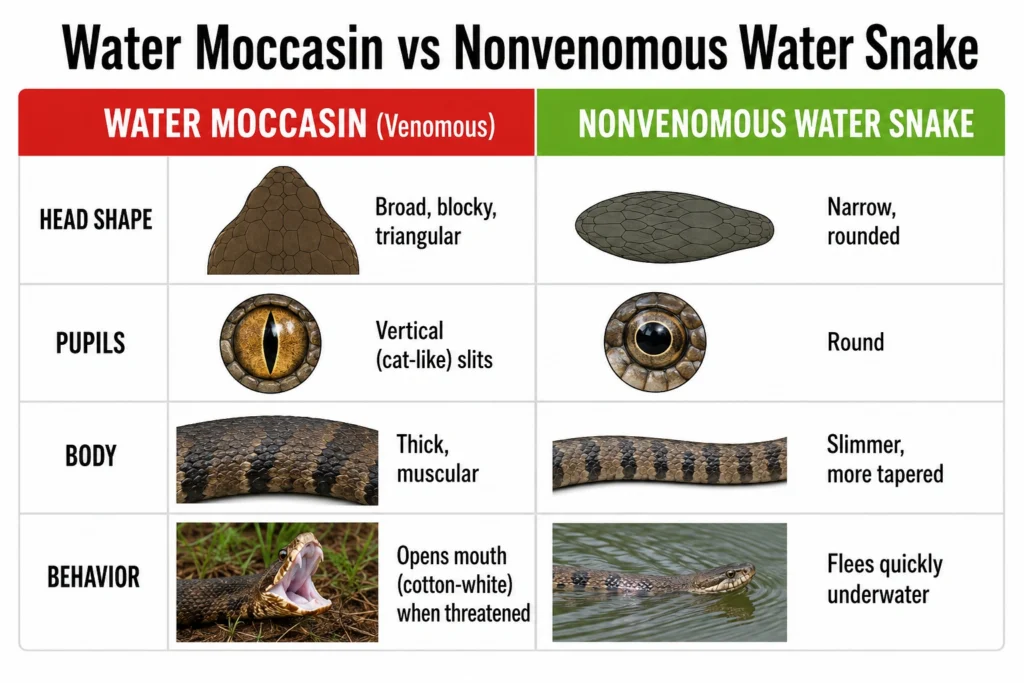
Four traits separate water moccasins from the nonvenomous water snakes they’re often confused with.
Physical Features
- Body shape: Thick, muscular, often visibly heavier than nonvenomous water snakes. Adults typically 2 to 4 feet long, occasionally over 5 feet.
- Color: Adults are usually dark olive, brown, or nearly black. Crossband markings are often faded or barely visible on older snakes. Juveniles are more distinctly banded with bright tail tips that fade with age.
- Head shape: Broad, blocky, distinctly triangular when viewed from above. Much wider than the neck. This is the single most reliable visual identifier.
- Mouth: Bright “cotton-white” mouth lining displayed when threatened (the source of the “cottonmouth” name).
- Pupils: Vertical and cat-like (not round). All pit vipers in the U.S. share this trait.
- Heat-sensing pits: Visible small pits between the eyes and nostrils on each side of the head.
Differences vs Nonvenomous Water Snakes
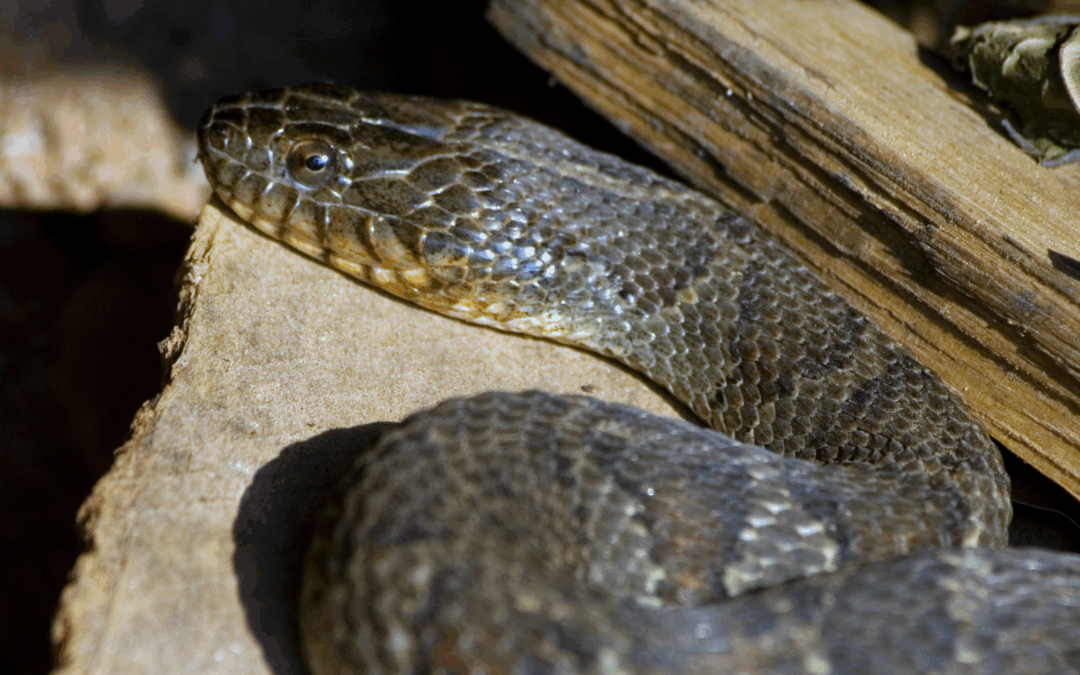
This is where misidentification causes the most unnecessary fear. Several harmless water snake species in the Southeast (especially the banded water snake, Nerodia fasciata, and the brown water snake, Nerodia taxispilota) are routinely killed because they’re mistaken for cottonmouths. The key differences:
- Head shape: Nonvenomous water snakes have narrow, rounded heads not much wider than the neck. Cottonmouths have wide, blocky, triangular heads.
- Pupils: Nonvenomous water snakes have round pupils. Cottonmouths have vertical slits.
- Body shape: Nonvenomous water snakes are slimmer and more tapered. Cottonmouths are thick and muscular.
- Behavior when threatened: Nonvenomous water snakes typically flee quickly underwater. Cottonmouths often stand their ground, coil defensively, vibrate the tail, and open the mouth to display the white lining.
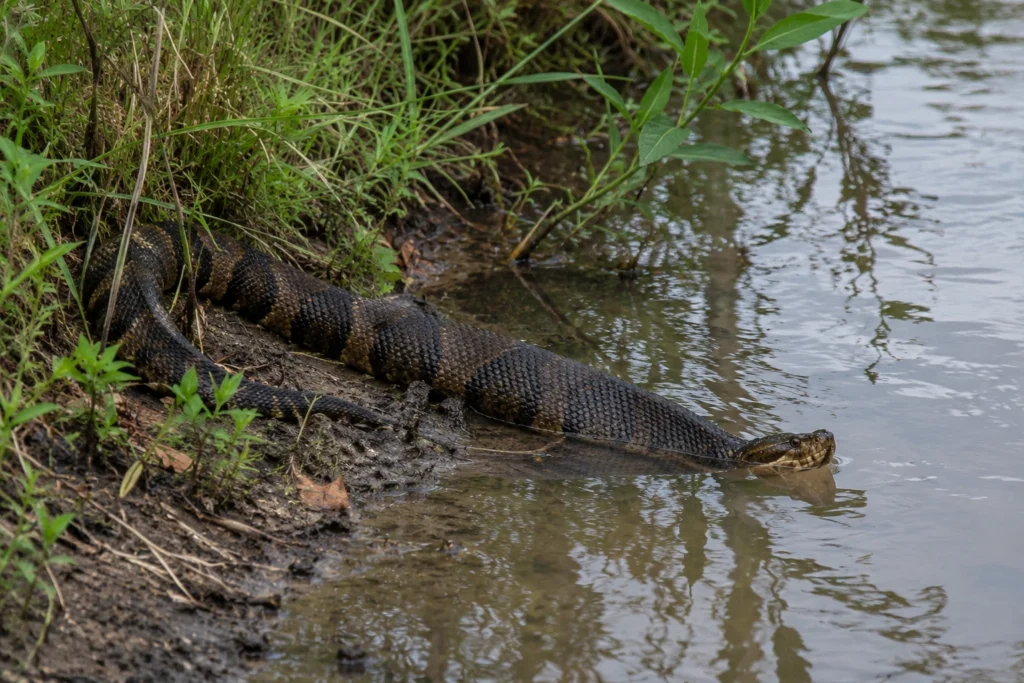
- Swimming style: Cottonmouths often swim with the head and most of the body visible above the water. Nonvenomous water snakes typically swim with only the head visible.
When in doubt, assume venomous and keep your distance. Identification at a distance is plenty.
Are Water Moccasins Aggressive?
This is one of the most exaggerated reputations in North American wildlife. Water moccasins are defensive, not predatory toward humans. They do not chase people. Studies tracking cottonmouth behavior consistently show they will hold ground when threatened, but they don’t pursue.
The defensive behavior that gets misinterpreted as aggression:
- Standing ground: Unlike many snakes that immediately flee, cottonmouths often stay put when approached. This is conservation of energy, not aggression.
- Open-mouth display: The cotton-white mouth opening is a warning (“I’m here, I’m venomous, back off”), not an attack signal.
- Tail vibration: Rattled tail against leaves can sound similar to a rattlesnake. Same warning function.
- Defensive striking: Will strike if cornered, stepped on, or directly handled. Bites occur almost exclusively in these scenarios.
Give a cottonmouth 6+ feet of distance and step around it, not toward it, and you almost certainly won’t be bitten.
How Dangerous Is a Water Moccasin Bite?
Venom and Medical Risk
Water moccasin venom is hemotoxic, meaning it affects tissue and blood circulation rather than the nervous system. Effects of a bite include:
- Immediate intense pain at the bite site
- Rapid swelling and bruising
- Tissue damage that can progress for hours or days without treatment
- In severe cases: blood-clotting issues, blistering, and tissue necrosis
- Systemic symptoms (nausea, weakness, low blood pressure) in moderate to severe envenomation
Death from a cottonmouth bite is rare in the modern era thanks to antivenom availability, but bites are medical emergencies that require immediate hospital treatment. Tissue damage from untreated bites can be permanent. Approximately 25% of cottonmouth bites are “dry bites” with no venom injected, but you cannot reliably tell at the time of the bite, so always seek emergency care.
First Aid for a Snake Bite
Current medical guidance (per CDC and major emergency medicine organizations) for any suspected venomous snake bite:
- Call 911 immediately. Don’t drive yourself. Don’t wait to see if symptoms develop.
- Keep the affected limb still and below heart level. Movement spreads venom faster through the lymphatic system.
- Remove rings, watches, and tight clothing from the affected limb before swelling sets in.
- Take a photo of the snake if you can do so safely from a distance. Helps medical providers confirm species. Do NOT try to capture or kill the snake.
- Stay calm and minimize movement until help arrives.
What NOT to do (these were old advice and are now known to make outcomes worse):
- Do not cut the bite or try to suck out venom.
- Do not apply a tourniquet.
- Do not apply ice or cold packs.
- Do not give the bite victim alcohol or caffeine.
- Do not try to capture the snake.
For authoritative reference on snake bite first aid, see the CDC’s venomous snake safety guidance.
Where You’re Most Likely to Encounter a Water Moccasin in the Southeast
- Swamp and marsh edges
- Slow-moving creeks and rivers, especially the muddy banks
- Pond and lake shorelines, particularly with overhanging vegetation
- Drainage ditches in rural and suburban areas
- Around boat ramps, docks, fishing piers, and fish-cleaning stations
- Yards with persistent standing water, water features, or proximity to wetlands
- Under or near woodpiles, debris piles, and dense ground cover near water
Water Moccasin Safety Tips for Southeast Homeowners
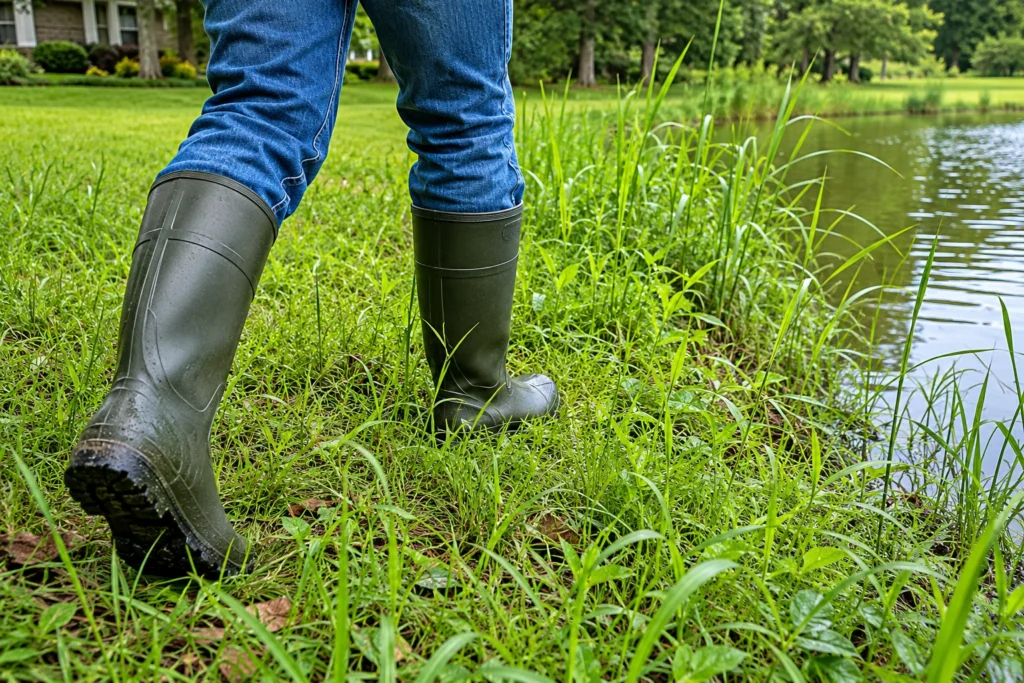
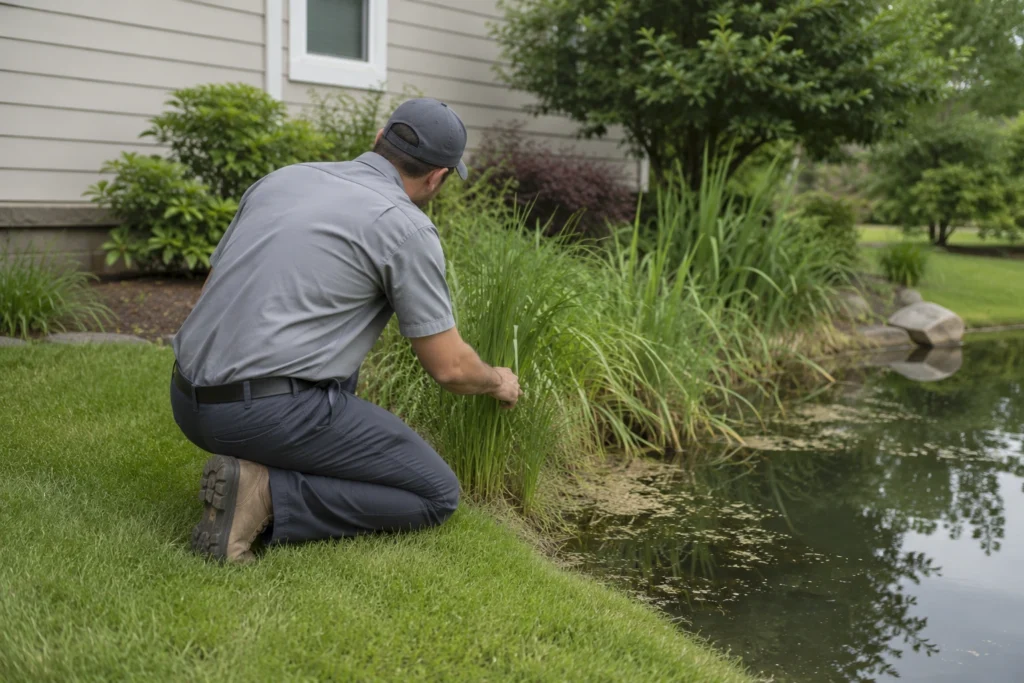
Tall boots, long pants, and visual awareness are the simplest snake-safety baseline for Southeast yards near water.
Avoiding Encounters
- Stay on cleared paths near water rather than walking through tall grass or dense underbrush.
- Avoid wading in murky water where you can’t see the bottom.
- Don’t reach under logs, rocks, or debris near water without looking first.
- Make noise as you walk near water (snakes feel ground vibrations and typically move away).
- Be especially cautious from late spring through early fall when snakes are most active.
- Check before stepping over logs or large rocks near water.
What to Wear Outdoors Near Water
- Tall waterproof boots (knee-high) when working in or near wetlands.
- Long pants tucked into boots.
- Avoid sandals or open-toe shoes near any water body.
- Carry a flashlight after dark and look before each step.
Yard Safety
- Remove brush piles, woodpiles, and debris that provide snake shelter.
- Keep grass trimmed short, especially around any water features.
- Clear vegetation around pond edges and drainage features.
- Eliminate rodent populations that attract snakes as a food source.
- Seal gaps in foundations, sheds, and outbuildings that snakes might enter.
Teaching Kids About Snake Safety
- Teach the rule: “If you see a snake, stop, back up slowly, and tell an adult.”
- Never try to pick up, touch, or kill a snake.
- Identify safe and unsafe play areas (no playing barefoot near ponds, creeks, or tall grass).
- For more general snake prevention strategies, see our home remedies to keep snakes away guide.
Water Moccasin Myths vs Facts
- Myth: Water moccasins chase humans. Fact: They don’t. They stand their ground, but they don’t pursue. Documented research shows zero cases of intentional cottonmouth pursuit of humans.
- Myth: All cottonmouth bites are fatal. Fact: With modern antivenom and prompt medical treatment, fatalities are extremely rare. Tissue damage is the more common serious outcome.
- Myth: You can identify them by color alone. Fact: Adult cottonmouths are often nearly solid dark color, easily confused with several harmless water snakes. Head shape, pupil shape, and behavior are more reliable identifiers.
- Myth: Cottonmouths can bite underwater. Fact: They can, technically, but bites in water are extremely rare. Most defensive behavior happens on land or while basking partially out of water.
- Myth: Killing a snake on your property prevents future encounters. Fact: Other snakes typically move into vacated territory. Habitat modification is far more effective than removal.
When to Call Professional Help
Professional wildlife or snake control is worth calling Northwest about if:
- You’ve confirmed a water moccasin on your property (especially repeat sightings).
- Snake sightings are happening near play areas, patios, pool decks, or other high-traffic zones.
- You need inspection and habitat modification to prevent repeated encounters.
- You’re managing a property with significant water features (ponds, retention areas, drainage ditches).
- Snake activity is accompanied by visible rodent activity (the food source that’s attracting them).
Professional snake services typically include identification, safe removal when needed, habitat modification (removing harborage, addressing rodent populations), and ongoing prevention recommendations. For broader snake prevention strategies, see our snake repellent guide.
(Spotted a water moccasin or seeing recurring snake activity? Schedule a free Northwest inspection and we’ll identify what’s around, address the conditions attracting them, and lay out a prevention plan.)
Frequently Asked Questions About Water Moccasins
Can water moccasins climb trees?
Yes, but rarely. Cottonmouths can climb low branches, especially overhanging water. They’re not arboreal hunters like rat snakes. Most encounters happen at ground level or in water. Snake sightings high in trees are far more likely to be rat snakes or other nonvenomous climbers.
Do water moccasins chase people?
No. This is one of the most persistent and inaccurate myths in Southeastern wildlife folklore. Cottonmouths are defensive, not predatory toward humans. They will hold their ground when threatened, but they don’t pursue. Most perceived “chasing” is actually the snake moving toward water (its escape route), which happens to be in the same direction as the person.
Are all cottonmouths dangerous?
All cottonmouths are venomous and warrant respect. About 25% of defensive bites are “dry bites” with no venom injected, but you can’t reliably tell at the time of a bite. Always treat any suspected cottonmouth bite as a medical emergency and seek immediate hospital care.
How common are water moccasin bites?
Bites are uncommon relative to encounter rates. Most cottonmouth sightings result in zero contact between snake and human. Bites occur almost exclusively in cases where the snake is stepped on, handled, or cornered. In Georgia and Alabama combined, fewer than 100 documented cottonmouth bites occur in a typical year, the vast majority non-fatal with proper medical care.
How do I tell a water moccasin from a harmless water snake?
Four traits: (1) head shape (cottonmouth = wide, blocky, triangular; nonvenomous = narrow, rounded), (2) pupils (cottonmouth = vertical slits; nonvenomous = round), (3) body shape (cottonmouth = thick and muscular; nonvenomous = slimmer), and (4) behavior (cottonmouth = stands ground, opens mouth, vibrates tail; nonvenomous = flees quickly underwater). When in doubt, keep your distance regardless.
Snake prevention is mostly about removing the conditions that bring them in: harborage, rodent food sources, and overgrown ground cover.
Schedule a Snake & Wildlife Inspection
If you’ve confirmed water moccasin activity, you’re seeing recurring snake sightings, or you have property features (ponds, drainage, dense brush) that attract snakes, Northwest’s team handles identification, habitat modification, and ongoing prevention. Most snake problems are really habitat problems, and habitat changes hold longer than removal alone.
About the Author
Anna V., Editorial Lead — Pest Education leads pest education content for Northwest Exterminating, working with senior technicians and service center managers across our Georgia, Alabama, Tennessee, and South Carolina service areas to translate field expertise into homeowner-friendly guides. The focus: accurate, regionally-specific answers to the pest questions Southeast homeowners are actually searching for.
Jul 21, 2022 | Georgia Blogs, Pest Control, Snake Control, Wildlife
By Anna Vaccaro, Editorial Lead — Pest Education · Last updated: April 2026
If you’ve spotted a snake coiled near your back steps or sliding through the mulch by your flower bed, the first question is almost always the same: How do I make sure that doesn’t happen again? At Northwest, we get asked about snake repellent almost every day during warm-weather months in Georgia, and the answer surprises most homeowners. Most sprays, powders, and home-remedy scents don’t do much. What does work is changing your yard so snakes stop choosing it in the first place.
Video Transcript
Snakes are usually after just two things. Food and a safe place to hide. If your yard offers either, they may stick around longer than you’d like. The good news, a few simple steps can make a big difference. First, reduce food and moisture. Keeping rodents and insects under control helps, and fixing leaks or standing water is key. Snakes are drawn to damp areas. Second, remove hiding spots. Trim grass, clear brush, and leaf piles. Elevate firewood and fill in old holes around your yard. Third, use natural deterrence. Plants like maragolds and lemongrass or scents like clove and cinnamon oil can help make your space less inviting. When you’re ready to call a professional for a peaceful home, feel free to reach out to our team at Northwest Exterminating.
This guide walks you through exactly that. We’ll break down what a real snake repellent strategy looks like in the Southeast, the seven natural methods that actually move the needle, the myths to skip, and how to know when a sighting means it’s time to call a pro.
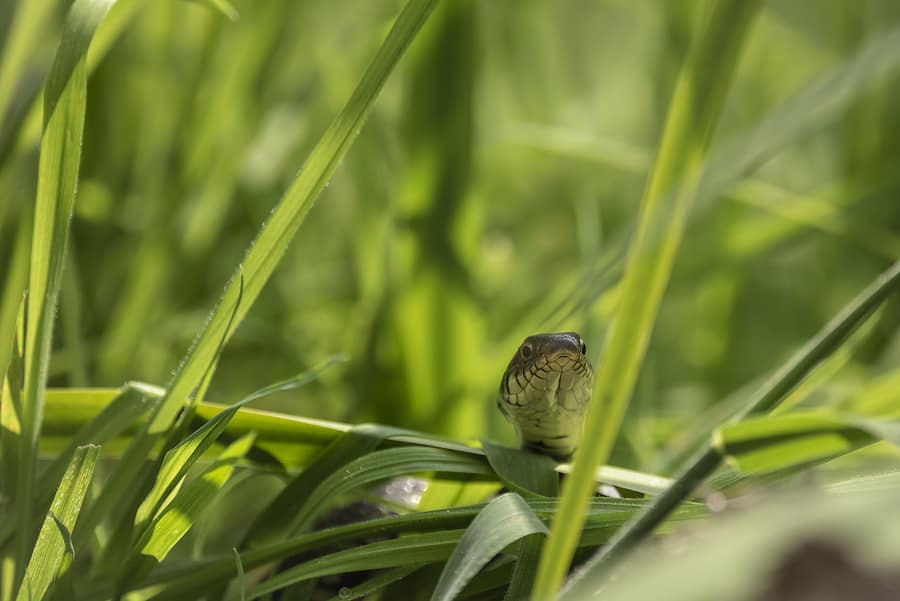
Most snakes you see in a Georgia yard are non-venomous and quietly help control rodents.
Can You Actually Repel Snakes Naturally?
Short answer: sort of. You can make your property a much less attractive place for a snake to hang out, but you can’t spray a scent line that a snake won’t cross. Here’s why that matters.
Snakes navigate the world with a specialized organ in the roof of their mouth called the Jacobson’s organ. It reads chemical cues in the air. That’s very different from how a mammal smells, and it’s the reason most of the “strong scent” tricks you see online underperform. A snake doesn’t process cinnamon oil or garlic the way we do. If there’s a rodent to chase or a warm crawl space to hide in on the other side of that scent, the snake keeps going.
The most effective natural snake repellent isn’t a product. It’s a habitat change. Take away food, shelter, and moisture, and snakes move on.
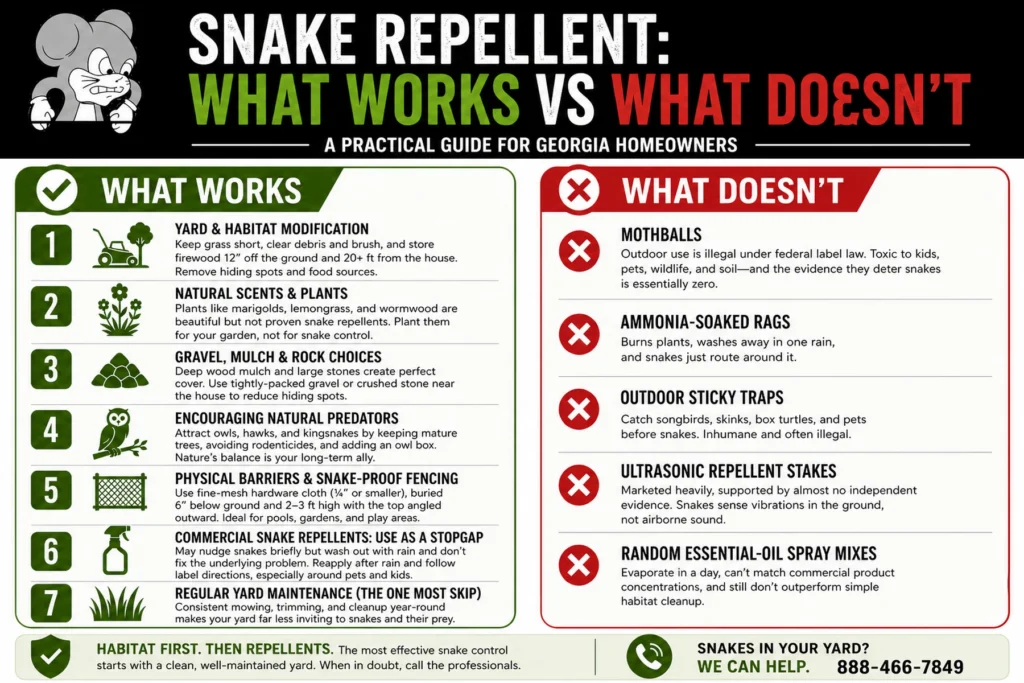
7 Natural Snake Repellent Methods That Actually Work
These are the seven moves that consistently reduce snake activity around Southeast homes. Use them together, not one at a time. Snake prevention works by stacking small changes.
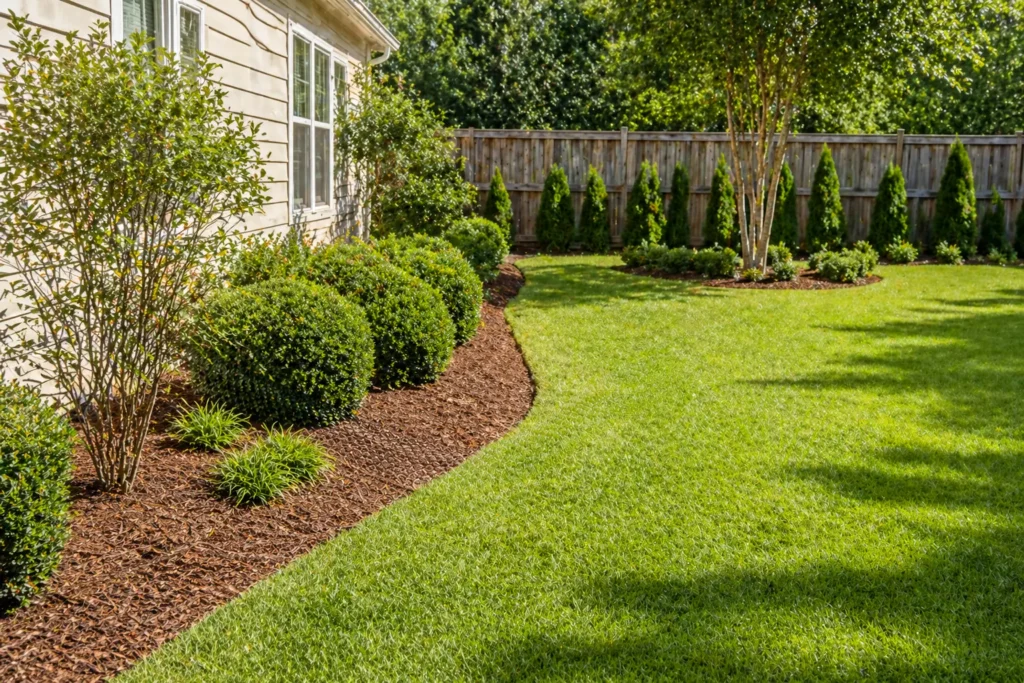
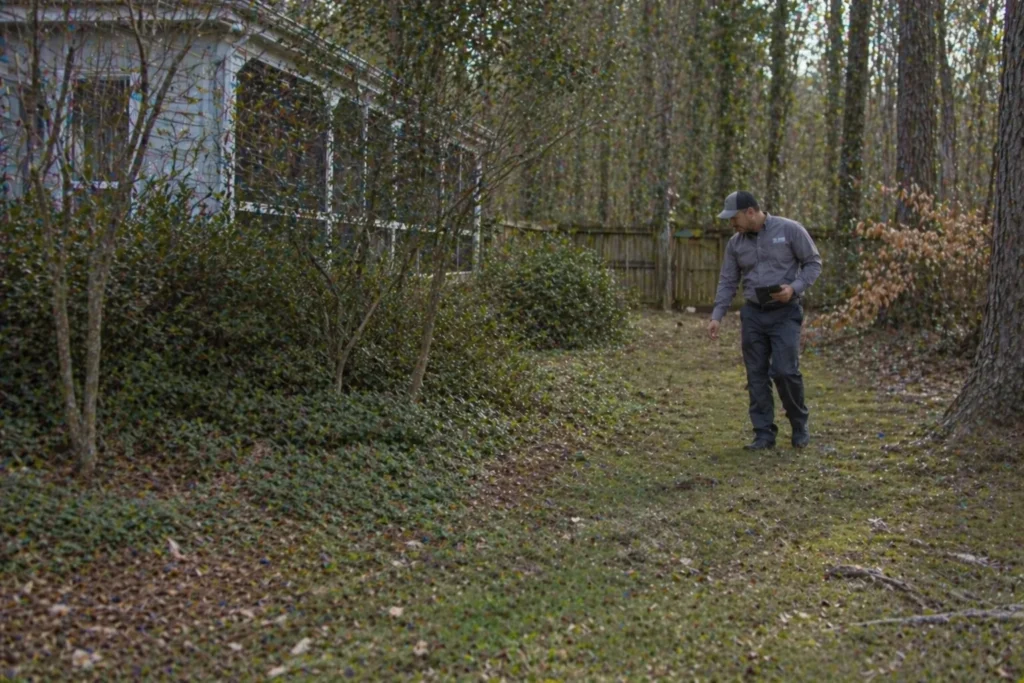
The yards we treat for repeat snake problems almost always share one thing: too many places for snakes to hide.
1. Yard & Habitat Modification
Snakes show up because something else is there first, usually rodents, frogs, or big insects. Cut off the buffet and the snakes stop visiting. Keep your grass short so snakes can’t cross the yard unnoticed. Clear tall grass along fence lines, brush piles, fallen branches, and leaf debris. Store firewood on a rack at least 12 inches off the ground and at least 20 feet from the house. Every pile of stuff in a Georgia yard is potential snake real estate.
2. Natural Scents & Plants
You’ve probably read that marigolds, lemongrass, or wormwood keep snakes out of a yard. They make a pretty border, but don’t count on them as a standalone snake repellent. Independent research on scent-based plant repellents is thin, and a snake that’s locked onto a mouse isn’t going to be turned back by a flower bed. Plant them for the garden, not for the reptile protection.
3. Gravel, Mulch & Rock Choices
Thick wood mulch and big decorative stones are exactly what snakes love: damp, dark, warm, and easy to slip under. If you’ve had repeat sightings along a bed line, swap the deep wood mulch closest to the house for tightly-packed gravel or crushed stone. The sharp, irregular surface is uncomfortable for snakes to cross and offers nowhere to burrow.
4. Encouraging Natural Predators
Owls, hawks, and kingsnakes are the original snake control crew in the Southeast. You can’t install them, exactly, but you can make your property more hospitable to them: keep mature trees, avoid broad-spectrum rodenticides that poison the food chain, and consider a simple owl box on the back of the property. This won’t clear an active snake problem overnight, but over a season it tips the balance.
Owls, hawks, and kingsnakes are the original snake-control crew in the Southeast.
5. Physical Barriers and Snake-Proof Fencing
If you live backed up to a field, creek, or wooded lot, which is a very common setup in the Georgia and Alabama suburbs we serve, a physical barrier is one of the few methods that physically stops a snake. Snake-proof fencing uses fine-mesh galvanized hardware cloth (quarter-inch or smaller), buried at least 6 inches below grade and rising 2 to 3 feet up, with the top angled outward. It’s not right for an entire property line, but it’s excellent around a pool deck, a play area, or a garden gate.
6. Commercial Snake Repellents: Do They Work?
Walk into any hardware store and you’ll see granular and liquid snake repellents on the shelf. Most use cinnamon oil, clove oil, sulfur, or naphthalene derivatives. The research on them is mixed at best. They can nudge a snake off a specific path for a short window of a few days after application, but they wash out with rain, fade in heat, and do nothing to address the reason the snake came in the first place. If you use one, treat it as a stopgap around a problem area, reapply after every rain, and read the label carefully if you have pets or small kids.
7. Regular Yard Maintenance (The One Most People Skip)
The yards we see with recurring snake problems almost always share one thing: they look great once a month and neglected for the three weeks in between. Snake repellent is really a maintenance habit. Walk the property every couple of weeks in spring and summer. Trim back anything touching the foundation. Pick up fallen fruit under pecan or fig trees (rodents follow fruit; snakes follow rodents). Check for new burrows along the fence line. Ten minutes of weekly attention beats a hundred dollars of repellent.
(If snakes keep showing up after you’ve tightened up the yard, it’s usually a sign something bigger is going on underneath, often rodents in a crawl space or moisture you can’t see. Schedule a free Northwest inspection and we’ll walk the property with you.)
What Doesn’t Work — Snake Repellent Myths to Skip
A few “classic” home remedies for keeping snakes away are worse than ineffective. Some are illegal, unsafe for pets, or actively bad for your soil. Save your weekend.
- Mothballs. Outdoor use of mothballs as a snake repellent is actually against federal label law. Naphthalene and paradichlorobenzene are toxic to kids, pets, wildlife, and soil, and the evidence they deter snakes is essentially zero.
- Ammonia-soaked rags. Burns plants, washes away in one rain, and snakes just route around it.
- Outdoor sticky traps. They catch songbirds, skinks, box turtles, and sometimes the family cat before they catch a single snake. Inhumane and often illegal.
- Ultrasonic repellent stakes. Marketed hard, supported by almost no independent evidence. Snakes rely on vibration through the ground, not airborne sound.
- Random essential-oil spray mixes. Evaporate in a day, can’t match the concentration a commercial product uses, and still don’t outperform simple habitat cleanup.
Habitat changes outperform every commercial snake repellent on the market.
Snake Prevention Tips for Homes & Yards
A good snake repellent plan for your home isn’t just yard work. It’s also sealing the house itself. Two-thirds of the “snake in the garage” or “snake in the laundry room” calls we get trace back to the same kinds of openings that let rodents in.
- Walk the foundation and seal gaps around utility penetrations, dryer vents, and brick weep holes with hardware cloth. Never use expanding foam alone, because snakes push right through it.
- Screen every crawl space vent with galvanized ¼-inch mesh. Replace any torn screens. This alone will stop most garage and crawl-space snake sightings.
- Re-caulk door thresholds and replace worn weatherstripping, especially on garage side doors and basement hatches.
- Fix leaky outdoor faucets, redirect gutter runoff away from the foundation, and don’t over-water the lawn. Moisture pulls in frogs and insects, which pull in snakes.
- Treat rodent control as snake control. If you have mice in the crawl space, snakes are just the next chapter. Take care of the rodent problem with professional rodent control and the snake issue often resolves itself.
When to Call a Professional for Snake Control
Most snakes in Georgia and Alabama yards are harmless, and actually beneficial. A black racer or garter snake eating the mice by your shed is doing you a favor. But there are three situations where it’s time to stop DIY-ing and pick up the phone:
- Venomous species on the property. The Southeast is home to Copperheads, Cottonmouths (Water Moccasins), Timber Rattlesnakes, Pigmy Rattlers, and along the coast, Eastern Diamondbacks and Coral Snakes. If you can’t confidently identify what you’re seeing, back up and call.
- A snake inside the house. Inside the living space, garage, crawl space, or attic is never a “just wait it out” situation. It means an entry point that needs finding and sealing.
- Repeat sightings in the same spot. More than two sightings in the same part of the yard within a season means there’s a harborage or food source you haven’t found yet. That’s what a professional inspection is for.
Snakes in the Southeast — What You’re Likely Seeing
Knowing what lives in a typical Georgia or Alabama yard takes a lot of the panic out of a sighting. The vast majority of what we encounter is non-venomous. The UGA Extension guide to Snakes of Georgia is the best free resource for identifying any snake you see on the property.
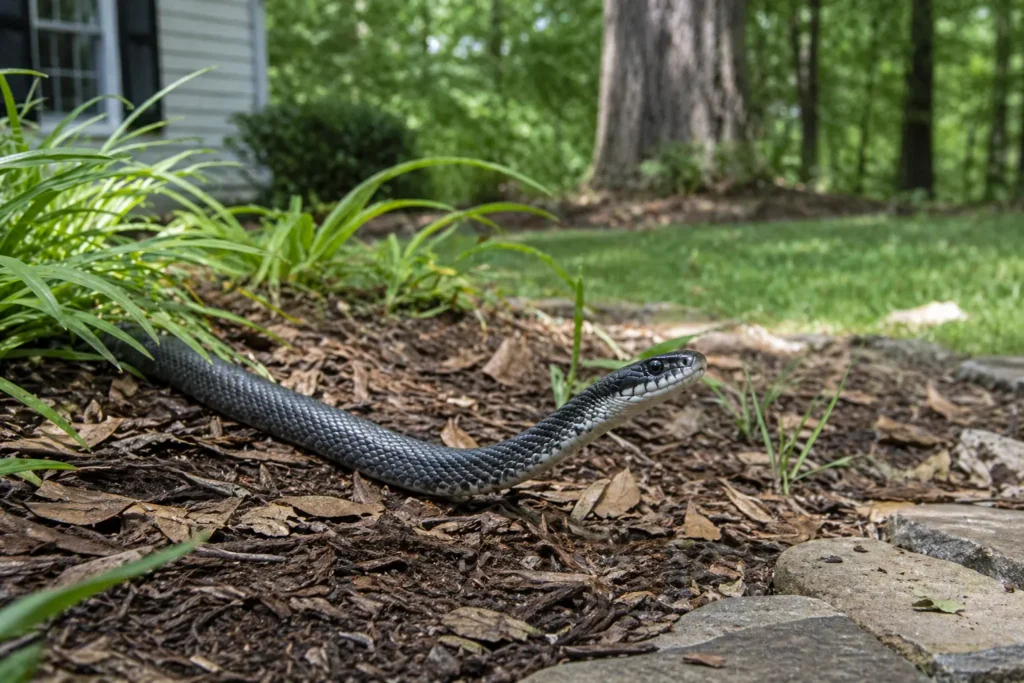
- Eastern Rat Snake (Black Rat Snake). Long, black, often climbs into shrubs or attics chasing rodents. Non-venomous and one of the best natural rodent controls you can have.
- Black Racer. Slender, fast, jet-black. Harmless to humans, feeds on insects, lizards, and small rodents.
- Garter Snake. Small, striped, very common near gardens and water features.
- Kingsnake. Non-venomous, and remarkably, it actually eats venomous snakes. Leave it alone if you can.
- Copperhead (venomous). Tan and dark-brown hourglass banding. Hides beautifully in pine straw and leaf litter, which is the cause of most venomous bites in the region. Call a pro.
- Cottonmouth / Water Moccasin (venomous). Thick-bodied, found near water. Will stand its ground. Call a pro.
Peak activity in the Southeast runs April through October, with two noticeable spikes: early spring (emerging from brumation) and late summer (looking for food before the cooler months).
Frequently Asked Questions About Snake Repellent
Do snake repellents really work?
Commercial snake repellents offer limited, short-term help at best, and most scent-based home remedies don’t work at all. The most reliable “repellent” is removing what attracts snakes in the first place: rodents, tall grass, standing water, and hiding places around the foundation.
What scent keeps snakes away?
Snakes may avoid strong-smelling compounds like cinnamon oil, clove oil, and cedarwood in close range, but these won’t stop a snake that’s tracking prey. Use scents as a supplement to habitat cleanup, never as the whole plan.
Are snake repellents safe for pets?
It depends on the active ingredient. Many granular snake repellents use essential oils with reasonable safety profiles, but always check the label. Do not use mothballs or ammonia as a snake repellent. Both are genuinely toxic to dogs, cats, and children.
How do I keep snakes out of my yard permanently?
There’s no one-time fix. Long-term snake control in a Southeast yard comes from stacking three things: consistent yard maintenance, rodent control inside and around the home, and physical snake-proof fencing around the areas you most want protected (play areas, pool decks, garden entries).
When should I call professional snake control?
Call right away for any venomous snake, any snake inside the home, or repeat sightings in the same part of the yard. Northwest Exterminating handles inspection, humane removal, exclusion, and the underlying rodent and moisture issues that drive most snake problems.
Northwest’s wildlife team handles the entry points and rodent issues that drive most snake problems.
Ready to Keep Snakes Out of Your Yard for Good?
If you’ve seen a snake on your property more than once this season, the odds are good there’s a rodent or moisture issue feeding the problem. Our team has been clearing snake problems out of Georgia and Alabama homes for decades, and we handle the thing that caused it, not just the snake you saw.
About the Author
Anna Vaccaro, Editorial Lead — Pest Education leads pest education content for Northwest Exterminating, working with senior technicians and service center managers across our Georgia, Alabama, Tennessee, and South Carolina service areas to translate field expertise into homeowner-friendly guides. The focus: accurate, regionally-specific answers to the pest questions Southeast homeowners are actually searching for.