Jan 24, 2014 | Uncategorized
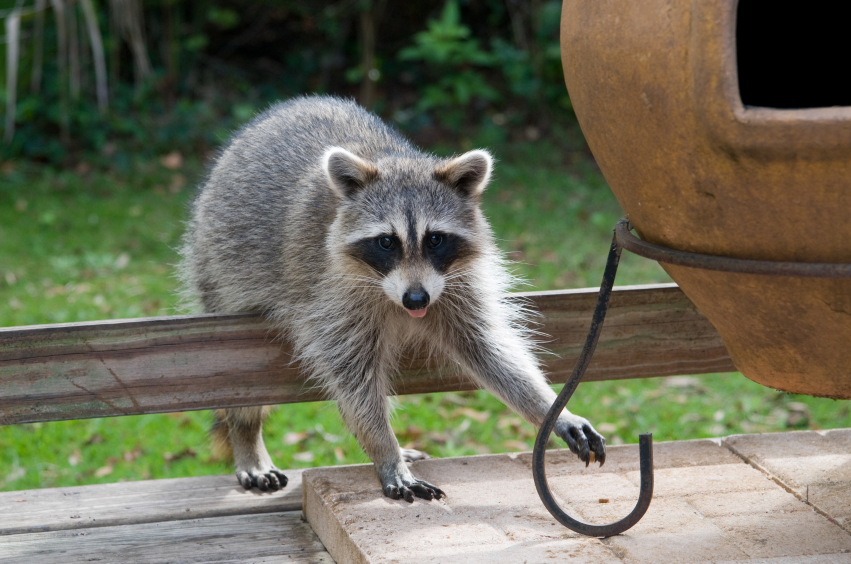
If you are hearing scratching in your attic at night there is a good chance that you could have a raccoon. If you search your attic in the daytime you will probably not find the raccoon. Raccoons are nocturnal creatures found throughout the US but are more common in wooded areas.
Raccoons do not hibernate but they do become inactive in the winter months by seeking shelter…hence why they are in your attic. Raccoons can cause damage to structures as they enter your attic or chimney. They can cause a huge mess by raiding garbage cans in search of food and will even destroy gardens by running through and/or eating crops. In addition to the property damage that they cause, they also carry rabies.
Raccoon Prevention:
To prevent raccoons from entering your home make sure that all possible entrances around the attic and roofline are sealed. Repair broken vent covers, loose siding or shingles, and install mesh covers or caps over chimneys to prevent raccoons from entering. Make sure that all outside trash is in an animal proof, tightly sealed garbage can.
If you believe that you may have raccoons in your attic, call Northwest Exterminating for raccoon removal.
Mar 18, 2013 | Uncategorized
Northwest’s Wildlife Services Team specializes in the exclusion, removal, and control of animal nuisances. Among our specialties are squirrels, rodents, raccoons, opossums, bees, armadillos, and chipmunks. An important wildlife service in the coming warm months is our snake removal! Our Wildlife team uses a Green product that is used to deter snakes. We also spend a great deal of time educating the customer on snakes.
Georgia is among the states with the highest biodiversity of snakes in the U.S. with 43 different species. They are located anywhere in Georgia from the mountains in the north to the barrier islands along our eastern coast. Below we have pictures and descriptions of the most common venomous snakes. If you spot one of these, call our Wildlife Services Team at 770.436.3362 to get them off your hands, or better yet, remove them very far away from your hands!
Copperhead

Copperhead
Copperheads are fairly large – anywhere from 2 to over 3 feet long! They have brown, triangular heads and elliptical pupils. You likely won’t want to get close enough to be sure, but they have two tiny dots at the center of the top of the head. More distinguishing features include yellow tails for juvenile snakes, and the brown bands that run along their body are in a distinct hourglass shape. They are found mostly in the forested areas of Georgia and South Carolina.
Cottonmouth/Water Moccasin
Cottonmouth
Water Moccasin
Just like copperheads, cottonmouths have large, triangular heads with elliptical pupils. They get the name water moccasin from their semi-aquatic nature and are likely to be found by mostly all types of freshwater habitats. These are more difficult to identify by appearance because they have a wide range of colors but tend to feature colors that will camouflage them into their habitats.
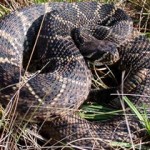
Eastern Diamondback Rattlesnake
Eastern Diamondback Rattlesnake
Eastern diamondbacks are among the largest of 32 species of rattlesnakes, ranging anywhere from 2.75 feet to 6 feet long. They have large, broad heads with two light lines on their faces. These are easily recognized by their brown diamonds, surrounded by lighter colored brown, tan or yellowish scales. They can be located anywhere from the southern part of North Carolina, but especially in South Georgia and Florida. They like to be in drier, sandy or low cut grass areas and tend to avoid wetter areas, though they are great swimmers and even travel through saltwater!
Canebrake/Timber Rattlesnake
Canebrake-timber rattlesnake
These snakes tend to range from about 3-5 feet in length and are usually gray with a pink, yellow, orange or brown stripe running along their back. They have solid black tails and black chevrons along the back and sides of their body with the point of the (V) pointing forward. They are found in most of the eastern United States, but are somewhat absent from Florida. They can be found in a wide range of areas, but are least likely to be found in highly urbanized or residential areas.
Pigmy Rattlesnake
Pigmy rattlesnake
This rattlesnake is on the smaller side, usually coming in at under 2 feet in length. This snake has 9 large scales on the top of it’s head and a tiny rattle that can rarely be heard. They have a row of mid-dorsal spots and a bar from the eye to their mouth that ranges from black to brownish. The name is deceptive as they can be gray, tan, lavender, orange, red, or even black. These are mostly located from central Georgia up throughout South Carolina. They also like to be near water sources like creeks, marshes, and swamps.
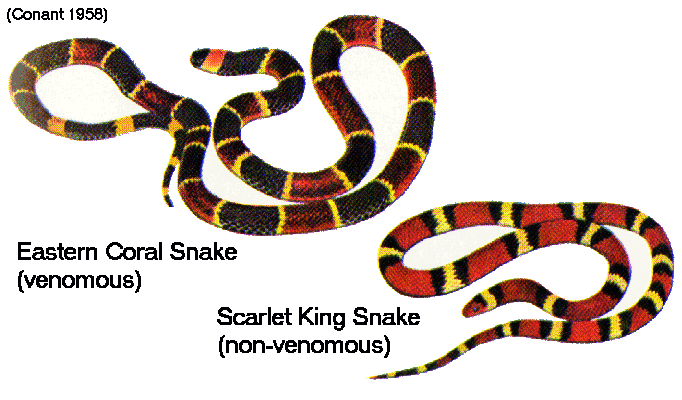
Eastern Coral Snake
Coral Snake
“Red on yellow, kills a fellow. Red on black, friend of Jack.” These snakes are sometimes up to 4 feet in length with smooth heads with a bright body pattern of black rings in which the red and yellow rings touch each other. These are sometimes confused with king snakes, but these snakes only have the red touching the black rings and are not venomous. These snakes are found all the way from Louisiana to Florida, where they are most prevalent. They are rarely spotted because they hide under ground and spend only a limited time crawling above ground. Unfortunately, because of these secretive habits, coral snakes tend to persist in suburban areas.
Melissa Brown
[email protected]
Sources:
http://georgiawildlife.com/node/497
https://uga.edu/srelherp/snakes/index.htm
http://srelherp.uga.edu/snakes/pics/agkcon210.jpg
http://srelherp.uga.edu/snakes/pics/agkpis210.jpg
http://srelherp.uga.edu/snakes/pics/agkpis4.jpg
http://srelherp.uga.edu/snakes/pics/croada210.jpg
http://srelherp.uga.edu/snakes/pics/crohor3.jpg
http://srelherp.uga.edu/snakes/pics/sismil210.jpg
http://www.petmd.com/sites/default/files/coral_snake.gif
Apr 6, 2012 | DIY, DIY Pest Control, Pest Control
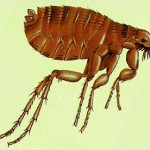
It is a common misconception that if you don’t have animals in your home that you can’t get fleas…FALSE. Fleas can be an issue in homes both with and without pets. They often attach themselves to rabbits, skunks, possums, and other rodents or wildlife that can be found living in wooded areas around a structure. Their 6”-8” vertical jump gives them the ability to attach themselves to humans and animals.
The thought of fleas creates a sense of uneasiness…and with good reason; fleas can carry several diseases like plague, tapeworm, and murine typhus that effects humans and pets alike. Flea prevention is much easier and less expensive than flea treatment.
Flea Prevention Tips:
- Clean your home regularly – Regular cleaning prevents fleas and many other pests from being attracted to your home. Make sure that spills and crumbs are cleaned up quickly, vacuum floors and upholstery*, and wipe down counters and furniture. Regular maintenance will make a huge difference against pests. (*Immediately empty, seal, remove, and dispose of the vacuum bag outdoors for your trash provider to retrieve.)
- Wash and treat pets – Bathe your pets on a regular basis. Wash any bedding the pet is allowed to sleep on. Treat your pets with flea prevention by taking them to your veterinarian, the groomer, or using over the counter medication. When cleaning, special attention should be paid to areas where pets often spend time.
- Shampooing carpet – Shampooing carpet can be more beneficial than vacuuming alone.
- Keep out wild animals – Wild animals such as rodents and opossums should be prevented from entering the structure and appropriately trapped.
- Wear light colors when outdoors – Wearing light colors enables you to spot fleas more easily.
- DEET – Apply DEET, an insect repellant, when outside.
- Make a fashion statement – Wear long pants and hiking boots when you are outside. It is also best to tuck pant legs into your socks. A look that your neighbors will surely follow!
Do it yourself flea treatments can be effective. However, we would like to warn you that flea exterminating is a difficult task and more often than not should be done by a professional exterminating company like Northwest Exterminating. When getting rid of fleas yourself, keep in mind that fleas can lay up to 50 eggs per day. Only 5% of the flea population is on your dog or other household pets, the rest have fallen off in and around your home.
DIY Flea Treatments:
Disclaimer: Northwest Exterminating does not encourage the use of the following treatments. We strongly recommend that all instructions are carefully followed on packaging of the following products and hold no liability for the following DIY treatments. Please contact a doctor, veterinarian and a professional pest control company before trying any of these treatments.
- Borax powder – Sprinkle borax powder on your carpet (always do a test patch before treating your whole carpet) and let sit for approximately 24 hours. Vacuum and immediately seal and dispose of vacuum bag. Repeat until fleas are gone.
- Water & Dish Soap – Put ½”-1” of water in shallow dish with a squirt of liquid dish soap. Put the dish directly under a lamp or some other form of light. The fleas are drawn to the light and heat which causes them to jump in the water. The soap makes it difficult for the fleas to move and they will eventually drown. Do this for several days until there are no new fleas found in your dish. Continue for a few days to make sure they are gone. Placing several soap and water dishes around the home where fleas are suspected gives you a better chance of getting rid of the fleas faster.
If you have tried DIY flea control methods without any luck, a pest control professional is your best option. A good exterminating company will be knowledgeable about flea prevention and treatment and should treat your home until fleas are gone.
If you’re looking for flea control in the Atlanta, Savannah, Nashville, or Columbus areas Northwest Exterminating is your best choice. Visit us at callnorthwest.com or call at 888.466.7849
Have you tried any of these DIY flea treatments?
Additional links:
https://www.callnorthwest.com/2011/08/facts-about-ticks-and-fleas/
https://www.callnorthwest.com/2011/06/dog-fleas/