Apr 12, 2013 | Uncategorized
Why Should I Aerate My Lawn?
Just like any living being, lawns need TLC too. Throughout the seasons, climates, and general wear and tear, lawns can become damaged. The ground gets hard and compacted, not allowing water and nutrients to get through. This can make for an unhealthy lawn.
Aerating can be just what your lawn needs to allow it to “open back up” and be able to receive its water and nutrients again. Aerating consists of inserting holes into the lawn for better water and nutrient absorption, and eliminating thatch (organic and non-organic debris that settles between the green and the soil). All of this build up makes the soil hard and compacted. Aerating will loosen the compacted soil and allow your grass to grow faster and thicker.
Aeration will make your lawn treatments more effective. Oxygen, fertilizer, water, and other nutrients will be better absorbed.
When is the Best Time to Aerate?
It is recommended that cool season grass be aerated in the fall. Warm season grass should be aerated in spring or summer.
For more information on aeration and other lawn care services, contact the professionals at Northwest . We will come out and do a FREE lawn care analysis of your lawn and work with you to create a customized lawn care program that is right for your yard.
Apr 10, 2013 | Uncategorized
Everyone knows that warmer weather, mixed with a little rain and lots of sunshine makes for a spring full of bloom and growth. However, it may not be as common knowledge that, just like plants, insect population growth responds to certain types of weather, while being discouraged by some other weather patterns. In particular, temperature and moisture have quite an effect, especially during the warm and dry weather months of April, May, and June.
Temperature has such a significant effect because insects are poikilothermic, which means cold-blooded. Cold-blooded animals are unable to regulate their body temperature, so the environmental temperature affects their internal temperature. Certain insects develop rapidly when environment temperatures are in the 85-90 degree range. Development alone is not the only aspect of insect life affected by temperature, but also insect behavior such as flight, movement, reproduction and feeding. Extreme temperatures, whether very hot (> 120 degrees Fahrenheit) or extremely cold (< 32 degrees Fahrenheit) makes insect growth and behavior restricted and is often deadly.
Moisture is important in a way that most people don’t expect. Humidity itself affects insect development, because low humidity can make it difficult for an insect to regulate it’s water loss. Alternatively, too much moisture, such as excessive rainfall or winter storms, can damage insects. The amount of moisture in an insect’s environment is particularly important for those who depend on crops as their food supply. Cold, wet moisture extremes can also lead to disease, slow growth rates and disturb feeding patterns.
Source
Melissa Brown
[email protected]
Apr 10, 2013 | Uncategorized
Everyone knows that warmer weather, mixed with a little rain and lots of sunshine makes for a spring full of bloom and growth. However, it may not be as common knowledge that, just like plants, insect population growth responds to certain types of weather, while being discouraged by some other weather patterns. In particular, temperature and moisture have quite an effect, especially during the warm and dry weather months of April, May, and June.
Temperature has such a significant effect because insects are poikilothermic, which means cold-blooded. Cold-blooded animals are unable to regulate their body temperature, so the environmental temperature affects their internal temperature. Certain insects develop rapidly when environment temperatures are in the 85-90 degree range. Development alone is not the only aspect of insect life affected by temperature, but also insect behavior such as flight, movement, reproduction and feeding. Extreme temperatures, whether very hot (> 120 degrees Fahrenheit) or extremely cold (< 32 degrees Fahrenheit) makes insect growth and behavior restricted and is often deadly.
Moisture is important in a way that most people don’t expect. Humidity itself affects insect development, because low humidity can make it difficult for an insect to regulate it’s water loss. Alternatively, too much moisture, such as excessive rainfall or winter storms, can damage insects. The amount of moisture in an insect’s environment is particularly important for those who depend on crops as their food supply. Cold, wet moisture extremes can also lead to disease, slow growth rates and disturb feeding patterns.
Source
Melissa Brown
[email protected]
Apr 8, 2013 | Uncategorized
Monday, April 1, 2013
This April, the National Pest Management Association encourages homeowners to take precautions against common pests
FAIRFAX, VA – The National Pest Management Association (NPMA) celebrates April as National Pest Management Month, an observance that’s been taking place for more than 30 years to recognize the pest management industry for its commitment to the protection of public health and property from common household pests.
“Whether it’s rodents, ants, termites, bed bugs or cockroaches, pest professionals play an important role in preserving our quality of life,” said Missy Henriksen, vice president of public affairs for the NPMA. “We’d like to recognize these men and women for all they do to keep our families and homes safe from unwanted pests not just during National Pest Management Month, but year-round.”
This April, homeowners are reminded to pest-proof their home in preparation for the upcoming pest season. NPMA experts recommend the following tips:
- Seal cracks and holes on the outside of the home including entry points for utilities and pipes.
- Repair fascia and rotted roof shingles.
- Replace weather-stripping and repair loose mortar around the foundation and windows.
- Keep tree branches and shrubbery well trimmed and away from the house.
- Store fire wood at least 20 feet away from the house and five inches off the ground.
- Eliminate sources of standing water around the house, including birdbaths and in clogged gutters.
- Keep basements, attics and crawl spaces well ventilated and dry.
- Keep kitchen counters clean, and store food in sealed containers.
- Store garbage in sealed containers and dispose of it regularly.
- Avoid leaving pet’s food dishes out for long periods of time.
“As the weather continues to get warmer, pests will begin to emerge from their overwintering sites and look for food indoors. National Pest Management Month comes at the perfect time to make pest-proofing a priority to prevent an infestation during the spring and summer seasons,” added Henriksen.
For more information on National Pest Management Month or for information on common household pests, please visit Pestworld.org.
The NPMA, a non-profit organization with more than 7,000 members, was established in 1933 to support the pest management industry’s commitment to the protection of public health, food and property.
Source
Apr 5, 2013 | Uncategorized
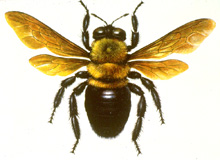
 Carpenter bees are often mistake for bumble bees because of their similarity in size and color.
Habits
- Often found under decks or porch railings and under the eaves of a house.
- Make nests by tunneling into wood.
- Leave a trail of sawdust as they discard of the wood to build partitions within the tunnels.
- Feed on plant nectar, not wood.
Threats
- Homes with wooden decks, eaves, or other areas of exposed wood are likely targets for carpenter bee damage.
- Males do not have stingers but can be aggressive to other bees, animals, or people near the nest.
- Females can sting but rarely do unless they are agitated.
Prevention
- Treat or paint all exposed wood surfaces.
- Each nest hole should be treated individually if bees are inside.
- Seal or paint nest holes if bees are not inside.
Other Pests to Look Out For:
For more information on carpenter bees you can visit our PEST ID page or call Northwest Exterminating at 888.466.7849.