Sep 20, 2024 | Pest Control
Pest control is an essential part of maintaining a clean and safe home, especially when faced with recurring pest problems. When unwanted pests invade, the first instinct for many homeowners is to search for quick and effective solutions. For some, this means tackling the issue themselves with do-it-yourself (DIY) pest control methods, while others prefer to call in professional pest control services.
Both approaches come with their own advantages and drawbacks, and understanding them can help you make an informed decision about which method works best for your specific pest problem. In this article, we will explore the pros and cons of DIY pest control and professional pest control, highlighting factors like cost, effectiveness, safety, and long-term results.
The Pros of DIY Pest Control
1. Cost-Effectiveness
One of the biggest advantages of DIY pest control is the potential cost savings. Professional pest control services can come with significant fees, which can add up over time. Many homeowners prefer to buy pest control products and handle the issue themselves, believing it will save money in the long run.
DIY pest control products, such as sprays, traps, and bait systems, are often available at affordable prices at local hardware or home improvement stores. Additionally, online retailers provide a wide variety of pest control solutions, making it easy to find what you need at a reasonable cost.
2. Immediate Action
When you spot pests in your home, immediate action is often necessary to prevent further damage or infestation. DIY options allow homeowners to take action right away without waiting for a professional service to arrive.
With DIY pest control solutions readily available in stores or online, you can quickly eliminate pests like ants, spiders, or cockroaches as soon as you notice them.
3. Convenience
Handling pest control yourself offers the convenience of addressing the problem on your own schedule. You can apply treatments at any time, without needing to coordinate appointments with a pest control company.
For small, isolated pest problems, DIY methods are usually sufficient and allow homeowners to manage minor infestations with ease.
4. Control Over Methods
For homeowners who are environmentally conscious or prefer natural alternatives, DIY pest control provides greater control over the types of products used. You can choose non-toxic or organic pest control products if you’re concerned about the chemicals found in conventional pesticides.
This flexibility ensures that you are using methods that align with your personal preferences and household safety standards.
The Cons of DIY Pest Control
1. Limited Knowledge and Experience
One major drawback of DIY pest control is that most homeowners lack the experience and expertise of professional pest control technicians. Identifying the exact pest and knowing the most effective way to eliminate them requires specialized knowledge. For example, a termite problem is far more complex than an ant infestation, and using the wrong products or methods can make the situation worse.
Without proper training, DIY solutions may only provide temporary relief from a pest problem rather than a long-term solution. In more serious cases, pests may return or even become resistant to certain treatments.
2. Safety Concerns
Many over-the-counter pest control products contain chemicals that can be harmful to humans, pets, and the environment if not used correctly. Misuse or overapplication of these products can lead to health risks, including respiratory issues or skin irritations.
Professional pest control services are well-versed in handling hazardous substances and take proper precautions to ensure the safety of your household. DIY methods, on the other hand, may expose you and your family to unnecessary risks if instructions aren’t followed precisely.
3. Effectiveness
While DIY pest control solutions can be effective for minor issues, they often fall short when dealing with more severe infestations. For example, a large rodent problem or a bed bug infestation requires more specialized knowledge, tools, and products that most homeowners don’t have access to.
DIY methods may not address the root cause of the problem or prevent future infestations. Without a thorough understanding of the pests’ behavior, DIY treatments might eliminate visible pests without targeting their nests or breeding sites, leading to recurring infestations.
4. Time-Consuming
Pest control is not always a one-time fix. Many DIY treatments require frequent applications and monitoring to ensure the pests are completely eliminated. For busy homeowners, this can become time-consuming and inconvenient.
In contrast, professional pest control companies offer long-term pest control solutions that require less involvement from the homeowner.
Conclusion: DIY vs. Professional Pest Control
When deciding between DIY pest control and professional pest control, it’s essential to consider the severity of your pest problem, your budget, and your comfort level with handling chemicals and treatments.
DIY pest control can be a cost-effective and convenient solution for minor pest issues, but it often lacks the expertise and long-term effectiveness of professional services. On the other hand, professional pest control offers more comprehensive pest control solutions and peace of mind but comes at a higher cost.
If you’re dealing with a recurring or severe pest infestation, it’s worth considering professional pest control services to eliminate pests and prevent future problems. For those looking for quick fixes or minor pest issues, DIY pest control may be a suitable option.
When searching for solutions, whether it’s DIY pest control near me or a trusted pest control company, understanding the pros and cons of each method will help you make the best choice for your home and family.
Feb 16, 2024 | Georgia Blogs, Pest Control
By Anna V., Editorial Lead — Pest Education · Last updated: May 2026
Few household pests collect as many bad facts as the daddy long legs spider. The “world’s most venomous spider but can’t bite you” story has been around forever. The “it’s actually a fly, not a spider” theory has its own corner of the internet. At Northwest, we field these questions every spring from Georgia and Alabama homeowners spotting long-legged spiders in basements, garages, and ceiling corners. The truth is much less dramatic and much more useful: the daddy long legs spider is a real spider (eight legs, two body parts, makes silk), it’s almost entirely harmless to humans and pets, and it actually helps keep other household pests in check.
Here’s what a daddy long legs spider actually is, how to tell it apart from the bug it gets confused with most often (the crane fly), and what to do when you find one in the house.
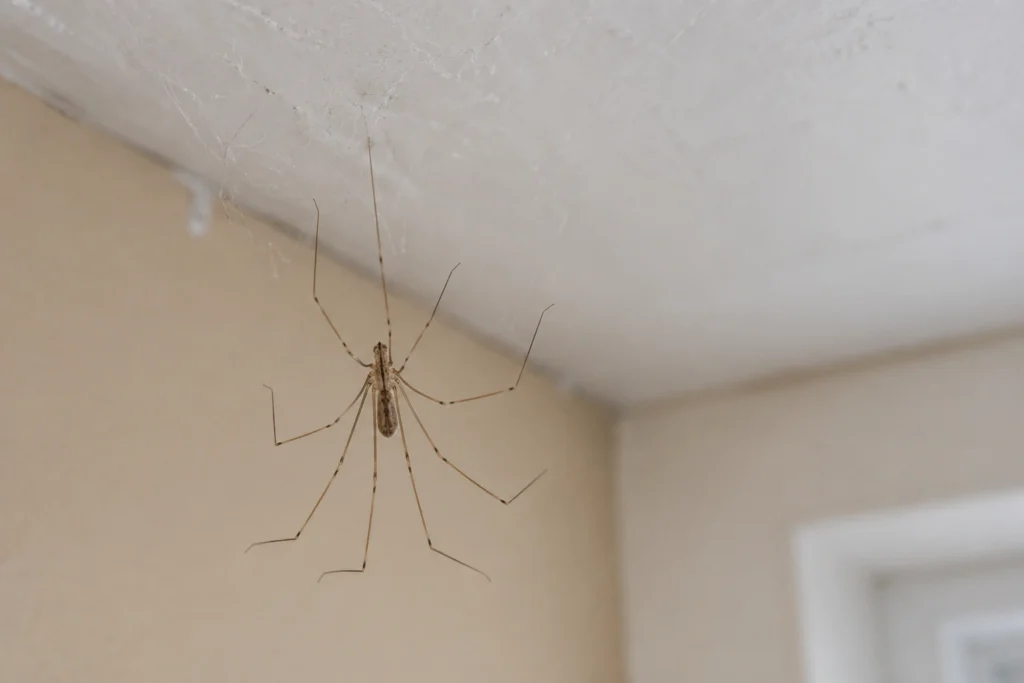
The daddy long legs you see indoors is almost always a Pholcidae spider, not a fly.
What Is a Daddy Long Legs Spider?
The term “daddy long legs” gets applied to three different creatures depending on where in the country you grew up. In the Southeast, when someone says they have a daddy long legs in the house, they almost always mean a cellar spider (family Pholcidae). These are real spiders: eight legs, two clear body segments (cephalothorax and abdomen), silk-producing spinnerets, the works.
The other two creatures sometimes called “daddy long legs” are:
- Harvestmen (order Opiliones) — arachnids, but not actually spiders. One fused body segment, no silk, no venom. Typically outdoors.
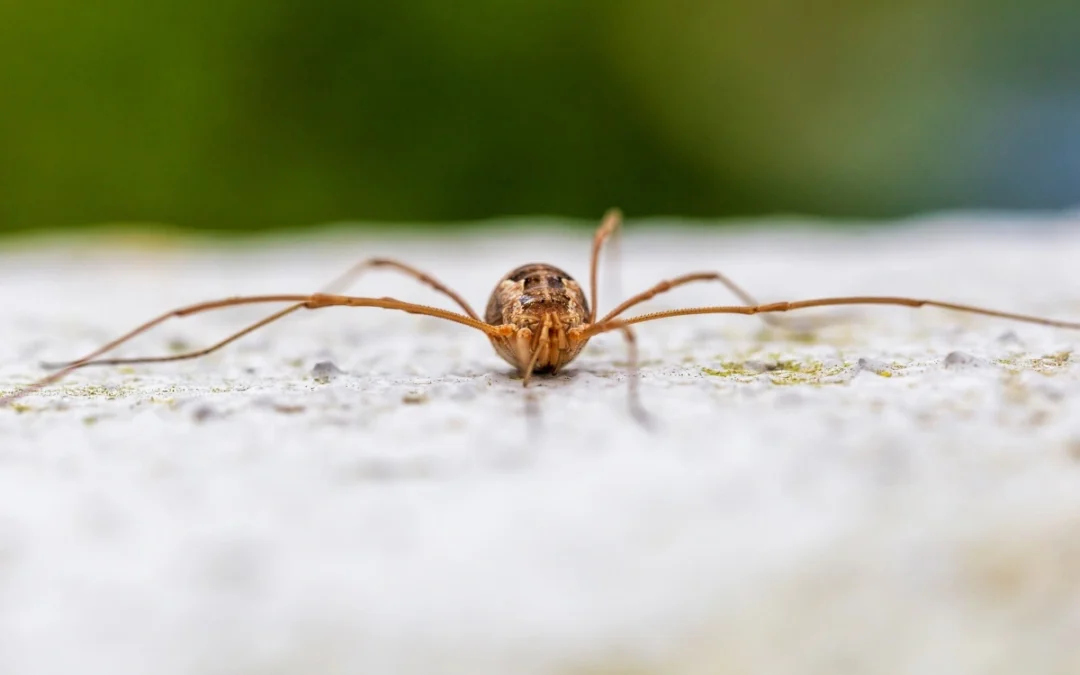
- Crane flies (order Diptera) — actual insects with six legs and wings. They look like enormous mosquitoes and show up around porch lights. They don’t bite. They don’t sting. They aren’t spiders at all.
For homeowners spotting one indoors, the answer is almost always option one: a Pholcidae spider. If you want the full myth-busting overview of all three creatures and why the name gets so confused, see our guide to granddaddy long legs myths vs facts.
Daddy Long Legs Spider vs Crane Fly & Other Lookalikes
The single most common identification mistake we see homeowners make is calling a crane fly a spider. They have very different bodies once you know what to look for.
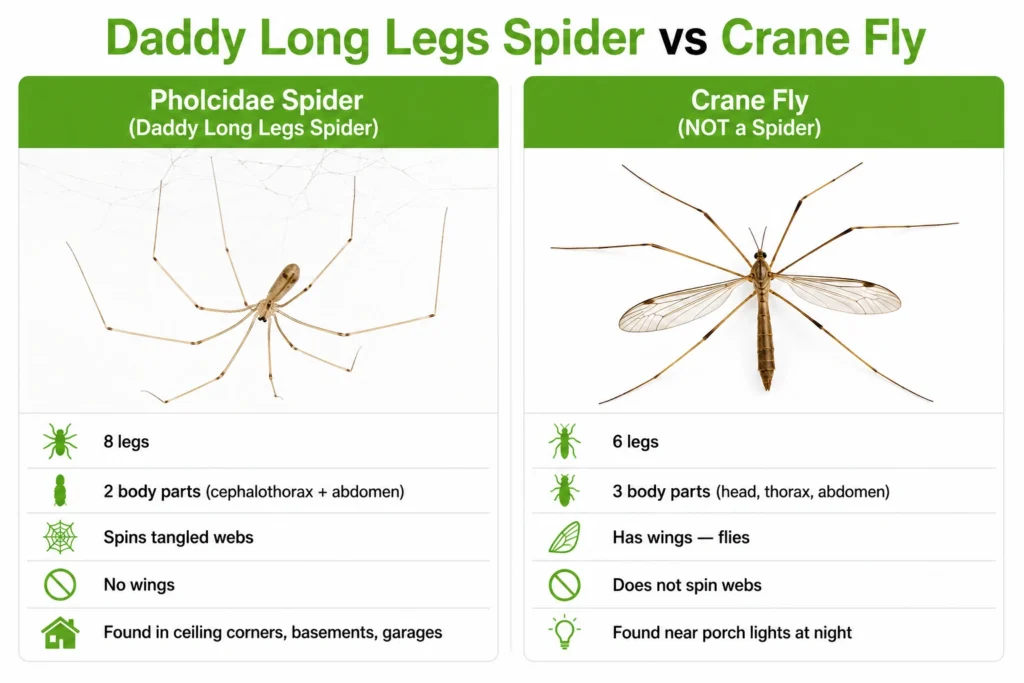
Eight legs and two body parts mean spider. Six legs and wings mean crane fly.
Spider vs Insect Anatomy
The fastest way to tell them apart is to count legs and body segments:
- Spiders have 8 legs, 2 body parts, no antennae, and produce silk.
- Insects (including crane flies) have 6 legs, 3 body parts, antennae, and do not produce silk.
If you can see a small tangled web nearby, you’re looking at a spider. If the creature has wings, you’re looking at an insect.
Visual Cues at a Glance
Daddy long legs spiders hang upside down in messy, irregular webs strung across ceiling corners and the angles where walls meet shelving units. They move with a distinctive “bouncing” motion when their web is disturbed (it’s a defense behavior). Crane flies, by contrast, are usually seen flying clumsily around porch lights, resting on exterior walls, or sometimes blundering into the kitchen through an open door. They don’t sit in webs because they don’t make them.
Are Daddy Long Legs Spiders Dangerous?
This is the question we get most often. The short answer: no.
The “world’s most venomous spider but their fangs can’t pierce human skin” story is almost completely false. Two pieces of it are true: Pholcidae spiders do produce a small amount of venom (they use it to subdue prey), and their chelicerae (mouthparts) are indeed quite small. But the venom itself is not exceptionally potent, especially not to humans. The few documented Pholcidae bites on humans show only minor, brief irritation — less than a mosquito bite, in most cases. There is no medical record of a serious human reaction.
Three plain facts about daddy long legs spider safety:
- They almost never bite humans. Bites only occur if the spider is physically pressed against skin (caught under clothing, trapped against a hand).
- Their venom is not dangerous. The “world’s most venomous” claim is internet folklore with no scientific basis.
- They actively help with other pests. Pholcidae spiders eat mosquitoes, gnats, flies, moths, and even other spiders. A small population in a garage or basement is essentially free natural pest control.
The University of Georgia Extension’s guide to common household spiders confirms the same: Pholcidae are among the most harmless spiders you’ll encounter indoors in the Southeast.
Daddy Long Legs Spider Behavior & Habitat
Where you find a daddy long legs spider in your Georgia or Alabama home tells you a lot about how it got there and how to handle it.
Where They Live Indoors
Daddy long legs spiders are drawn to undisturbed corners and dim, slightly humid spaces. The most common indoor locations:
- Ceiling corners of basements, garages, and crawl spaces
- Under stairs, in laundry rooms, and around hot water heaters
- Inside sheds, detached garages, and outbuildings
- Behind rarely-moved furniture and stored boxes
What They Eat
Pholcidae spiders are predators. Their diet inside a house includes:
- Mosquitoes, gnats, fungus gnats
- House flies and fruit flies
- Moths and small beetles
- Other spiders, including larger species like wolf spiders (they’re surprisingly aggressive predators of bigger spiders)
This last point is worth pausing on. A daddy long legs spider in your garage is actively reducing the population of more concerning spiders nearby. We’ve seen homes with persistent wolf spider sightings clear up after homeowners stopped knocking down Pholcidae webs.
Daddy Long Legs Spider in Your Home: When You See Them and Why
Indoor daddy long legs sightings spike at two predictable times of year in the Southeast:
- Early fall (September through November), when outdoor temperatures drop and the insects spiders feed on start moving indoors looking for shelter. The spiders follow.
- Late summer (July through August), when peak indoor insect populations attract more spiders into rooms with the worst pest pressure (kitchens with fruit flies, bathrooms with drain flies, basements with fungus gnats).
If you’re suddenly seeing more daddy long legs than usual, the message is almost always: there’s another pest issue inside that’s drawing them. Address the small flies, mosquitoes, or fungus gnats and the spider numbers drop on their own.
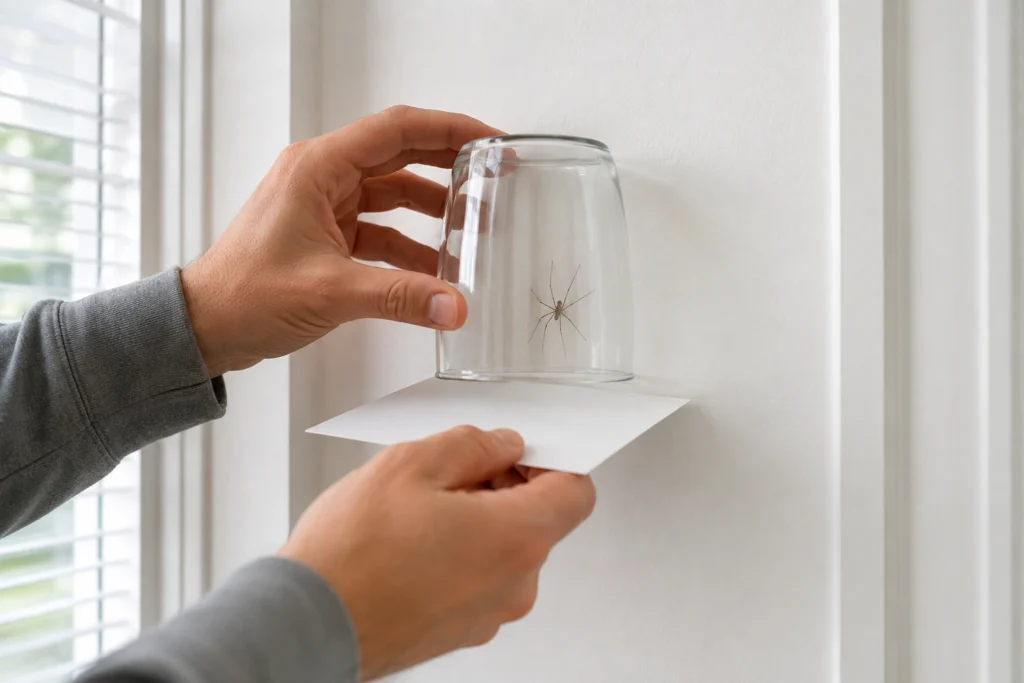
A cup and piece of cardboard handles most indoor sightings without anyone getting hurt.
How to Manage or Remove Daddy Long Legs Spiders
Most homeowners want a daddy long legs spider gone for one of two reasons: the webs look bad, or there are a lot of them in one room. Neither is dangerous, but both are addressable.
Prevention
- Seal entry points. Cracks around windows, gaps in foundation, openings around utility lines, torn weatherstripping. Spiders walk in through the same gaps as ants and roaches.
- Cut indoor insect populations. Drain flies, fruit flies, gnats, mosquitoes, and moths are the food source. Less food, fewer spiders.
- Reduce clutter in basements, garages, and storage areas. Spiders need stable, undisturbed surfaces to build webs.
- Manage humidity. Pholcidae prefer slightly damp environments. A dehumidifier in a wet basement reduces their preferred conditions.
- Move outdoor lights away from entry doors. Porch lights pull insects toward the house. Insects pull spiders.
Humane Removal
For one or two spiders, the simplest method is the cup-and-cardboard relocation. Slide a glass cup over the spider, slide cardboard underneath, carry it outside, release. Vacuum cleaner attachments work too if you’d rather not handle the spider directly. For visible webs, a long-handled duster or vacuum hose attachment clears them in seconds without harming the surrounding paint.
When Professional Help Makes Sense
Call for professional pest control if:
- You’re seeing more than 10 to 15 daddy long legs spiders in a single room consistently.
- Webs reappear within 24 to 48 hours of being cleared.
- You’re also seeing other pests (small flies, moths, mosquitoes) indoors, which means the underlying food source needs treatment.
- You want a clean exclusion plan that addresses entry points along with current activity.
(Spiders keep coming back faster than you can clear them? Request a free Northwest inspection and we’ll find the actual source.)
Daddy Long Legs Spiders vs Other Common Household Spiders
If you’re trying to figure out exactly which spider you’ve got, the most important distinction is between daddy long legs spiders (harmless, helpful) and the few spider species that actually warrant concern in the Southeast.
- Daddy long legs spider (Pholcidae) — small body, very long thin legs, tangled corner webs. Harmless.
- Cellar spider — technically the same as a daddy long legs spider in most cases. See our detailed cellar spider vs daddy long legs comparison.
- Wolf spider — large, hairy body, ground-dwelling, doesn’t make webs. Not dangerous but startling.
- Orb weaver — large symmetrical webs (the classic Halloween web shape). Outdoor species, mostly harmless.
- Brown recluse — uncommon but present in parts of the Southeast. Small brown body with a violin-shaped marking on the back. Bite is medically significant. If you’re not sure, call us.
- Black widow — jet-black body, red hourglass on the underside. Bite is medically significant. Less common indoors than outdoors.
Frequently Asked Questions About Daddy Long Legs Spiders
Do daddy long legs spiders spin webs?
Yes. Pholcidae spiders produce loose, irregular, tangled webs in ceiling corners, the angles between walls and floors, and the upper corners of basements and garages. The web is the easiest way to confirm you’re looking at a spider and not a crane fly (which has no web).
What do daddy long legs spiders eat?
They eat small flying insects (mosquitoes, fruit flies, gnats, moths) and surprisingly often, other spiders. A small population in a garage or basement is effectively free pest control for the kinds of bugs you don’t want.
Can daddy long legs spiders bite humans?
Bites are extraordinarily rare and typically only occur if the spider is trapped against skin. Symptoms are mild — usually less than a mosquito bite — and the persistent rumor that their venom is “the most dangerous in the world” is not supported by any scientific evidence.
Are daddy long legs spiders helpful?
Yes. They actively reduce other indoor pest populations, including more concerning spider species like wolf spiders. Most pest professionals (including ours) tell homeowners to leave one or two alone in the garage or basement as a form of natural pest control.
How do I get rid of daddy long legs spiders if I want them gone?
Seal entry points around windows and foundation, address the indoor insect populations they feed on, cut clutter in storage areas, and relocate visible spiders with a cup-and-cardboard method. If they keep returning quickly, there’s usually a moisture or food-source issue worth a professional inspection.
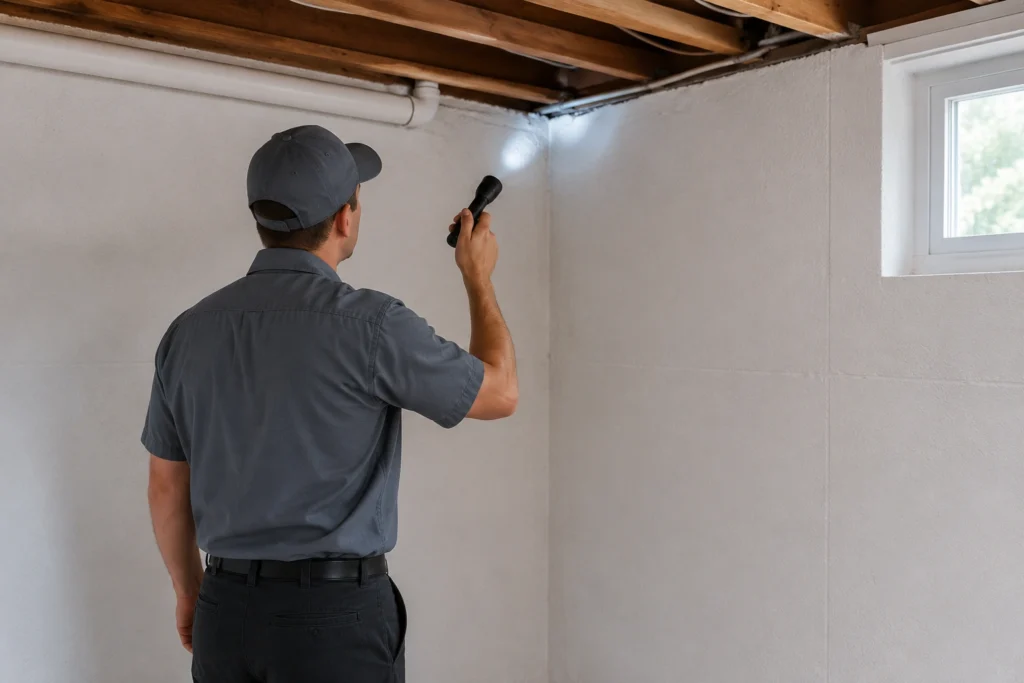
When spiders keep returning, the issue is usually whatever they’re eating.
Stop Worrying About Daddy Long Legs Spiders
If you’re seeing daddy long legs spiders and you’d rather not, the good news is they’re one of the easiest spider issues to solve. They’re harmless, they respond to environmental changes, and they’re often a signal that another (more fixable) pest issue is going on indoors. Northwest’s team has been clearing spider problems out of Georgia and Alabama homes for decades, and most of what we do for spider calls is actually addressing the food source they’re feeding on.
About the Author
Anna Vaccaro, Editorial Lead — Pest Education leads pest education content for Northwest Exterminating, working with senior technicians and service center managers across our Georgia, Alabama, Tennessee, and South Carolina service areas to translate field expertise into homeowner-friendly guides. The focus: accurate, regionally-specific answers to the pest questions Southeast homeowners are actually searching for.