Jul 26, 2013 | Uncategorized
Recently the news has been booming about the new healthy alternative:
Eating Insects
Eating insects may be a new form of pest control but it appears to serve a larger and healthier purpose. The United Nations recently released an extensive document on the health impact of consuming edible insects. Okay don’t stop reading this is serious.
Did you know that over two billion people, largely in Asia, Africa, and Latin America already include edible insects into their daily diets? The idea has been around forever and some candy makers have even made money off of imitation insect candies or even a real version. Have you seen chocolate covered crickets or ants? Although I have spent my whole life in the pest control industry I can honestly say I have never eaten an insect…on purpose. The United Nations believes that proper education and communication could not only help us with our health but also help the world fight hunger. Studies have shown that there are approximately 1,900 edible insects in the world. The edible insects show amazing study results when it comes to their nutritional makeup. Certain insects like grasshoppers and can go toe to toe and ounce to ounce with other high protein foods like lean ground beef. These 1,900 edible insects are high in protein and fiber, and contain helpful minerals like iron, zinc, and magnesium.
Are you convinced to switch your whole diet over yet? Probably not and neither am I and most of the population. This is a hard concept for many of us to swallow (literally) because insects should be exterminated and they scare us. Well, I hate to be the bearer of bad news but we all have already consumed some insects or their parts in what we eat already. Some insects have been used for their colors for dyes in food, while others just have accidentally made it into the food. If you ever want to learn more and don’t have a weak stomach I urge you to look into some of the acceptable thresholds for insect parts in common food we consume.
So where do I stand with this? Lets just say I am excited we might have found a solution to help the world’s hunger problem but at this point I think I will stick to my current diet while making a conservative effort to try new things as our food choices evolve. Will the United States ever evolve and jump on this new alternative food? Maybe eventually, we already have with other things like lobsters (who were once viewed as rats of the sea) and/or any other bottom feeding fish or crustaceans. One thing is for sure, Northwest Exterminating will always be around for those who still wish for the Mouse to Protect their house!
Adam Vannest
Director of Pest Services
Northwest Exterminating
[email protected]
Jul 24, 2013 | Uncategorized
Pests can show up in the most unexpected of places – in your bed, in your luggage and unfortunately in your food. What might have appeared to be a perfectly fresh and untouched package might actually be home to insects that infect food products. These insects are aptly named stored product pests and are usually small beetles or moths. For the most part, you will notice the adult form of these insects as they immediately begin their search for more food, typically in the area where the infestation first began.
These insects have a rather rapid life cycle lasting just four to five weeks. During this time, adult females can lay anywhere from 1000 to 1,000 eggs! If the adults themselves do not eat your food, then they serve as breeders who locate food sources for their larva. The name suggests that these pests only consume food products, but actually have a very large appetite including, but not limited, dried flower arrangements, bird seed, dog bones and even jewelry or holiday decorations!
In the Southeast, one particular stored product pest you may spot is an Indianmeal moth. Despite what their name suggests, these moths can be found in bird seed, breakfast cereals and other consumables, typically located in kitchen cupboards. However, because of their great ability of flight, adult Indianmeal moths can be found pretty much anywhere within an infested home. Indianmeal moths are also easy to spot during the larva stage, as they are almost an inch long and create webs of silk in the items they infest.
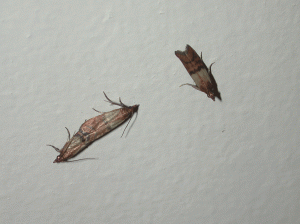
Indianmeal moth

Another well-known insect is the which commonly infests dried herbs and spices as well as other dried plant and animal material. These pests can chew through paper packaging and even aluminum foil. You’ll spot these pests as they are active, great flyers that are attracted to light. However, don’t assume that one not moving is one not to worry about. These pests, like another stored product pest known as the weevil, may pretend to be disturbed when threatened.
Drugstore beetle
Preventing these infestations is difficult as many of these pests do not appear until the packaging has been opened. It’s important though to keep food in tightly sealed containers and also use older products first. If the infestation is relatively bad, pest control companies such as Northwest Exterminating can provide traps to bait these pests using pheromones that attract these insects.
Sources:
http://www.caes.uga.edu/publications/pubDetail.cfm?pk_id=7914
Jul 22, 2013 | Uncategorized
During this time of year, you may notice that your lawn isn’t as green as the grass on the other side. Have no fear, Northwest services can provide diagnostics to let you know what’s going on beneath the surface of your lawn. For the most part, the summer months can mean very green lush grass, but the same warm temperatures might permit infections in your lawn. Way may seem like an unfortunate eye sore to you, may be one or more lawn diseases interrupting your summer plans.
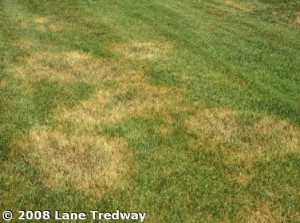
Brown patch
This is a very prevalent disease that may make you think your lawn isn’t getting enough water and treatment. In actuality, this results due to moist, hot weather or over-fertilized lawns. This is active when grass remains wet at temperatures between 80 to 90 degrees Fahrenheit. It’s important to improve aeration and drainage on such lawns by watering deeply and infrequently, mowing high and removing excess thatch.
Brown Patch
Fairy Rings
Despite what their name suggests, fairy rings are not due to Tinkerbell and her friends dancing across your yard. Rather, patterns of circles of mushrooms or unusually lush grass are due to soil exhaust forcing nutrients to the outer edge of dying mycelium. Your only choice in this instance is to dig up the affected area and use lawn treatments in order to make this area less visible.
Fairy rings
Summer patch
This disease grows as a result of a fungus that infects and destroys grass roots. It mostly affects gross growing in a sunny, hot lawn. The grass will begin as wilted, dark green and eventually turn straw brown. The most effective means eliminating this is using preventive measures that Northwest provides.
Summer patch
If you are interested in learning about more lawn diseases, please visit the link below. If there are any that you feel affect your lawn, please contact Northwest and schedule an appointment today!
Sources:
http://www.yardcare.com/restore/fighting-lawn-diseases/summer-lawn-diseases/
Jul 19, 2013 | Pest Control
It’s summer time and BBQ season is in full effect. Naturally, your family and friends aren’t the only ones attracted to the smell of something good on the grill. We at Northwest Exterminating provide extensive treatments for mosquitos, fleas & ticks and other creepy crawlers that may want to stop by. However, being proactive in small ways can add to the benefits of pest and mosquito control. Below is a list of tips to help you keep your BBQ guests from getting bugged!
- Keep your outdoor dining area clean. For instance, flies hate the scent of Pine-sol. Mix it with water and put it in a spray bottle to use to wipe down the porch and furniture.
- Place a fan near your BBQ area. This moderate breeze will blow tiny insects off-track
- If you have a more serious mosquito problem, use a fogger in the BBQ area before the event and make sure to spray bushes as well.
- Tiki torches, citronella candles or insecticide candles should go around the edge of your BBQ area, though guests will have to be mindful if you choose to go this route.
- Screen tents are a useful means of protecting food and guests.
- Keep food inside and have guests serve themselves indoors before coming outdoors to eat.
- Bug spray is useful plus and there should be enough for each guest to use.
Sources:
http://www.ehow.com/how_8229328_keep-bugs-away-during-barbecue.html
Jul 17, 2013 | Pest Control
Hornets are wasps that are closely related to, but not to be confused with yellow jackets. In all, there are about 20 hornet species worldwide, but the primary hornet in North America is the European hornet. Just like other social wasps, hornets create their nests from chewing wood into a papery pulp to raise their eggs to adults.
European hornet
You’ll tend to see hornet activity during warmer weather because hornet nests get abandoned in the winter. During this time, they’ll hide under tree bark or even inside human dwellings in order to protect themselves and their eggs. When spring hits, the surviving queens crate a new nest and this is when they become quite an issue for homeowners.
Their threat to homeowners is in their sting, as they use it to kill prey and defend their hives. Unlike bees, hornets can sting multiple times as they do not die after stinging. The toxicity of their sting depends on their species, but the Asian giant hornet is the most venomous. People must be very careful because as social wasps, hornets can mobilize the entire nest to sting in defense, creating a highly dangerous situation. Furthermore, it’s better to call an exterminating company to eliminate the entire hive. This is because if hornets are killed near their hive, their bodies may release a pheromone which can cause other hornets to attack.
Asian giant hornet
Sources:
http://en.wikipedia.org/wiki/Hornet
http://animals.nationalgeographic.com/animals/bugs/hornet/