
Formosan vs. Eastern Subterranean Termites: What’s the Difference?
Quick answer: Formosan and Eastern subterranean termites both live in soil, build mud tubes, and damage wood. Formosan colonies can hold a million or more workers, against about 100,000 in many native colonies. Formosan soldiers have oval heads and release a white secretion, and their swarmers fly in the evening. Both respond to the same professional treatments.
Swarmers around a porch light or mud tubes on a foundation wall raise the same question: is this an ordinary native termite or a Formosan? The answer changes how quickly damage can build, what a thorough inspection covers, and how closely a property should be monitored.
“Formosan vs. subterranean termites” is a slightly off comparison, because Formosan termites are a type of subterranean termite. The real comparison is Formosan subterranean termites against Eastern subterranean termites, the native species found across the eastern United States.
What Is the Difference Between Formosan and Eastern Subterranean Termites?
Colony size, soldier anatomy, swarm timing, and nesting habits. Both species nest in soil and respond to the same professional treatments, but Formosan colonies are far larger, their soldiers look and behave differently, and they are more likely to build nests above ground. The table lays out the differences.
| Eastern Subterranean Termite | Formosan Subterranean Termite | |
|---|---|---|
| Colony size | Many native colonies hold about 100,000 workers (Clemson) | A million or more workers (Clemson) |
| Soldier head | Rectangular head (UF/IFAS) | Oval, teardrop-shaped head (UF/IFAS) |
| Soldier defense | Does not exude the white, glue-like secretion | Exudes a white, glue-like secretion from an opening at the front of the head |
| Soldiers in the colony | About 1% to 2% of the colony | About 10% to 15% of the colony |
| Swarmers | About 3/8 inch, dark; swarm in early spring, often in the afternoon | About 1/2 inch, golden or amber-brown, with hairy wings; swarm in the evening, from mid-May to July in South Carolina, drawn to lights |
| Nests | Colonies are usually in the soil; aerial nests are uncommon | More apt to build aerial nests and carton (soil, wood, and saliva) where moisture allows |
| Range | Native; found throughout the eastern United States | Introduced; established in parts of the Southeast, Gulf Coast, Texas, Hawaii, and California |
Sources: Clemson Extension, Clemson Extension, and University of Florida IFAS (Formosan termite and native subterranean termite profiles). Appearance alone is not a reliable way to confirm a species at home. A trained professional should identify a sample.
Why Does Colony Size Matter Most?
Because it controls how fast damage builds. Clemson Extension says many native colonies hold about 100,000 workers, while Formosan colonies may hold a million or more. The workers themselves are not special: Clemson says a Formosan worker and a native worker eat wood at about the same rate.
The difference is volume. With ten times as many workers or more foraging, a Formosan colony can consume wood faster overall and has more chances to find a weak spot in a termite treatment. That is where the “super termite” label comes from. It describes colony size, not immunity to treatment.
How Can You Tell the Swarmers Apart?
By timing, size, and color. Clemson says native termites usually swarm in early spring, often in the afternoon, while Formosan termites often swarm from mid-May to July, in the evening, drawn to lights. Formosan swarmers are about 1/2 inch long and golden brown. Native swarmers are about 3/8 inch and dark.
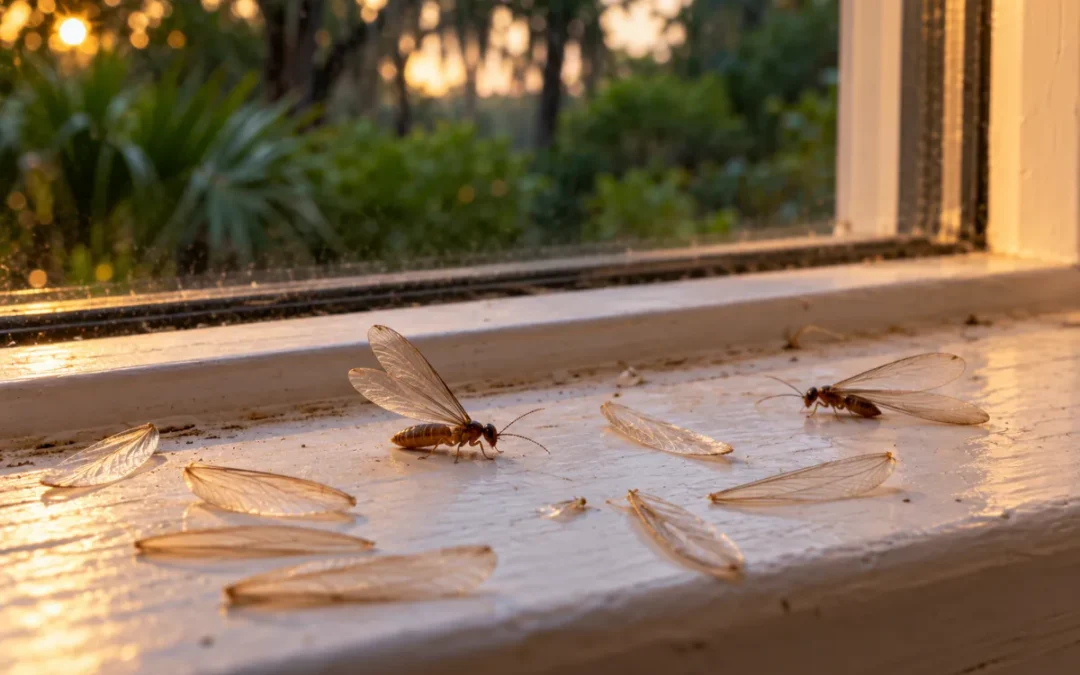
University of Florida IFAS adds that the bodies and wings of Formosan swarmers are covered in small hairs. A big evening swarm around outdoor lights points toward Formosan termites, but timing alone cannot confirm the species. Both species shed their wings after swarming, so wings on a windowsill only tell you a swarm happened.
What Does a Formosan Soldier Look Like?
Soldiers are the most useful caste for identification. According to University of Florida IFAS, a Formosan soldier has an orange-brown, teardrop-shaped head and an opening at the front of the head that releases a white, glue-like secretion when the termite is threatened. Native soldiers have rectangular heads and no such secretion, per University of Florida IFAS.
“When I’m out in the field and need to confirm a species, the soldier is what I go to first. The head shape and whether you see that milky secretion when the termite is disturbed, those two things together tell you a lot.”
Tim Rodgers, Region 2 Area Technical Leader, Northwest Family of Brands
Formosan colonies also carry far more soldiers. UF/IFAS puts the share at roughly 10% to 15% of the colony, against 1% to 2% in native colonies, so soldiers are easier to find when a Formosan colony is disturbed.
What Are Carton Nests, and Do Formosan Termites Build Them Above Ground?
Carton is a firm material made of soil, digested wood, and saliva that Formosan termites use to fill voids and build nests. Where a sustained moisture source exists, such as a plumbing leak, those nests can sit above ground inside a structure. Native subterranean termites are far less likely to do this.
That does not mean most Formosan infestations start above ground. A Clemson survey of 50 Formosan-infested structures in Charleston in the 1980s found that 94 percent were infested from ground-based colonies and 6 percent from aerial colonies, according to Clemson Extension. Clemson adds that aerial nests may be more common now, and that soil treatment does not reach them. Ground colonies are still the main pathway, and a thorough inspection still checks above the foundation.
What Are the Two Biggest Myths About Formosan Termites?
That they resist treatment and that they nest mostly above ground. Neither holds up. Clemson Extension states that termites are not resistant to any insecticides, and that professional termiticides, baits, and wood treatments work against Formosan termites at the same concentrations used for native termites. Most infestations come from the ground, as the Charleston survey above shows.
Where Are Formosan Termites Found?
In the coastal Southeast, the Gulf Coast, Hawaii, and a few other areas. In South Carolina, Clemson Extension lists 16 counties with established populations, including Beaufort County, with the heaviest concentration along the coast from Charleston south to Beaufort.
Clemson dates the species’ introduction in Charleston to the mid-1950s, and a University of Georgia-hosted termite survey puts the first collected specimen in South Carolina in 1957. It did not spread mainly by flying. Clemson says swarmers are weak fliers and that people have moved the species around, mostly through infested material such as old railroad ties. For a local look at the risk, see our guide to Formosan termite treatment in Hilton Head and our page on termite control in Hilton Head.
Does the Species Difference Change How You Treat Them?
Not the products, but the stakes. Liquid soil treatments and baiting systems that work on Eastern subterranean termites also work on Formosan termites. Where the species matters is inspection scope and monitoring: a larger colony can do more damage before anyone notices it.
“The biggest practical difference we see in the field is not the products, it’s the stakes. A Formosan colony can be ten times the size of a native colony, which means accurate identification and a thorough inspection matter even more. You want to know what you’re dealing with before damage gets ahead of you.”
Tim Rodgers, Region 2 Area Technical Leader, Northwest Family of Brands
Because aerial nests do happen, Clemson recommends that a house with Formosan termites be inspected from the foundation to the roof, not just at the first-floor level. Our overview of termite control and treatment explains how inspection, treatment, and monitoring fit together, and our guide to whether your termite bond covers Formosan termites covers the paperwork side.
How Do You Get an Accurate Identification?
Have a trained professional look at it. Soldier head shape, swarmer features, and nest material are easiest to confirm in person by someone who knows both species. If you have swarmers or soldiers, collect a few in a jar of rubbing alcohol (not water) so a technician or your county Extension office can examine them, as Clemson recommends.
Frequently Asked Questions
What is the difference between Formosan and subterranean termites?
Formosan termites are a type of subterranean termite, so the better comparison is Formosan versus Eastern subterranean termites, the native species. Formosan colonies can hold a million or more workers against about 100,000 in many native colonies. Their soldiers also have oval heads and release a white secretion, and their swarmers fly in the evening.
What do Formosan termites look like?
Formosan soldiers have an orange-brown, teardrop-shaped head and release a white, glue-like secretion when threatened. Formosan swarmers are about half an inch long, golden or amber-brown, with hairy wings. A professional should confirm the species from a sample.
When do Formosan termites swarm?
Clemson Extension says Formosan termites often swarm from mid-May to July, in the evening, and are drawn to lights. Native termites usually swarm in early spring, often in the afternoon.
Are Formosan termites resistant to termite treatment?
No. Clemson Extension states that termites are not resistant to any insecticides. Professional termiticides and baits work against Formosan termites at the same concentrations used for native species. The main concern is colony size and how long damage goes unnoticed.
Where are Formosan termites found in the United States?
Formosan termites are established in parts of the coastal Southeast, the Gulf Coast, Hawaii, Texas, and California. In South Carolina, Clemson Extension lists 16 counties with established populations, including Beaufort County, with the heaviest concentration along the coast from Charleston to Beaufort.
Get an Accurate Identification Started
If you have seen swarmers, soldiers, or mud tubes, or you want to know where your property stands, request a free termite inspection. A Northwest professional can walk the property with you and explain what they find.