May 19, 2022 | Pest Control
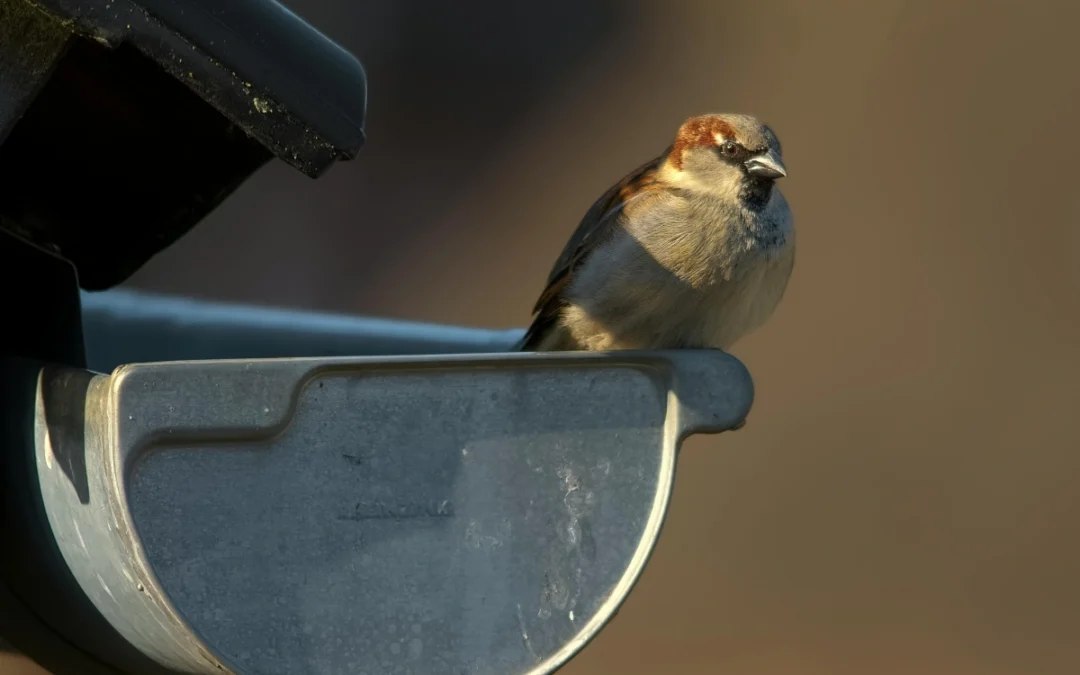
Did you know birds can be just as much of a nuisance (and potential health threat) as roaches and rodents? Common nuisance birds include pigeons, woodpeckers, sparrows, starlings, and Canadian geese.
Birds can cause a whole host of problems around your home and property. They can fly into your home and windows. They can build nests on or near your home, causing damage to your house or just being a noisy pest. Nests can clog gutters, downspouts, drains, vents, and chimneys. Bird droppings contain uric acid and can eat away at paint and building materials on cars and homes.
Birds and their droppings are known to carry over 60 diseases including E. coli, salmonellosis, and cryptococcosis.
Anytime you’re dealing with birds it’s important to remember that many species are protected by federal and/or state regulations, as is bird nest removal.
Here are 9 of our favorite DIY bird deterrents:
#1. Bird Deterrents
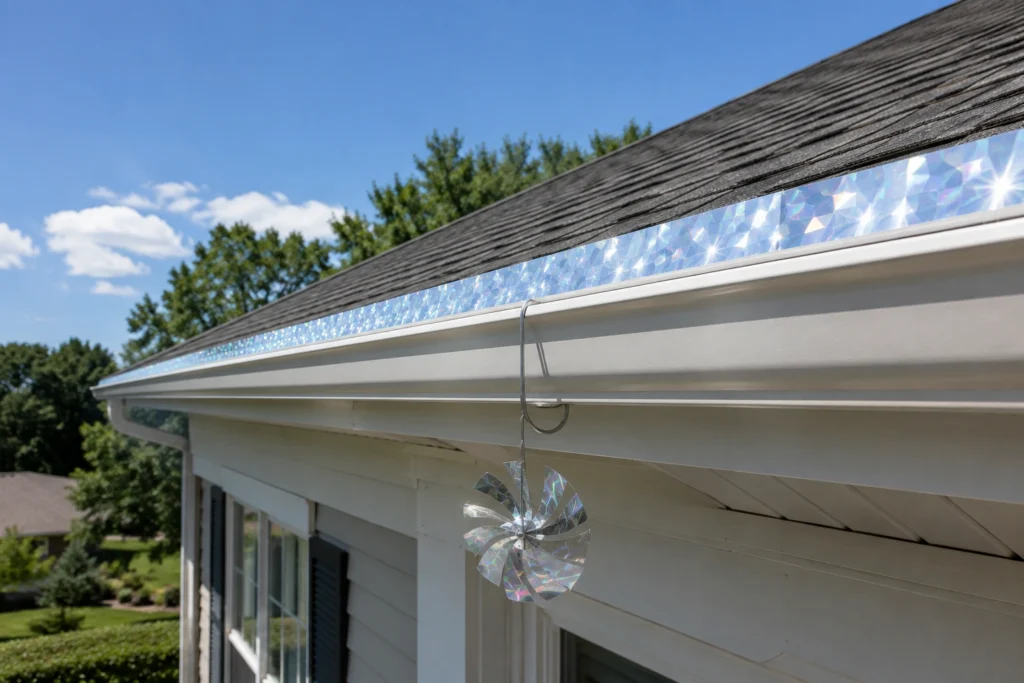
Visual bird deterrents are products designed to scare off birds or prevent them from landing or roosting where you don’t want them to. Their efficacy depends on the type of bird you are dealing with and the type of deterrent you are using. There is a wide range of choices when it comes to these deterrents. Many include gel because its reflective surface looks like fire to birds. It also feels sticky if birds land on it. Some of these deterrents are also scented, many with peppermint oil, to also help deter birds from getting near them.
#2. Predator Decoys
Predator decoys can be effective for a short period of time but aren’t usually good for long-term use. It is important to choose a realistic predator for the bird species you are dealing with. If owls aren’t a natural predator of the bird you are dealing with, a decoy owl won’t work very well. It is also important to rotate or move the decoy frequently so birds don’t realize it isn’t real.
#3. Reflective Deterrents
There is a wide range of products you can use as a reflective deterrent, from prefabricated spirals to DIY aluminum foil strips. The most important thing to remember is to use something highly reflective that also moves with the wind. It also helps to move it around frequently or even take it down for a while to trick the birds into thinking it’s real.
#4. Bird Spikes
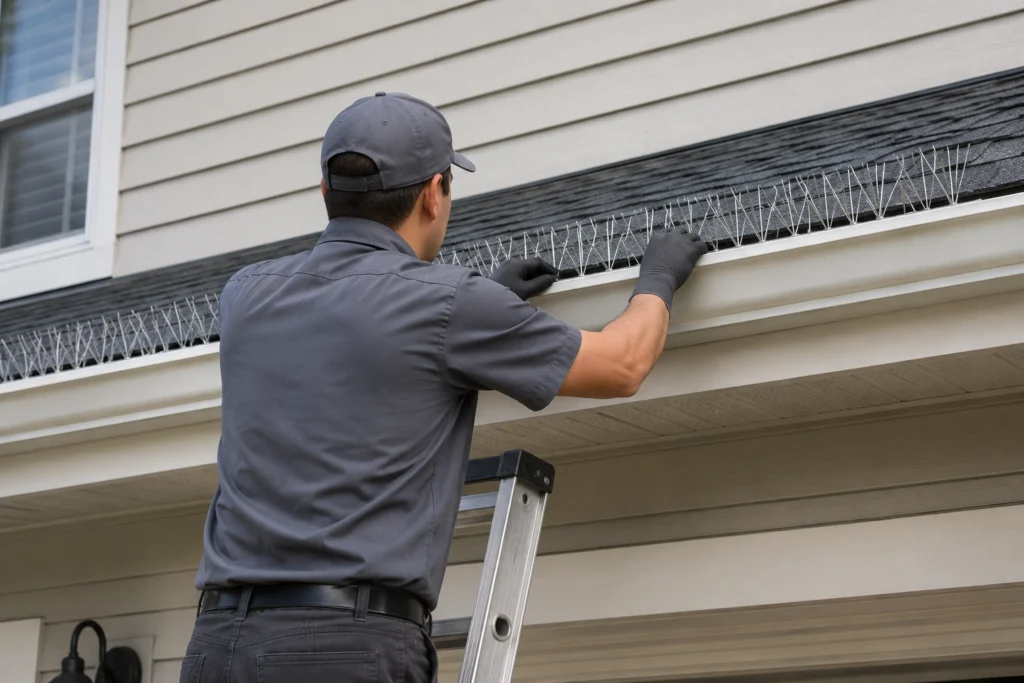
These are narrow spikes that attach to window sills, roofs, eaves, or any other large areas you want to keep birds off of. They can attach to concrete, wood, or other surfaces with screws or glue. The spikes can be metal or plastic. These deterrents are most effective against pigeons, crows, and gulls and are less effective against smaller types of birds.
#5. Bird Coils
Bird coils are similar to spikes. They are extendable stainless steel coils that stretch along ledges to deter birds from landing on them. If they do, the coils move and make the bird feel unstable, making them less likely to perch and roost.
#6. Bird Wire
Bird wire is a tension wire system that creates an unstable landing area to deter birds from landing. Bird wire is more low profile compared to spikes or coils and can be used on exposed ledges, beams, and pipes. The negative to bird wire is that it can be time-consuming and difficult to install.
#7. Bird Netting
Bird netting is commonly used in gardens or on fruit trees but can also be used under roofs and around eaves. Bird netting is less expensive than other deterrent methods. It is important to remember when installing bird netting that you don’t cut out sections of the net to fit around obstructions; instead, cut a slit in the netting, slide the obstruction through it, and then reseal it when it’s above the object. One negative to netting is that birds can get stuck in the net.
Eliminating Food and Water Sources
Birds usually come to your home or yard in search of a nesting site, food, or water. Eliminating these things will make your property less appealing to them. Install bird netting over gardens to keep them from getting to your fruit. Keep trash cans covered. Clean your gutters to prevent standing water or install gutter guards. Don’t use birdfeeders in the warmer months. If you do use birdfeeders, don’t use suet or corn in them. Instead, replace with whole peanuts, safflower seeds, or sunflower seeds in the shell.
Exclusion
The best way to keep birds out of your home is to make sure they don’t have a way in. Carefully inspect the exterior of your home or other outbuildings and seal any openings you find, especially those that lead to the attic. Block any openings to eaves or vents with 1/4″ wire mesh or netting.
Bird and bird nest removal can be a difficult (and sometimes illegal) job. If you have a problem with birds this season, contact your local pest control company who can properly identify the types of birds you are dealing with, along with the most appropriate elimination and prevention methods for you.
You May Also Be Interested In:
Keeping Summer Pests Away
What Attracts Snakes to Your Yard?
Keeping Cool for the Summer
Why Rain and High Temperatures Bring Mosquitoes
Pest Prevention Tips After It Rains

Apr 17, 2020 | Alabama Blogs, DIY, DIY Wildlife Prevention, Georgia Blogs, Wildlife
By Anna V., Editorial Lead — Pest Education · Last updated: May 2026
If birds have taken over your roofline, started nesting in your dryer vent, or covered your back deck in droppings, you’re probably searching for a bird deterrent that actually works. At Northwest, we get bird control calls year-round across our Georgia and Alabama service area, but they spike sharply from late March through July when nesting season hits its peak. The honest version most homeowners don’t hear: most DIY bird deterrents work briefly, then stop working as birds adapt. The few that work long-term are usually the unglamorous ones (sealed vents, physical barriers, removed food sources), not the gimmicky owl decoys and ultrasonic gadgets sold on Amazon.
Here are the five DIY bird deterrents with the strongest track record in Southeast homes, what to expect from each, and the gimmicks worth skipping entirely.
Visual deterrents work for a while, then stop. Rotation is the difference between weeks and months of effectiveness.
Why Bird Deterrents Matter
Bird activity around a Southeast home isn’t just an annoyance. Persistent bird problems lead to:
- Droppings. Bird droppings are acidic and stain paint, siding, decking, and concrete. Cleanup is constant, and accumulated droppings can damage surfaces permanently.
- Nesting in vents and gutters. Dryer vents, bathroom vents, gable vents, and gutter corners are favorite nesting spots. Nests block airflow, create fire risk (especially in dryer vents), and trap moisture.
- Noise. Pigeons, sparrows, and starlings start their day before dawn. Nesting season runs March through August in Georgia and Alabama.
- Structural damage. Roof damage from nesting materials, clogged gutters that overflow and rot fascia boards, and acid damage to paint from droppings.
- Health and sanitation concerns. Bird droppings can carry pathogens including histoplasmosis and salmonella. Most healthy adults aren’t at significant risk, but people with respiratory issues should avoid disturbing dried droppings without proper protection.
The species causing most of the bird-control calls we run are house sparrows, European starlings, and rock pigeons. All three are non-native and not protected under federal migratory bird law, which matters when you start considering removal options (more on that below).
Do DIY Bird Deterrents Really Work?
Yes and no. Most DIY bird deterrents produce short-term results, then lose effectiveness as birds figure out they’re not actually threats. The deterrents that hold up long-term are the ones that don’t depend on birds being fooled: physical barriers and habitat changes.
Two important caveats before you start any DIY bird control:
Federal law protects most native bird species. The Migratory Bird Treaty Act of 1918 protects more than 1,000 native species, and it’s illegal to disturb their active nests, eggs, or young without specific permits. The three most common nuisance species in the Southeast (house sparrows, European starlings, rock pigeons) are non-native and not protected, but several species you may encounter (swallows, woodpeckers, robins, mockingbirds, blue jays) are protected. If you’re not sure what species you’re dealing with, pause and identify before doing anything.
Active nests with eggs or young require special handling. Even for non-protected species, the humane and recommended approach is to wait until the nest is empty before removing it. Active nest removal during breeding season is one of the situations where calling a professional is often the right move.
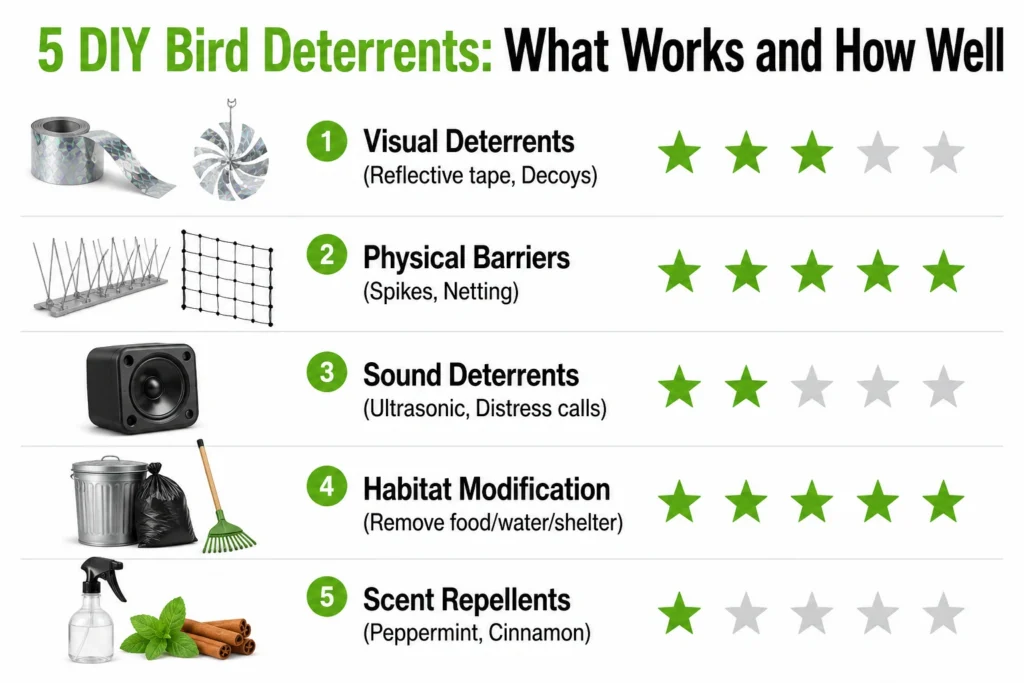
5 Effective DIY Bird Deterrents
Physical barriers and habitat changes do most of the heavy lifting. The other three are short-term tools.
1. Visual Deterrents (Reflective + Predator Decoys)
Reflective bird tape, hanging spinners, and predator decoys (plastic owls, hawks) all work on the same principle: scare birds with movement, light flashes, or the appearance of a predator. They work briefly, especially for new arrivals. The catch is habituation. Within two to four weeks, birds figure out the owl doesn’t move and the tape doesn’t actually threaten them.
Best practice: rotate visual deterrents weekly. Move the owl decoy to a new spot, replace reflective tape, swap the spinner for a different design. The rotation is what extends effectiveness from “a few weeks” to “all season.” Static visual deterrents left in one place stop working fast.
2. Physical Barriers (Spikes + Netting)
The single most effective long-term bird deterrent is making the landing spot physically unusable. Bird spikes installed along ledges, gutter edges, and rooflines prevent landing entirely. Bird netting stretched across eaves, soffit openings, or under solar panels blocks nesting access without harming birds.
Where physical barriers shine in Southeast homes:
- Gutter edges (favorite pigeon and starling landing spots)
- Eave overhangs (common sparrow nesting locations)
- Solar panel undersides (a big issue in newer Georgia construction)
- HVAC equipment housings and mini-split heads
- Window AC unit tops
- Gable vents and attic vents (with proper mesh, not just bird netting)
Bird spikes and netting installed correctly can last 10+ years and require near-zero maintenance. The catch: installation matters. Poor installation creates gaps birds exploit, and once a bird gets through, the whole barrier loses credibility.
3. Sound Deterrents (Ultrasonic + Distress Calls)
Ultrasonic devices and recorded distress calls (audible to birds, played on speakers) can disrupt new arrivals and slow nesting attempts. The research on ultrasonic devices specifically is mixed. Most independent testing shows limited effectiveness for birds, despite aggressive marketing claims. Audible distress calls work better but have an obvious downside in residential settings: they’re loud, and your neighbors will notice.
Sound deterrents are most useful in open commercial settings (parking lots, warehouse rooflines, agricultural buildings). They’re rarely the right choice for a single-family home in a Georgia or Alabama neighborhood.
4. Habitat Modification (the Most Overlooked Method)
The most underrated bird deterrent strategy isn’t a product. It’s removing the things drawing birds to your property in the first place. Birds keep showing up because the conditions are good. Change the conditions and most of them move on.
- Eliminate food sources. Bird feeders that overflow, pet food bowls left outside, accessible trash, fallen fruit under pecan or fig trees, breadcrumbs after outdoor meals. Any of these will pull birds in and keep them returning.
- Cut off water access. Standing water in birdbaths, clogged gutters that pool water, irrigation puddles, and uncovered pools all draw birds. Mosquitoes too, which then draws other pests.
- Trim trees and shrubs back from the house. A three-foot clear zone around the foundation and roofline reduces nesting opportunities and travel routes onto the house.
- Clean gutters regularly. A clogged gutter with debris is a five-star nesting site for sparrows and starlings.
- Seal entry points. Gaps in soffits, broken or missing vent covers, open chimneys without caps. The same exclusion work that keeps rodents out keeps birds out too.
Habitat modification is the only DIY method that addresses why birds came in the first place rather than just shooing them away. It’s also the only one that compounds: each year you maintain it, the cumulative effect grows.
5. Scent Repellents (Honest Effectiveness)
Peppermint oil, cinnamon, methyl anthranilate (the active compound in commercial bird repellents like grape extract sprays), and other scent-based products show modest, short-term effects in field testing. The catch: outdoor scents fade within days, wash out with rain, and require constant reapplication. They’re not a standalone solution.
Where scent repellents can earn their place: as a supplement to physical barriers in spots where you can’t install spikes or netting. Otherwise, treat them as the lowest-tier option.
The yards we treat for repeat bird problems almost always have an exposed food source, a water source, or open nesting cavities.
What Doesn’t Work (Bird Deterrent Myths to Skip)
A few “classic” bird deterrent ideas circulate widely but don’t hold up.
- Fake owls left in one place. Birds figure them out in days. Without rotation, they’re inert.
- Random DIY sprays. Vinegar, dish soap, garlic water, cayenne pepper, and similar mixes don’t have research support for bird control. They wash out fast and damage plants in the meantime.
- Wind chimes alone. Birds adapt to consistent sounds within a week. Wind chimes are pleasant. They’re not deterrents.
- Single-method approaches. Any one DIY deterrent works briefly. Combining two or three (e.g., physical barriers + habitat modification + rotating visual deterrents) is where homeowners see lasting results.
Humane Bird Exclusion: The Long-Term Approach
The most effective bird control isn’t a product. It’s exclusion, which means making your property physically unable to host birds in the spots they want to nest. Exclusion combines:
- Sealing every gap in vents, soffits, and rooflines with appropriate mesh or hardware cloth
- Installing bird spikes on landing surfaces
- Adding bird netting under solar panels and over open eaves
- Capping chimneys with bird-proof caps
- Modifying the surrounding habitat to remove food, water, and shelter
Exclusion done right typically lasts 10 years or more with minimal maintenance. It’s also the only approach that fully complies with the Migratory Bird Treaty Act, because it prevents nesting before it starts rather than removing active nests later.
When to Call a Professional for Bird Control
DIY bird deterrents handle small, early-stage bird problems well. Call Northwest for bird control if:
- Birds keep returning to the same spot despite your DIY efforts.
- Nests are in hard-to-reach or hazardous areas (high roofs, gable vents, solar panels).
- You’re dealing with large flocks (more than 10 birds at a time) or commercial properties.
- You suspect protected species are involved.
- An active nest needs removal mid-season.
- You want long-term exclusion done correctly the first time.
(Birds keep returning after you’ve tried DIY? Request a free Northwest bird control inspection and we’ll identify the species, find the entry points, and lay out a long-term exclusion plan.)
Bird Control in the Southeast
Birds in Georgia, Alabama, Tennessee, and South Carolina behave a little differently than in cooler parts of the country. Three regional factors increase bird pressure on Southeast homes:
- Longer nesting season. Warm spring weather arrives early and lingers into fall. House sparrows can produce three to four broods per year here, compared to two in colder regions.
- Year-round resident populations. Rock pigeons and house sparrows don’t migrate. They’re a problem every month of the year, not just in summer.
- Construction patterns. Open soffits, gable vents, and unscreened crawl space vents are common in older Atlanta, Birmingham, Savannah, and Macon homes. Each is a bird entry point.
The good news: the same exclusion approach that solves bird problems also solves rodent problems and helps with snake prevention. For more on how those pest categories connect, see our snake repellent guide on the rodent-snake-bird sealing connection. For the broader question of getting rid of birds already established on your home, see our companion guide on how to get rid of birds around your home.
Frequently Asked Questions About Bird Deterrents
What bird deterrent works best?
Physical barriers (bird spikes and netting) are the most effective long-term solution because they don’t depend on birds being fooled. Combined with habitat modification (removing food, water, and shelter), they handle most residential bird problems for years with minimal maintenance.
Are bird deterrents harmful to birds?
Most modern bird deterrents are designed to be humane and non-lethal. Bird spikes, netting, sound, scent, and visual deterrents discourage birds without injuring them. Avoid sticky gels or glue traps marketed for birds. They can trap and injure or kill birds and are illegal to use against protected species.
Do birds come back after deterrents are installed?
They can, especially if deterrents aren’t maintained or rotated. Static deterrents (a single fake owl, reflective tape that never moves) lose effectiveness within weeks. Combining multiple methods and rotating visual deterrents weekly extends results dramatically.
Are birds protected by law?
Yes, most native bird species are protected under the federal Migratory Bird Treaty Act, which makes it illegal to disturb their nests, eggs, or young without specific permits. The three most common nuisance species in the Southeast (house sparrows, European starlings, rock pigeons) are non-native and not protected. If you’re unsure what species you’re dealing with, identify the bird before removing nests.
How long does it take to get rid of birds with DIY deterrents?
If you start at the early-arrival stage (a few birds scouting, no active nests), DIY deterrents can resolve the issue in one to two weeks. If birds have already established nests, expect a longer timeline (often a full nesting season) before you can fully exclude them. Active nests of protected species cannot be removed mid-season; you’ll need to wait for the young to fledge before sealing the area.
Professional exclusion lasts years. DIY deterrents that get rotated and maintained can match it for smaller problems.
Ready to Stop the Bird Problem at the Source?
If you’ve tried a DIY bird deterrent or two and the birds keep coming back, the problem isn’t the deterrent. It’s the conditions around your home that keep drawing birds in. Northwest’s wildlife team handles the full bird-control workflow: species identification, exclusion installation, habitat assessment, and follow-up to make sure birds don’t find a new spot to set up shop.
About the Author
Anna V., Editorial Lead — Pest Education leads pest education content for Northwest Exterminating, working with senior technicians and service center managers across our Georgia, Alabama, Tennessee, and South Carolina service areas to translate field expertise into homeowner-friendly guides. The focus: accurate, regionally-specific answers to the pest questions Southeast homeowners are actually searching for.