Jul 13, 2012 | Wildlife
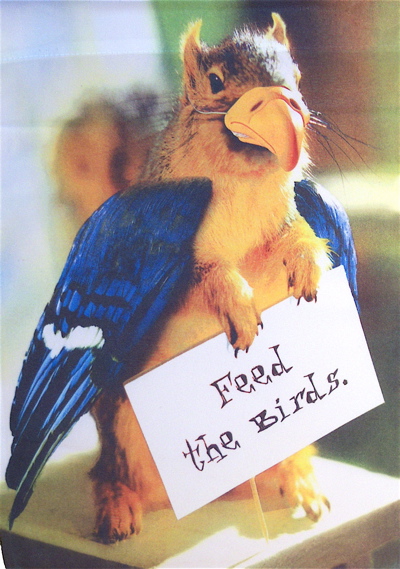 The southeast is home to an assortment of alluring birds. What better method to admire them than hanging their favorite treats around your humble abode. Your backyard birds adore it when you keep hanging up birdseed for them. Your backyard squirrels adore it even more.
Watching your bird seed being devoured by a squirrel can be very disheartening. Squirrels are attracted to the most commonplace varieties of birdseed including black oil sunflower seeds, nuts, and suet. In the process of feasting upon your sweet bird’s food, squirrels frighten and chase away your feathered friends. They can also wreck and ruin your feeder. To top it all off, squirrels can be predators and have been known to eat eggs and kill baby birds.
Here are some techniques to make your birdfeeder less attainable to squirrels but still captivating to your avian amigos:
- Location, location, location: Place feeders as far away from trees and other launching points that would benefit a squirrel.
- Cleanliness: Squirrels are attracted to debris and spilled seed, so keep the bird’s feeding area tidy.
- Seed: Squirrels are less attracted to nyger and safflower seed so keep those handy.
- Some don’t like it hot: Adding cayenne pepper or similar spices to birdseed can deter squirrels. Luckily, birds are not sensitive to the heat of the peppers. Make sure you wear gloves and avoid breathing in the dust when handling peppers!
- Northwest Exterminating Wildlife Control: If your squirrel problem is just too much too handle, give us a call at 888-466-7849!
Happy Birdfeeding!
What kind of birds are you seeing around your house right now?
Cara Carver
[email protected]
Jul 6, 2012 | Fire Ant, Pest Control, Wildlife
People love a good myth. These narratives contribute bright symbolism of interactions between higher powers, people, and nature. They assist in many relevant functions as well as further adding colorful stories. One valuable role of myths is to illustrate some angle of life.
Several myths describe the beginnings, morphology, and conduct of various insects. Here are just a few:
The origin of mosquitoes is revealed by The Tlingit Indians of North America. The narration tells of a blood sucking carnivorous giant who dines on humans. This giant is eventually avenged after his horrific death by coming back to feed on humans in the appearance of blood sucking mosquitoes.
An Algonquin tale of North America justifies why bees, wasps, and hornets have stingers. This myth grants that the god Wakonda bestowed stingers to bees because the bees were industrious, but required a defense. Since wasps and hornets are linked to bees, The Great Spirit willingly endowed them with stinging weapons as well.
Ant actions are revealed in an African myth that reminds us of the everlasting punishments of Atlas, Prometheus, and Sisyphus of classical mythology. An infinite punishment of bearing a burden is handed down to ants by deception in the African myth. Accordingly, we see the outcome today in ants repeatedly transporting things in their everyday routine.

Atlas
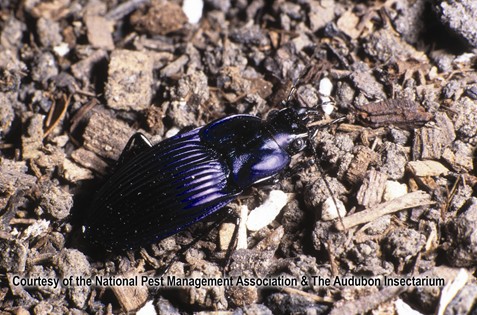
And on an absolutely universal spectrum, the composition of our galaxy, The Milky Way, is translated in an insect myth of the Cochiti. This myth tells of an Eleodes Beetle that was in charge of depositing stars in the sky. The stars were dropped due to his ego and recklessness, thus forming the Milky Way. The beetle was so distraught at what he had done, that even today, the beetle hides his face in the dirt when approached – will lower its head, raise its abdomen, and emit a disagreeable odor probably for defense. This simple insect myth explains not only insect behavior, but also the start of our own galaxy.
Beetle
Who are your favorite mythological characters?
May 23, 2012 | Wildlife
There’s nothing like jumping in the pool on a hot summer day (well, a day that feels like summer anyways)! So that is exactly what my family and I did on Saturday. We went to my in-laws’ house and jumped right in the pool. We had just begun to cool off and enjoy the water when we noticed we weren’t alone. There was a mole in the pool!!!
The mole was quickly removed without incident and the fun continued but of course my mother-in-law had lots of questions about what it was doing in her yard, how did it get there, what is was looking for, and how does she get rid of them. So mother in law…this is for you!
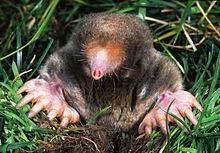
Moles are mammals that live underground and occasionally come to the surface. Above ground, they breathe in oxygen and are able to re-use it to survive in low-oxygen environments such as underground burrows. When they surface, they cause damage. Mole damage is divided into two types: burrows and mounds. Burrows occur when moles search for food near the surface, causing soil to be raised in ridges. Mounds are created when moles burrow deep or tunnel under solid objects such as tree roots or sidewalks and push the soil to the surface.
Mole's runway system
Moles’ bodies and front claws are ideal for digging. Their hands are quite large for their bodies and include an extra thumb and multiple joints in other fingers. There are situations where mole damage is mostly visual, but in other situations they can destroy root systems in your yard, eventually killing the grass.
Damage caused by moles:
- Interference of mowing and planting
- Create weed invasion
- Damage plants
- Damage drainage systems and watercourses
The best way to get rid of a mole is by trapping or baiting the runs. The trick to mole extermination is to find the feeding tunnels vs. the travel tunnels. A professional animal removal service provider can distinguish between the two and can humanely remove the moles from your yard. Call Northwest Exterminating for mole removal.
What is the craziest thing you ever jumped in next to?
May 23, 2012 | Wildlife
There’s nothing like jumping in the pool on a hot summer day (well, a day that feels like summer anyways)! So that is exactly what my family and I did on Saturday. We went to my in-laws’ house and jumped right in the pool. We had just begun to cool off and enjoy the water when we noticed we weren’t alone. There was a mole in the pool!!!
The mole was quickly removed without incident and the fun continued but of course my mother-in-law had lots of questions about what it was doing in her yard, how did it get there, what is was looking for, and how does she get rid of them. So mother in law…this is for you!
Moles are mammals that live underground and occasionally come to the surface. Above ground, they breathe in oxygen and are able to re-use it to survive in low-oxygen environments such as underground burrows. When they surface, they cause damage. Mole damage is divided into two types: burrows and mounds. Burrows occur when moles search for food near the surface, causing soil to be raised in ridges. Mounds are created when moles burrow deep or tunnel under solid objects such as tree roots or sidewalks and push the soil to the surface.
Mole's runway system
Moles’ bodies and front claws are ideal for digging. Their hands are quite large for their bodies and include an extra thumb and multiple joints in other fingers. There are situations where mole damage is mostly visual, but in other situations they can destroy root systems in your yard, eventually killing the grass.
Damage caused by moles:
- Interference of mowing and planting
- Create weed invasion
- Damage plants
- Damage drainage systems and watercourses
The best way to get rid of a mole is by trapping or baiting the runs. The trick to mole extermination is to find the feeding tunnels vs. the travel tunnels. A professional animal removal service provider can distinguish between the two and can humanely remove the moles from your yard. Call Northwest Exterminating for mole removal.
What is the craziest thing you ever jumped in next to?
May 14, 2012 | Community News, Wildlife
The following story is the reason I decided to start bringing a camera with me on the job. I didn’t want to miss any unique experiences like this one.
I showed up at the customer’s house on a rainy afternoon. They had told our office staff that they had seen
bees on the side of their home and had heard some buzzing in the wall. At first glance it seemed pretty typical, bees entering the structure of the home and building a hive. The customer asked me to look at something outside, she then pointed out a large mass in a tree in her neighbor’s yard. I grabbed my binoculars to get a better look and I couldn’t believe what I saw. Attached to the tree was a mass twice the size of a football and filled bees. (After researching this phenomenon I discovered this is how they transfer the queen to a new hive. All the workers gather around the queen to protect her while a select few special workers prepare the hive.)
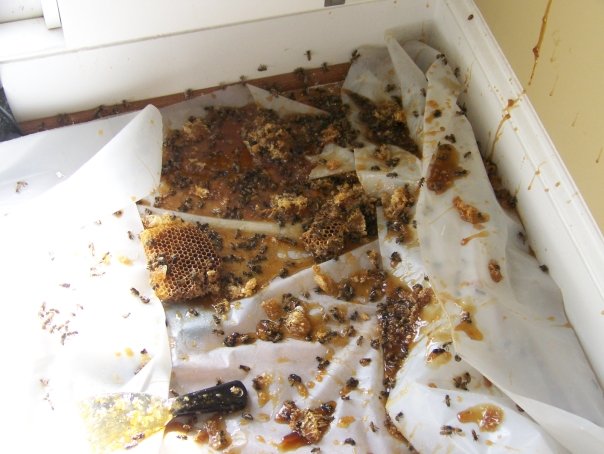
The bees were entering the customers house through a small gap between the brick basement and the hardy plank siding. By using a stethoscope, I was able to locate the exact location of the hive, the ceiling above their living room which was also the floor of the master bedroom. I drilled into the ceiling and found honey on my drill which confirmed the hive location.
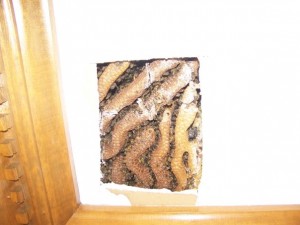
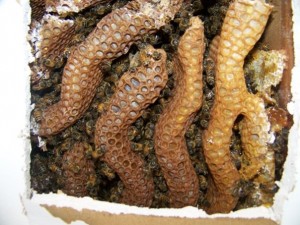
We began carefully cutting into the sheet rock to reveal the hive. What we saw was truly nature at work.
Thousands of bees working together for one common purpose, to make honey! The noise was deafening, the buzz of the bees filled the room, yet surprisingly they didn’t attack.
When bees are inside a home we remove them with a shop-vac. We began to remove individual pieces of honeycomb and place them in garbage bags, we filled up 2 contractor sized bags each weighing about 30-40 lbs! Once the honeycomb was removed, every ounce of wax and honey must be completely cleaned off, so we scraped and scrubbed to ensure the bees and other pests wouldn’t come back.
We sealed up the entry on the outside of the home and placed plastic around the opening to keep any left over bees from entering the living space of the home. Success! Hive removed, customer and family safe!
Matt Bowley
Mar 27, 2012 | Pest Control, Wildlife
Although you may be seeing bees buzzing around your home it doesn’t necessarily mean that you have an active bee hive in your area. There is a good possibility that you are seeing scout bees. The survival of a bee hive oftentimes depends on the scouting bee. Bees need a constant supply of nectar and have to find a new place to go once their source is low. This is where the scout bee comes in. Scouting bees are sent out to look for a new home for their hive and if you do not take action, your home could be their new home.
To most people, scout bees look just like other active bees but once you get a closer look, you are able to notice small differences in their behavior. Scout bees usually scout an area for about 3 days before moving in or moving on. If you see bees for 5 days or longer, there is a good chance that it is an active hive and not just a scout bee. Scout bees tend to hover around an area rather than a steady stream of bees that are coming and going from the same area; that is typically an active hive. Scout bees are not as aggressive as other bees since they are not protecting their hive.
It is better to treat for scouting bees rather than taking a chance of getting an active hive. Bees can cause structural damage to your property as well as pose a safety risk. It is always best to call a professional exterminating company for bee removal. If you live in the Atlanta, Columbus, or Nashville area and are seeing bees, call Northwest Exterminating and we will come take a look to see if you are seeing scouting bees or an active hive.
Have you seen scouting bees near your home?
Mar 23, 2012 | Pest Control, Wildlife
Carpenter bee
Last week it was the stink bug, this week it’s the carpenter bee! We told you that the weird temperatures were going to bring out these pests…and here they are!
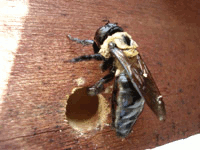
It’s officially spring which means that carpenter bees are out in Atlanta and other southeastern areas. There is a good chance that you are seeing these large black bees along with the large black tunnels that they create in wood around your home. Those are carpenter bees that have been living in those holes and tunnels throughout the winter and are emerging in the spring time to find places for new nests, which can mean new holes and tunnels in your wood. Carpenter bees are often confused with bumble bees but differ slightly in appearance. The upper surface of the carpenter bee’s abdomen is bare and a shiny black color; while bumble bees have a hairy abdomen and yellow markings.
Carpenter bees drill through wood to build nests where they stay all winter and throughout the spring until they find a new nest or emerge to mate. Although male bees tend to be aggressive, often hovering around people who are near their nests, they are mostly harmless since they do not have stingers. On the other hand, females can inflict a painful sting but rarely do unless they are being handled.
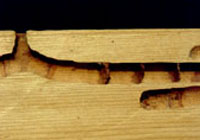
Carpenter bee tunnel
You may find piles of wood underneath the hole where the bee has drilled their nest. Carpenter bees prefer to make their nests in bare, untreated or weathered wood. Wood that is painted or pressure-treated is much less susceptible to a carpenter bees nesting. Common areas for nesting include window trim, facia board, siding, wooden shakes, decks and outdoor furniture.
The best control for carpenter bees is to treat or paint all exposed wood surfaces. If you are using a spray, it is best to spray at night, while wearing protective clothing, when bees are less active to reduce your risk of being stung. Each hole should be treated individually if the bees are inside the holes. If they are not in the hole, seal or paint the hole so the bees cannot return.
As with most infestations, it is best to call a professional exterminator to ensure that the issue is taken care of quickly and thoroughly. Call Northwest Exterminating if you are seeing carpenter bees or other pests around your home.
Feb 24, 2012 | Community News, Pest Control, Termite Control, Wildlife
We’ve recently discovered a useful tool that has helped us both inside and outside of the office. iPest is a mobile app that is beneficial not only for pest control technicians but homeowners, building managers, etc. The iPest app is a guide that was developed by researchers at the University of Florida. The app is a great tool to identify and educate yourself on common pests that are found in and around homes and businesses. iPest contains 3 series, a search tool, and color photos that can help you quickly find a particular pest.
Series:
iPest1 – cockroaches, flies, occasional invaders, and urban pest and wildlife droppings.
iPest2 – ants, beetles, termites and wood destroying insects.
iPest3 – biting, stinging, and bloodsucking arthropods.
This app has been a great tool in and outside of the office and we think it would be great for our customers as well.
Go to you app store and purchase iPest for $1.99
Feb 23, 2012 | Company News, Wildlife
Technician Tales
As you can imagine, there is never a dull moment in the pest control industry. It is our privilege to be able to help our customers keep their homes and businesses healthy and free of pests. Along the way, we get ourselves into some pretty interesting situations. Sometimes we get a good laugh about them around the different offices and thought that we would share our stories with our readers. Technician Tales will be stories from our ladies and gentlemen out in the field or in the office who have found themselves in some very interesting predicaments. For your enjoyment:
Technician Tales: There’s a boa in your refrigerator
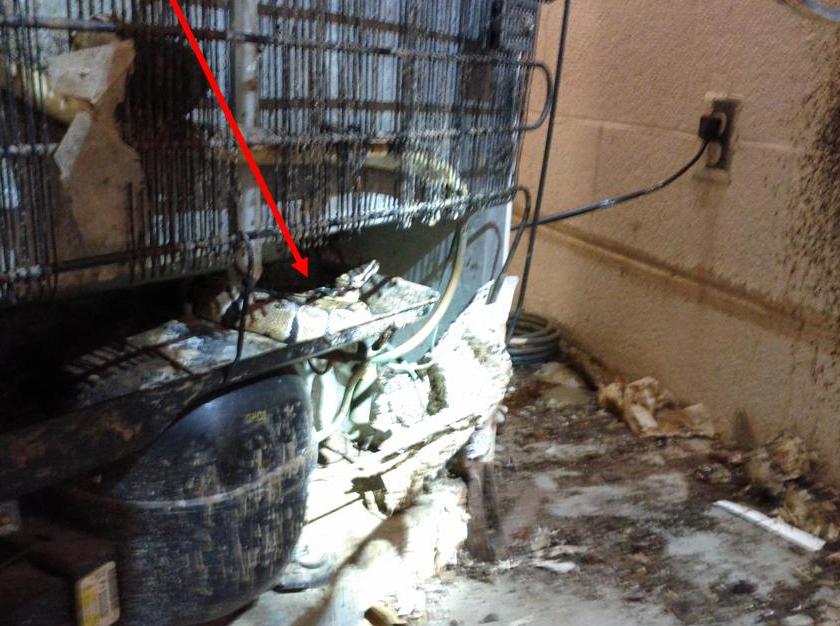
Recently our representatives went on a call for a German cockroach infestation. The area was crawling (no pun intended) in cockroaches. There were roach droppings covering the floors, walls, and naturally, surrounding the refrigerator. As a team of technicians were treating and vacuuming up the roaches, one of the technicians had pulled back the refrigerator and was treating around the area. The technician was working his way around when he all the sudden jumped back and screamed, “SNAKE!!!!!!”. Everyone hurried to see what he was yelling about. When they looked at the bottom of the refrigerator, curled up at the bottom was a 4 foot long boa constrictor!!!! Our technicians went to find someone at the location to let them know what they had found only to be met with the response “We’ve been looking for him”!!
Now THAT was a technician tale that we just had to share.