Dec 9, 2022 | Pest Control
Rats are one of the most destructive household pests, chewing through wires, walls, and insulation and contaminating your home with their feces and urine. They also carry some pretty serious diseases, putting both you and your family at risk. These risk factors make identification and rodent control an important part of your household pest control plan.
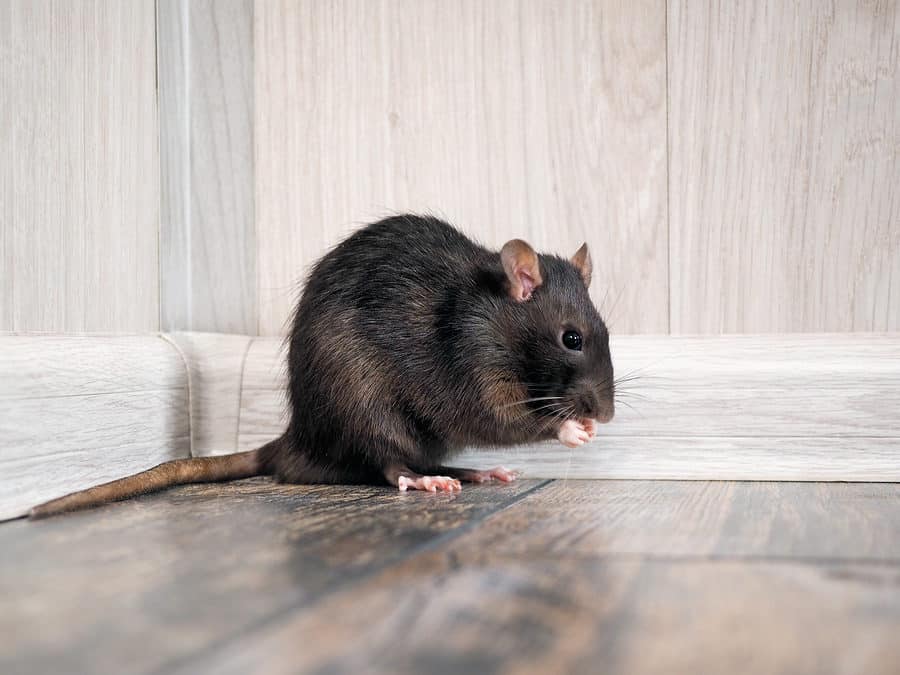
Rats are mostly nocturnal pests and it is rare for them to come out during the day. Their activity typically begins around dusk. Because rats commonly inhabit areas near humans, it is safer for them to come out after dark when there is less chance of them being caught. They will make an appearance during the daytime if they feel safe enough to do so and especially if food supplies are scarce.
Video Transcript
Rats are more than an unpleasant surprise. They’re one of the most damaging pests a home can have. They chew through wires and insulation, contaminate food, and spread harmful bacteria that can put your family’s health at risk. What makes them tricky is that you rarely see them. Rats are nocturnal, hiding during the day inside walls, attics, crawl spaces, and behind appliances. If one shows up in daylight, it’s often a sign the infestation is already growing. Instead, they leave clues behind. Small droppings, chewed food packaging, shredded paper or fabric, and a strong musty odor are all warning signs. Even spotting just one rat usually means there are more hiding nearby. When you’re ready to call a professional for a peaceful home, feel free to reach out to our team at Northwest Exterminating.
If they aren’t coming around during the day, where are they hiding? Rats prefer to hide in places that are tucked out of the way and that aren’t often disturbed. Outdoors they will hide under piles of debris, under trash piles, in dumpsters and trash cans, in trees, and in sewers. They can also be found under bushes and shrubs, in woodpiles, and in gutters. Inside, rats can be found hiding out in holes, cracks, and crevices; climbing up through drains in bathrooms and kitchens; behind cabinets; behind and under appliances; in air ducts and ventilation systems; in piles of clutter; in storage containers; in hollow walls; and in crawlspaces, attics, garages, and basements.
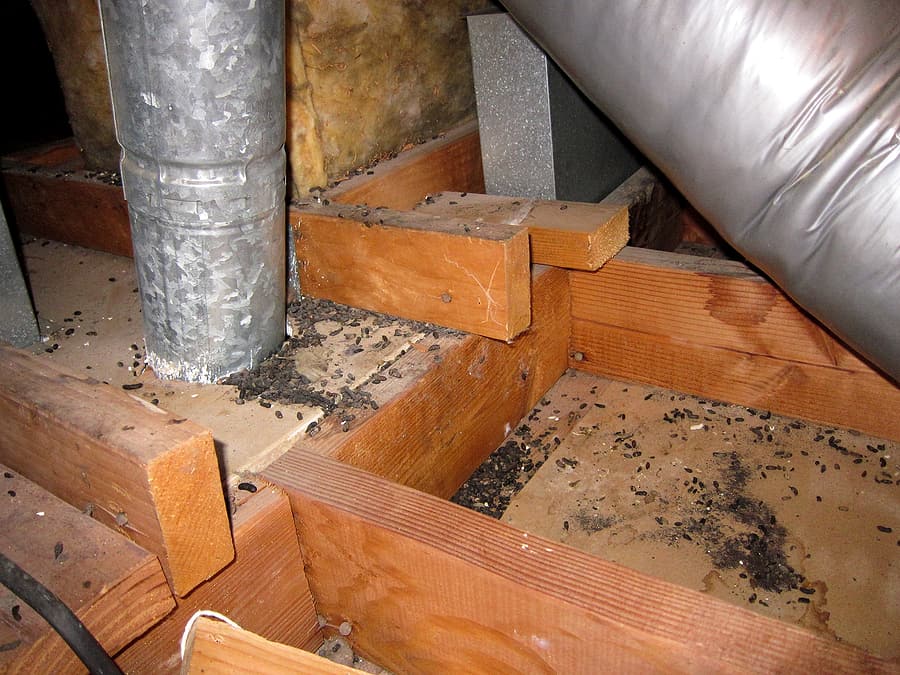
Seeing a rat during the day can be an indication of a larger rodent infestation. Seeing one rat may not be cause for alarm; seeing more than one or seeing one in conjunction with other signs of rodents can be cause for concern. Some common signs of a rodent infestation include rat droppings, especially in one specific area; chew marks or chewed through wires, food packages, and other household surfaces; nesting material like fabric and paper; and a musty smell.
If you suspect you have a problem with rats or any other rodents, contact your local pest control company who can provide you with a thorough evaluation and an ongoing treatment and prevention plan to keep your home pest free.
You May Also Be Interested In:
Winter Tips for Your Georgia Lawn
The Effects of Wildlife Activity on Your Attic’s Insulation
Preventing Wildlife in Attics
Do Roaches Die Off In Winter?
Crawlspace Enclosure: The Cure For Cold Feet

Jan 14, 2022 | Pest Control
As members of the rodent family, mice and rats look very similar and are often mistaken for one another. Both are harmful, transmitting serious diseases to humans and pets, contaminating surfaces in our home, and chewing through structures and wires, causing damage and putting you at risk for fires. How do you know if you are dealing with a mouse vs rat? Here are 5 key differences between these two rodents.
Physical Appearance
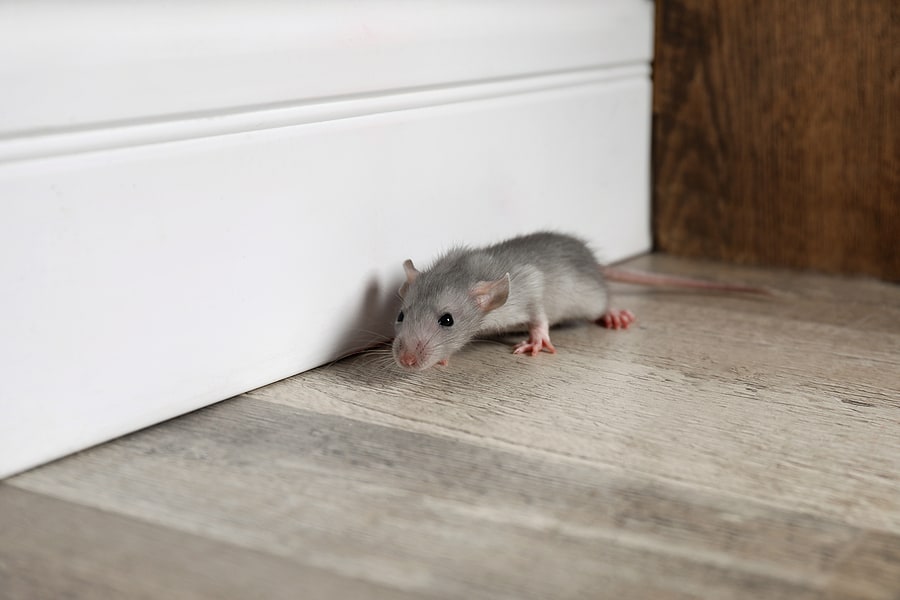
Mice are noticeably smaller than rats, growing 3 to 4 inches in length. Mice weigh anywhere from 0.5 oz to 3 oz. A mouse’s tail is equal in length to its body and is thin, long, and covered in hair. Mice have small heads and large ears with pointy, triangular snots and smooth fur. Mice can be white, gray, or brown in color. Rats, on the other hand, are much larger, measuring 9″ to 11″ in length and weighing anywhere from 12 oz to 1.5 lbs. A rat’s tail can be 7″ to 9″ in length and is long, thick, scaly, and hairless. Rats have small ears and large heads with blunt snouts. They have coarse fur that can be dark brown or multicolored.
Droppings
Mice have smaller droppings, about 1/4″ in length. Mice droppings are black with pointed ends and resemble a grain of rice. Mice can leave up to 100 droppings at a time. Rat droppings are larger with an elongated oval shape. These droppings are about 3/4″ long, black in color, and resemble a banana. Rats can leave up to 50 droppings at a time. Rodent droppings of both species are known to carry diseases that can be harmful to humans.
Diet
While both species are omnivores, their diets tend to vary. Mice commonly eat fruit, seeds, and plants. In your home they may nibble on bread crumbs or other cereals and grains. Their palates are not as wide as rats. Mice can also survive on 3 mL of water per day. Rats, on the other hand, will eat almost anything, even scavenging through your garbage for fruit, eggs, meat, and other leftovers. They will also eat plants and seeds. Rats need anywhere from 15 to 60 mL of water per day.
Habitat
While both rats and mice will come into your home, they tend to frequent different areas once inside. Mice can be found in garages, under trees, under decks, and in walls and other voids that are too small for other rodents to get into. The species of rat you are dealing with determines where they prefer to live. Norway rats can be found in sewers, inside walls, and in cellars. They prefer lower levels of your home to reside in. Roof rats prefer higher environments, often being found in cabinets and attics.
Behavior
Mice are nocturnal animals. They are timid but social within their own populations. They are very territorial and more curious than rats, making them easier to trap. They are skillful climbers and can access areas rats can’t because of their small size. Rats are also nocturnal but are more cautious and fearful of new things than mice are, making them more difficult to trap. Rats are also skillful climbers. Both rats and mice will gnaw through structures and wiring in your home, causing damage and putting you at risk for fire. Mice have weaker teeth and can’t chew through glass or metal to get to food. Rats have much stronger jaws and have been known to chew through wood, glass, sheet metal, aluminum, and even cinder blocks.
Regardless of which pest you are dealing with, proper identification and treatment is essential to eliminating them. Contact your local pest control company who can determine which type of pest you have and set you up with the appropriate rodent control plan to eliminate them.
You May Also Be Interested In:
Cockroaches: Types and Prevention Tips
Winter Pests to Watch Out For
Have a Pest-Free New Year
What Threat Do Rodents Pose To Humans?
Overwintering Pests: Boxelder Bugs and Ladybugs
Dec 9, 2021 | Pest Control, Wildlife
By Anna V., Editorial Lead — Pest Education · Last updated: May 2026
The short answer: yes, a single home can have rats and mice at the same time. It happens more often than most Georgia and Alabama homeowners realize, especially in larger homes, older homes, and homes with crawl spaces, attics, and basements that give the two species enough territorial separation to coexist. At Northwest, we typically find dual-species infestations in about one of every six rodent calls we run during the late fall and winter months, which is peak rodent season in the Southeast.
Co-infestation matters because the treatment plan changes when both species are present. Mice and rats respond to different bait, different trap placements, different timing, and different exclusion strategies. A control plan designed for one will leave the other behind. Here’s how to recognize when you have both, why it happens, what the combined health risks look like, and how to handle it without the two-species problem becoming a year-long battle.
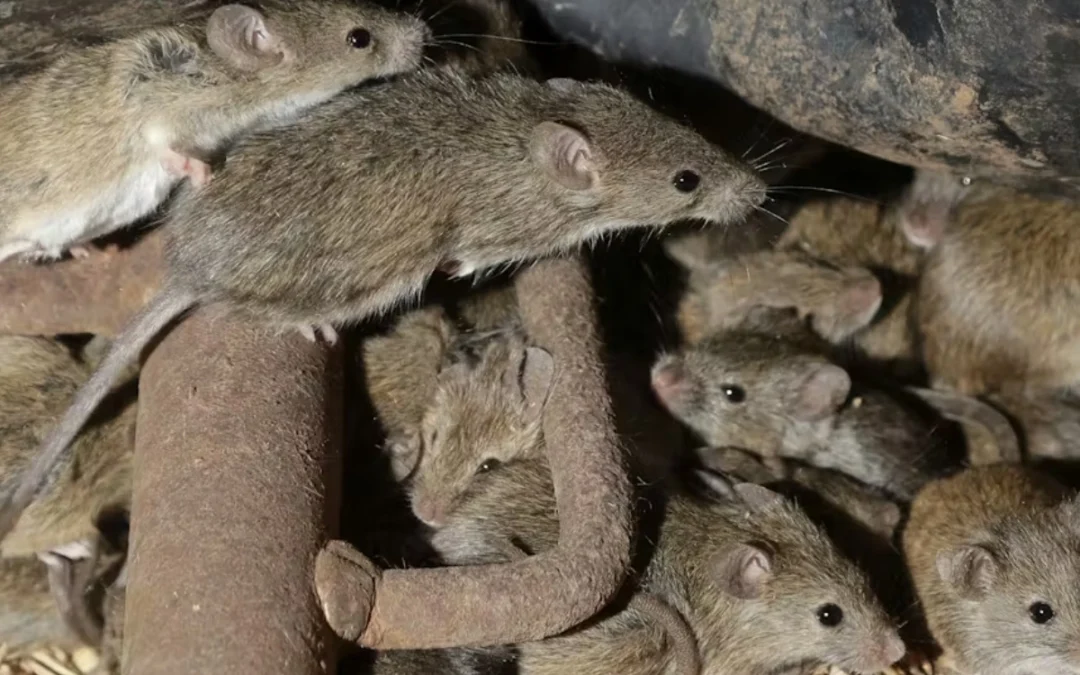
Larger Southeast homes can support both species at once, especially through the winter.
Understanding Rats and Mice as Different Species
Mice and rats are both rodents but they’re meaningfully different animals. Recognizing the differences is the foundation of effective dual-species treatment.
Mice (house mouse, deer mouse) are small, slender, and curious. Adult body length is 2 to 4 inches not counting the tail. They reproduce fast (5 to 10 litters per year per female), build small nests in wall voids and stored boxes, and explore new objects in their territory within hours.
Rats (Norway rat, roof rat) are much larger, heavier, and cautious. Adult body length is 7 to 10 inches. They reproduce more slowly than mice (2 to 5 litters per year) but produce larger litters. They build bigger nests, prefer outdoor burrows or basement-level indoor spaces, and will avoid new objects in their territory for days before approaching.
For the full physical and behavioral identification breakdown, see our companion guide on how to tell a mouse from a rat.
Signs of a Rat and Mouse Co-Infestation
The clearest evidence that both species are present is finding signs of both at the same time. Here’s what to look for.
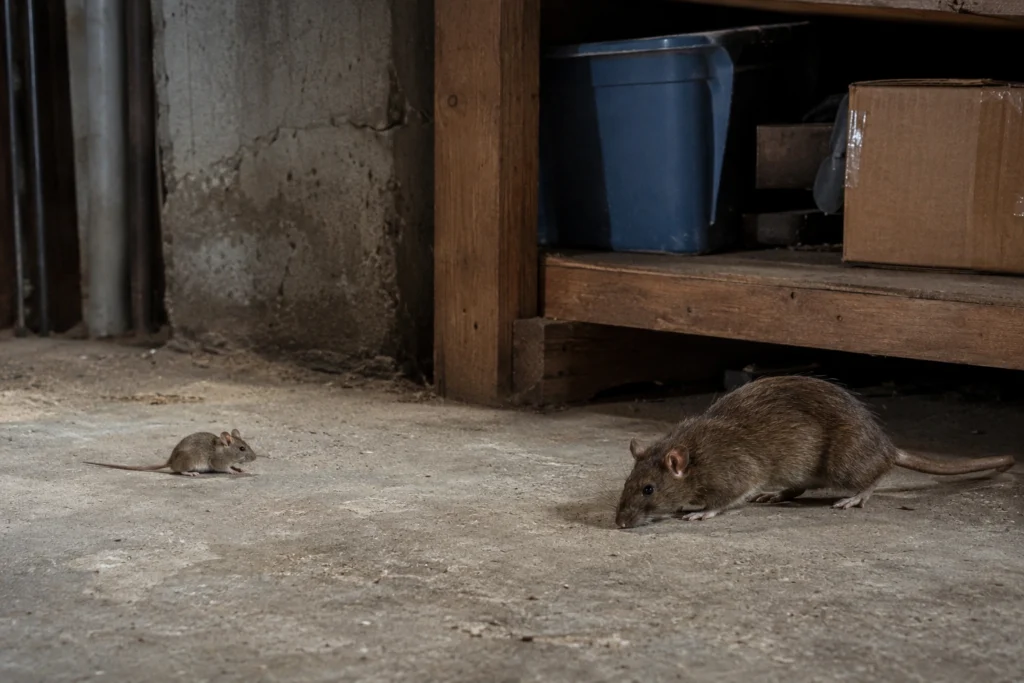
When you see both small rice-grain droppings AND larger capsule-shaped droppings, you likely have both species.
Two Different Sizes of Droppings
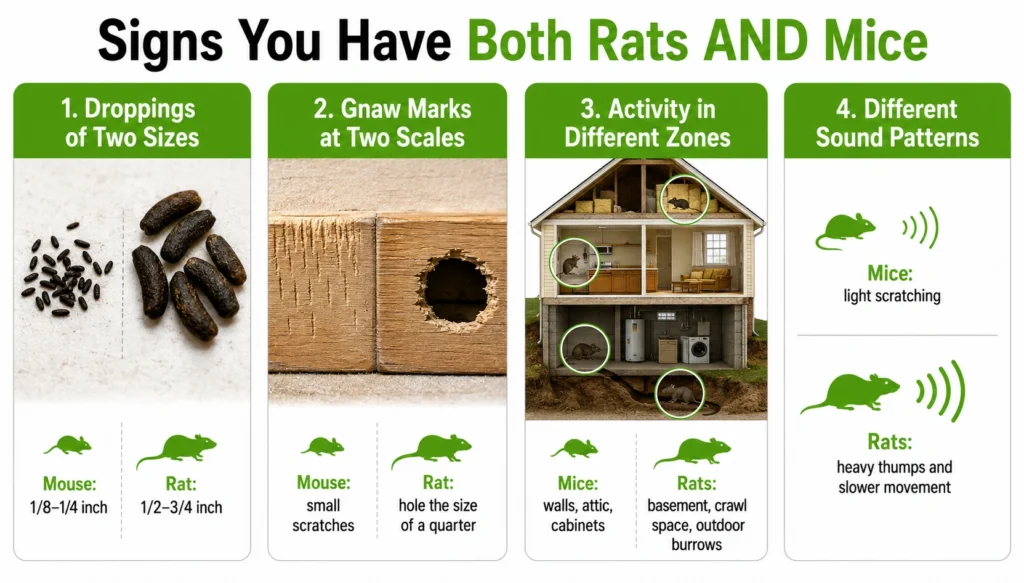
The most reliable sign of dual-species infestation is finding both sizes of droppings in your home. Mouse droppings are tiny (1/8 to 1/4 inch, shaped like rice grains with pointed ends). Rat droppings are much larger (1/2 to 3/4 inch, capsule-shaped). If you’re finding both in the same week, you almost certainly have both species.
The droppings often appear in different rooms because each species typically occupies different territory in the home. Mouse droppings concentrate in pantries, cabinets, drawer backs, and along baseboards on upper floors. Rat droppings concentrate in basements, crawl spaces, garages, and near food storage on lower levels.
Gnaw Marks at Two Different Scales
Mouse gnaw marks are small and scratchy: fine tooth marks on food packaging, the corners of cardboard boxes, and the edges of wooden trim. Rat gnaw marks are dramatically larger, including chewed holes the size of a quarter or larger, gnawed-through electrical wiring, and damaged plumbing or HVAC ducts. Finding both scales of damage in the same home suggests both species are present.
Activity in Different Parts of the House
Because rats are territorial and tend to exclude mice from their immediate range, the two species often partition the home rather than share the same nesting space. Common patterns:
- Rats in the basement or crawl space, mice in the upper-floor walls and attic.
- Rats in the garage and behind the kitchen appliances, mice in the pantry and bedroom closets.
- Rats outdoors in burrows (around the foundation or under decks), with mice indoors year-round.
Sounds at Two Different Volumes
Mice produce light scurrying and scratching sounds, usually high in walls or above ceilings. Rats produce much heavier, slower sounds, often including audible thumps when they jump from surface to surface. If you’re hearing both light scratching and heavier thumping at night, you may have both species in different parts of the home.
Why Rats and Mice Sometimes Coexist
Rats normally exclude mice from their territory. Where one rat is established, mice usually move out or get killed. So how do dual-species infestations happen?
Three factors make co-infestation common in Southeast homes:
Abundant Food and Water
When food is unlimited, competition between species drops. A home with overflowing trash, accessible pet food, an unused pantry, or an unsecured garbage can outside provides enough resources that rats don’t need to actively chase off mice. Both species can sustain populations without fighting for territory.
Separated Territories Within the Home
Larger homes, multi-story homes, and homes with multiple “zones” (basement, crawl space, attic, garage, main floor) give each species its own preferred space. Rats stake out the basement or crawl space. Mice take the attic, upper walls, and pantry. The two populations rarely overlap, so the rats don’t displace the mice.
Different Entry Strategies
Mice enter through holes the size of a dime (around 1/4 inch). Rats need holes the size of a quarter (around 1/2 inch). A home can have both small and large entry points active simultaneously: rats coming in through a garage gap or compromised crawl space vent, mice slipping in through a gap around the dryer vent or a small foundation crack. Each species has its own door, so to speak.
Risks of Co-Infestation
Having both species at once compounds the typical rodent risks in three ways:
Doubled Health Risk Exposure
Mice can transmit hantavirus (especially deer mice), salmonella, and allergens that trigger asthma. Rats can transmit leptospirosis, rat-bite fever, salmonella, and pathogens carried by the fleas that often travel with them. A dual-species infestation exposes your household to the full pathogen profile of both. The CDC’s rodent disease guidance documents the specific risks for each species and recommends professional cleanup of any active rodent contamination, especially when both species are present.
Faster Property Damage Accumulation
Rats cause significant structural damage (chewed wiring, torn insulation, gnawed plumbing). Mice cause widespread food contamination and minor damage to packaging and trim. Together, they produce both types of damage simultaneously, which means repair costs accumulate faster and across more categories than single-species infestations.
More Complex Treatment
The treatment plan for mice doesn’t work as effectively against rats, and vice versa. Mouse-sized snap traps won’t catch a Norway rat. Rat-sized snap traps placed for rat trails will be ignored by mice on completely different routes. Bait stations sized for one species often go untouched by the other. Treating both species at once requires planning trap and bait placement for two different size profiles, two different behavior patterns (mice are curious, rats are cautious), and two different territory maps.
Natural and Preventive Measures
The good news: the prevention measures that work for either species work for both. Co-infestation prevention is the same as single-species prevention, just applied more thoroughly.
Seal Entry Points (at Two Different Sizes)
- Walk the foundation and look for any opening larger than 1/4 inch. Mice can squeeze through anything bigger.
- Seal small gaps with steel wool and caulk. Steel wool is the only material rodents can’t gnaw through.
- Look for larger openings the size of a quarter or bigger. Garage door gaps, compromised crawl space vents, unsealed utility line penetrations, and damaged soffits are common rat-sized entry points.
- Install door sweeps and weatherstripping. Worn weatherstripping on garage side doors and basement hatches is a leading cause of rodent entry in older Southeast homes.
- Screen every crawl space vent with galvanized 1/4-inch hardware cloth.
Cut Off Food and Water
- Store all food (including pet food) in airtight glass or hard plastic containers, not bags.
- Take out trash daily during warm months and use lidded cans both indoors and outdoors.
- Fix slow drips and leaky pipes. Both species need water and seek it out.
- Don’t leave standing water in pet bowls overnight in active rodent areas.
Reduce Harborage
- Cut clutter in basements, attics, garages, and stored areas. Both species nest in undisturbed clutter.
- Move cardboard storage to plastic bins. Mice and rats both gnaw through cardboard easily.
- Trim outdoor vegetation back from foundations and rooflines. Rats use vegetation as cover; mice travel along it.
- Store firewood at least 20 feet from the house on raised racks.
Outdoor Yard Maintenance
- Keep grass short along the foundation.
- Remove fallen fruit under pecan, fig, or persimmon trees promptly.
- Don’t leave pet food bowls outside overnight.
- Block burrow entrances under decks and sheds with hardware cloth.
Dual-species infestations need traps and bait stations sized for both rat and mouse activity in different parts of the home.
When to Call a Professional for Dual-Species Rodent Control
Dual-species infestations are one of the situations we strongly recommend professional treatment for. The reason isn’t the rodents themselves (DIY can handle individual species), it’s the complexity of treating two species simultaneously without one undermining the treatment for the other.
Call Northwest for professional dual-species rodent control if:
- You’ve found droppings of two different sizes in the same week.
- You’ve heard both light scratching and heavier thumps in different parts of the house.
- Sightings or signs have appeared in both upper and lower levels of the home.
- DIY traps caught some rodents but the activity hasn’t stopped.
- You’re seeing rodents during daylight hours, which usually indicates a large hidden population.
- You’ve found gnaw marks at both small and large scales.
Northwest’s rodent control approach for co-infestations uses integrated pest management (IPM): identifying species and territory, setting appropriately-sized traps and bait stations for each species, sealing entry points at both 1/4-inch and 1/2-inch+ scales, and following up to confirm both populations have cleared before closing out the treatment.
(Suspect both rats and mice are present? Request a free Northwest rodent inspection and we’ll identify both species, map their territories, and lay out the dual-species treatment plan.)
What Happens If You Treat Only One Species
This is the most common mistake we see in homes that have tried DIY rodent control before calling us. A homeowner spots a few small droppings, identifies mice, sets mouse-sized snap traps in the pantry, catches three or four mice, and concludes the problem is solved. Two weeks later they’re hearing thumps in the basement at night and finding much larger droppings near the water heater.
That happens because rats and mice often coexist quietly in different parts of the home. Treating only the mice leaves the rat population fully intact. Within a few months, the rat population grows large enough to become noticeable on its own, and what felt like a successful single-species treatment turns into a much bigger second problem.
Effective rodent control assumes co-infestation is possible and treats accordingly: traps and bait stations sized for both species, placed throughout the entire structure, with follow-up to confirm both populations have cleared.
Rodent Control Drives Other Pest Outcomes
One last point worth knowing. Rodent populations don’t sit in isolation. They drive other pest outcomes in your home:
- Fleas and mites ride in on rodents and establish indoor populations of their own.
- Snakes follow rodent populations as a food source. The single most common reason snake sightings spike in a Southeast yard is an unaddressed rodent problem in or under the house. See our snake repellent guide for more on the rodent-snake connection.
- Stored product pests (pantry moths, weevils, beetles) thrive in the contaminated food residues rodents leave behind.
Solving a dual-species rodent infestation often clears two or three secondary pest issues at the same time.
Frequently Asked Questions About Rats and Mice
Can rats and mice live in the same area at the same time?
Yes. When food, water, and shelter are abundant and the two species can occupy separated territories within the home (rats in basements or crawl spaces, mice in walls or attics), they can coexist. About one of every six rodent calls we run involves both species in the same home.
How do I know if I have rats or mice or both?
The clearest sign is finding droppings of two different sizes. Mouse droppings are tiny (1/8 to 1/4 inch) and rice-shaped. Rat droppings are larger (1/2 to 3/4 inch) and capsule-shaped. Two different scales of gnaw marks, two different sound patterns (light scratching plus heavier thumps), and activity in different parts of the house also indicate co-infestation.
Are rats more dangerous than mice?
Rats cause more structural damage and carry a broader range of diseases than mice. Both species warrant treatment, but rat problems should be addressed faster. When both species are present, the combined health-risk and damage profile is more serious than either alone.
How quickly can rodents multiply?
Mice reproduce very fast: 5 to 10 litters per year per female, with each litter containing 5 to 8 pups. A single pair can become dozens within a few months. Rats reproduce more slowly (2 to 5 litters per year) but produce larger litters of 8 to 12 pups each. In a dual-species infestation, the mouse population usually grows faster than the rat population.
What’s the best way to remove rats and mice from a home?
Effective dual-species removal combines exclusion (sealing entry points at both 1/4-inch and 1/2-inch+ scales), sanitation (removing food and water access), and species-appropriate trapping and baiting. Professional integrated pest management is the most reliable approach when both species are confirmed present, because the treatment plan needs to address two different size profiles, behavior patterns, and territory maps simultaneously.
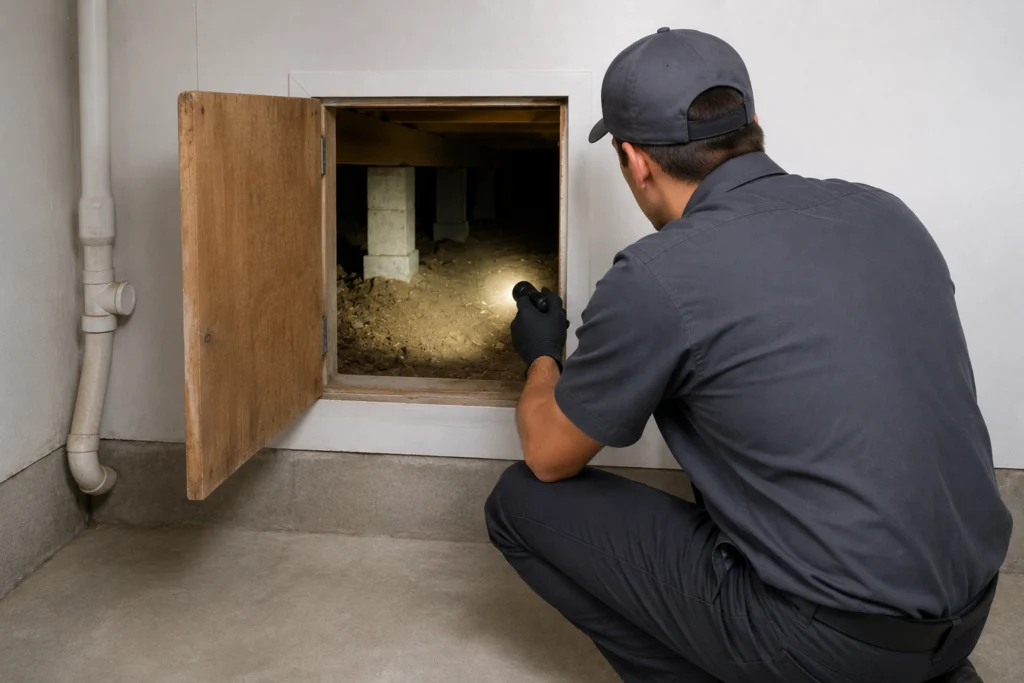
A dual-species inspection looks for entry points at two different sizes in two different parts of the home.
Schedule a Rodent Inspection
If you suspect both rats and mice are in your home, or you just want a professional confirmation of which species you’re dealing with, the smartest move is an inspection before the populations grow further. Dual-species infestations are very treatable when caught early, and Northwest’s team has been clearing rodent problems out of Georgia, Alabama, Tennessee, and South Carolina homes for decades.
About the Author
Anna Vaccaro, Editorial Lead — Pest Education leads pest education content for Northwest Exterminating, working with senior technicians and service center managers across our Georgia, Alabama, Tennessee, and South Carolina service areas to translate field expertise into homeowner-friendly guides. The focus: accurate, regionally-specific answers to the pest questions Southeast homeowners are actually searching for.
Oct 13, 2021 | Pest Control
During the colder months, rats are looking indoors for shelter, providing them with warmth and a food source. Once inside, they can not only cause considerable damage to homes by gnawing electrical wires, but they can also pose health risks as they are known to carry bacteria, such as salmonella. To help avoid these pests, every homeowner should utilize preventative measures throughout their house for rodent control.
Keeping the exterior of your home well-sealed is the first step to prevent rats from the inside. Check around the outside of your home for any gaps or holes that are leading inside. Make sure to seal around any openings in the walls, especially utility pipes and vents. Consider installing weather stripping for the gaps in doors and windows.
While outside, look throughout your yard for debris such as piles of leaves or excess woodpiles. Rats will often use these to hide or take cover. Consider keeping your woodpiles 20 feet from your home. Try to keep your shrubbery away from the sides of your home and mow the grass frequently.
Rats are always in search of a food source. Eliminating access to food from your property is another great way to keep them from infesting. If you leave your pet bowls outside, consider bringing them inside to avoid attracting them. Make sure to keep all food, including pet and bird food, in airtight containers. Likewise, make sure your trash cans are sealed tightly and take the garbage out frequently.
Suspecting that you have a rat inside your house is always alarming. It’s best to contact a pest control professional who can inspect your home, identify the type of rat, and set you up with a comprehensive treatment plan.