Oct 15, 2024 | Florida Pest Control
If there’s one thing most of us can agree on, it’s that spiders belong outside, not taking over our Naples homes! While these eight-legged visitors may be great for controlling other pests, no one wants to find them lurking in every corner of our home and property. If you’re tired of spotting webs and want to keep spiders out of your home, here’s how you can send them packing!
Easy DIY Steps to Keep Spiders Out
Naples offers a warm, humid climate that spiders thrive in! These pests are attracted to dark, undisturbed places like attics and even your closets. Plus, if you’ve got other pests hanging around, spiders will happily stick around for an easy meal. Check out our do-it-yourself tips to deter spiders from your home and property:
- Seal Up Entry Points: Spiders are sneaky and can slip through tiny cracks in doors, windows, and walls. Make sure to check for gaps or holes around your home and seal them with caulk or other sealants, depending on the size of the opening. Pay extra attention to places like vents, pipes, and electrical outlets.
- Declutter Your Spaces: Spiders love clutter! Piles of clothes, old boxes, and unused furniture give them the perfect hiding spots. Keep things tidy, especially in storage areas like the garage, attic, or basement, where spiders often make themselves at home.
- Turn Off Outdoor Lights at Night: Outdoor lighting can attract household pests, which in turn attract spiders. Turning off unnecessary lights in the evening can help reduce the spider activity around your home.
- Keep Your Home Clean: Spiders love places that are dusty and undisturbed. Regularly vacuuming, dusting, and wiping down surfaces can help make your home less inviting to them. Don’t forget to sweep away those webs too!
- Control Other Insects: Spiders go where their food is – so if you’ve got a pest problem, you’re likely to see spiders, too. Consider scheduling regular pest control treatments to help keep household pests in check.
- Consider Natural Repellents: Certain essential oils, like peppermint and tea tree oil, are known to repel spiders. You can mix a few drops of water and spray it around windowsills, doorways, and other spider-prone areas for a natural deterrent.
If you’ve tried everything and still find spiders creeping around, it might be time to call a local pest control company near you. These professionals can treat both the inside and outside of your home, ensuring that you can keep spiders out of your home.

Jul 10, 2024 | DIY Pest Control, Florida Pest Control
Spiders are typically harmless and even deemed beneficial by controlling other pests, but having them in your home can be alarming! We breakdown some easy do-it-yourself spider prevention tips that you can use around your Lauderhill home.
DIY Spider Prevention Tips
Keep you Home Clean & Clutter-Free
Spiders love to hide in cluttered spaces, so keeping your home clean and tidy can significantly reduce the chances of them making themselves at home. Always vacuum regularly, paying extra attention to corners, underneath furniture, and hard-to-reach areas. Look at dust surfaces and if you spot a spider web with no spider, carefully remove the web. It’s also crucial to declutter storage spaces, basements, attics, and garages. Organize items in sealed plastic containers instead of cardboard boxes, which spiders will infest.
Seal Entry Points
Spiders will enter homes through the tiniest cracks and gaps. Sealing these openings will help keep them from entering. Inspect your home and check for cracks in the walls, windows, and doors. Seal any you may find as soon as possible with sealant or caulk. Ensure that your windows and vents have tight-fitting screens, replacing any damaged screens to prevent entry.
Reduce Outside Lighting
Spiders are attracted to insects, which are drawn to lights at night. Look to reduce outdoor lighting to minimize spider activity. Replace white bulbs with yellow bulbs, as insects are less attracted to it. Additionally, consider utilizing timed outdoor lights to avoid them staying on overnight and attracting insects.
Maintain Your Yard
Your yard is the first line of defense to discourage spiders from entering your property, so it’s important to keep it well-maintained. Keep shrubs, trees, and other plants trimmed and pointing away from your home. Clear out leaves, unused woodpiles, and debris that spiders can hide in. If you use mulch, avoid placing it near your foundation so it doesn’t provide a habitat for spiders and other pests.
Regularly Inspect for Spiders
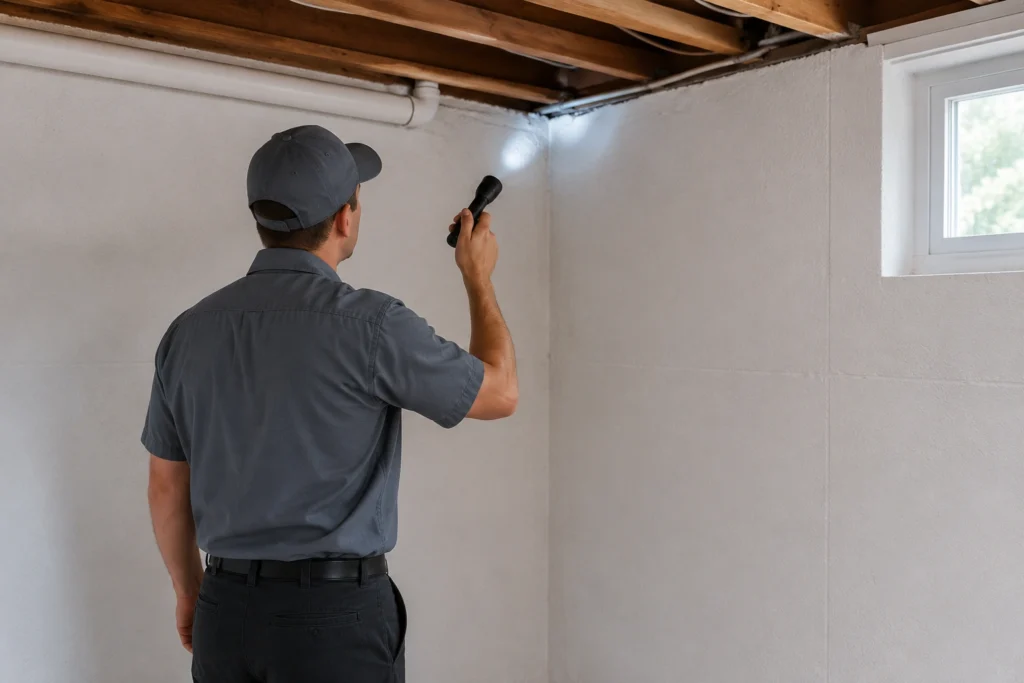
Keeping an eye out for early signs of spider activity will help you address the issue before it becomes a full-blown infestation. Make sure to regularly inspect areas like closets, basements, and garages for webs and spiders.
If you notice a significant spider problem, it’s always best to call a pest control company near you to help. These professionals will provide you with a comprehensive inspection and the best pest control plan for your situation.
Feb 16, 2024 | Georgia Blogs, Pest Control
By Anna V., Editorial Lead — Pest Education · Last updated: May 2026
Few household pests collect as many bad facts as the daddy long legs spider. The “world’s most venomous spider but can’t bite you” story has been around forever. The “it’s actually a fly, not a spider” theory has its own corner of the internet. At Northwest, we field these questions every spring from Georgia and Alabama homeowners spotting long-legged spiders in basements, garages, and ceiling corners. The truth is much less dramatic and much more useful: the daddy long legs spider is a real spider (eight legs, two body parts, makes silk), it’s almost entirely harmless to humans and pets, and it actually helps keep other household pests in check.
Here’s what a daddy long legs spider actually is, how to tell it apart from the bug it gets confused with most often (the crane fly), and what to do when you find one in the house.
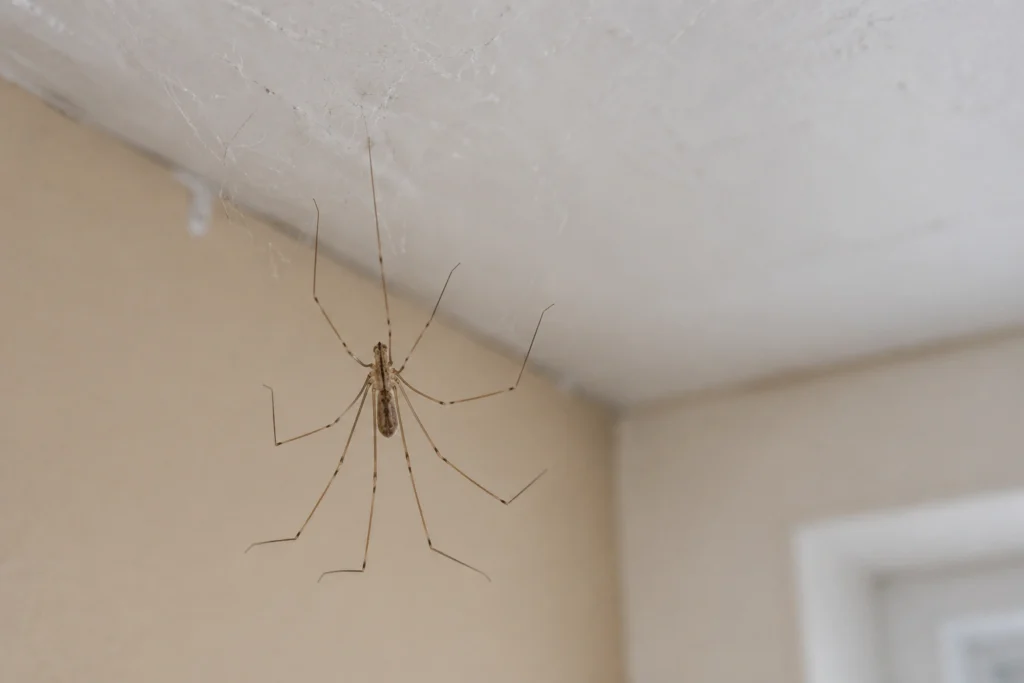
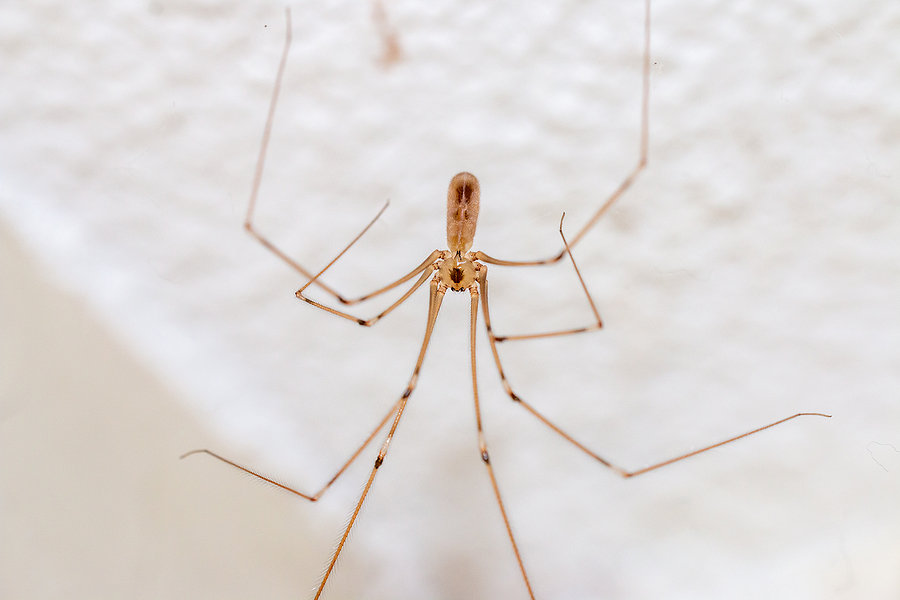
The daddy long legs you see indoors is almost always a Pholcidae spider, not a fly.
What Is a Daddy Long Legs Spider?
The term “daddy long legs” gets applied to three different creatures depending on where in the country you grew up. In the Southeast, when someone says they have a daddy long legs in the house, they almost always mean a cellar spider (family Pholcidae). These are real spiders: eight legs, two clear body segments (cephalothorax and abdomen), silk-producing spinnerets, the works.
The other two creatures sometimes called “daddy long legs” are:
- Harvestmen (order Opiliones) — arachnids, but not actually spiders. One fused body segment, no silk, no venom. Typically outdoors.
- Crane flies (order Diptera) — actual insects with six legs and wings. They look like enormous mosquitoes and show up around porch lights. They don’t bite. They don’t sting. They aren’t spiders at all.
For homeowners spotting one indoors, the answer is almost always option one: a Pholcidae spider. If you want the full myth-busting overview of all three creatures and why the name gets so confused, see our guide to granddaddy long legs myths vs facts.
Daddy Long Legs Spider vs Crane Fly & Other Lookalikes
The single most common identification mistake we see homeowners make is calling a crane fly a spider. They have very different bodies once you know what to look for.
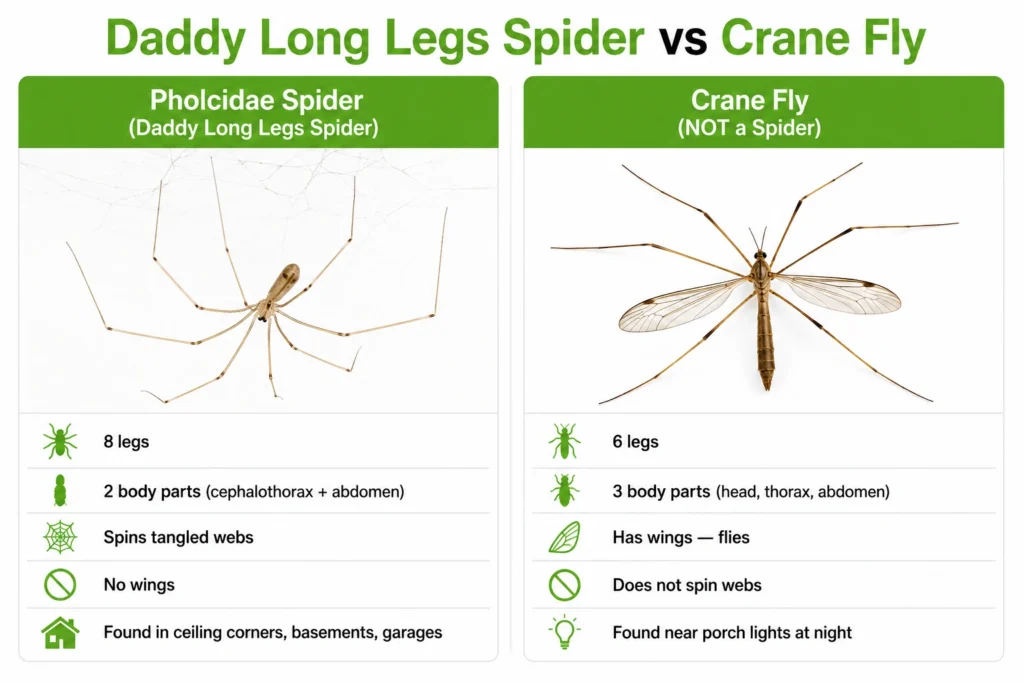
Eight legs and two body parts mean spider. Six legs and wings mean crane fly.
Spider vs Insect Anatomy
The fastest way to tell them apart is to count legs and body segments:
- Spiders have 8 legs, 2 body parts, no antennae, and produce silk.
- Insects (including crane flies) have 6 legs, 3 body parts, antennae, and do not produce silk.
If you can see a small tangled web nearby, you’re looking at a spider. If the creature has wings, you’re looking at an insect.
Visual Cues at a Glance
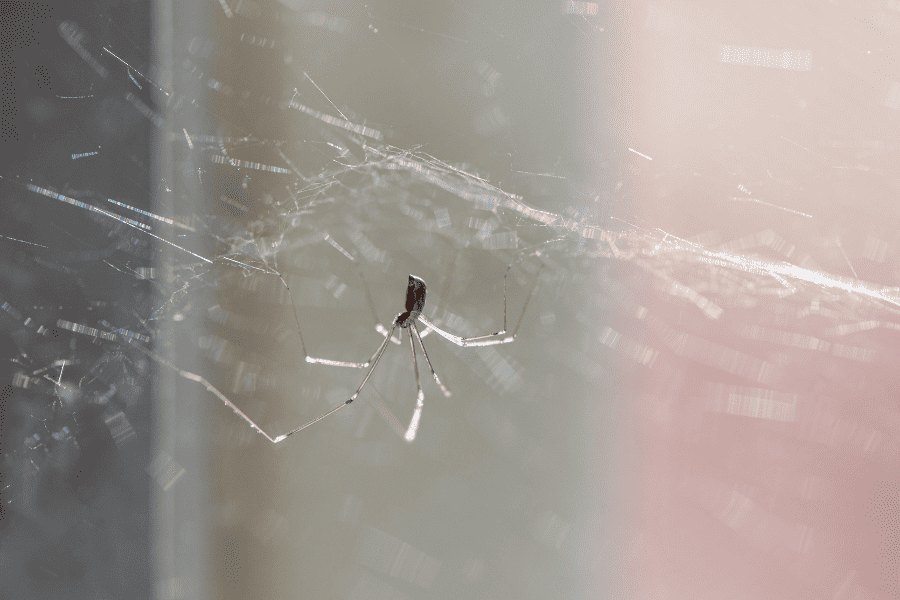
Daddy long legs spiders hang upside down in messy, irregular webs strung across ceiling corners and the angles where walls meet shelving units. They move with a distinctive “bouncing” motion when their web is disturbed (it’s a defense behavior). Crane flies, by contrast, are usually seen flying clumsily around porch lights, resting on exterior walls, or sometimes blundering into the kitchen through an open door. They don’t sit in webs because they don’t make them.
Are Daddy Long Legs Spiders Dangerous?
This is the question we get most often. The short answer: no.
The “world’s most venomous spider but their fangs can’t pierce human skin” story is almost completely false. Two pieces of it are true: Pholcidae spiders do produce a small amount of venom (they use it to subdue prey), and their chelicerae (mouthparts) are indeed quite small. But the venom itself is not exceptionally potent, especially not to humans. The few documented Pholcidae bites on humans show only minor, brief irritation — less than a mosquito bite, in most cases. There is no medical record of a serious human reaction.
Three plain facts about daddy long legs spider safety:
- They almost never bite humans. Bites only occur if the spider is physically pressed against skin (caught under clothing, trapped against a hand).
- Their venom is not dangerous. The “world’s most venomous” claim is internet folklore with no scientific basis.
- They actively help with other pests. Pholcidae spiders eat mosquitoes, gnats, flies, moths, and even other spiders. A small population in a garage or basement is essentially free natural pest control.
The University of Georgia Extension’s guide to common household spiders confirms the same: Pholcidae are among the most harmless spiders you’ll encounter indoors in the Southeast.
Daddy Long Legs Spider Behavior & Habitat
Where you find a daddy long legs spider in your Georgia or Alabama home tells you a lot about how it got there and how to handle it.
Where They Live Indoors
Daddy long legs spiders are drawn to undisturbed corners and dim, slightly humid spaces. The most common indoor locations:
- Ceiling corners of basements, garages, and crawl spaces
- Under stairs, in laundry rooms, and around hot water heaters
- Inside sheds, detached garages, and outbuildings
- Behind rarely-moved furniture and stored boxes
What They Eat
Pholcidae spiders are predators. Their diet inside a house includes:
- Mosquitoes, gnats, fungus gnats
- House flies and fruit flies
- Moths and small beetles
- Other spiders, including larger species like wolf spiders (they’re surprisingly aggressive predators of bigger spiders)
This last point is worth pausing on. A daddy long legs spider in your garage is actively reducing the population of more concerning spiders nearby. We’ve seen homes with persistent wolf spider sightings clear up after homeowners stopped knocking down Pholcidae webs.
Daddy Long Legs Spider in Your Home: When You See Them and Why
Indoor daddy long legs sightings spike at two predictable times of year in the Southeast:
- Early fall (September through November), when outdoor temperatures drop and the insects spiders feed on start moving indoors looking for shelter. The spiders follow.
- Late summer (July through August), when peak indoor insect populations attract more spiders into rooms with the worst pest pressure (kitchens with fruit flies, bathrooms with drain flies, basements with fungus gnats).
If you’re suddenly seeing more daddy long legs than usual, the message is almost always: there’s another pest issue inside that’s drawing them. Address the small flies, mosquitoes, or fungus gnats and the spider numbers drop on their own.
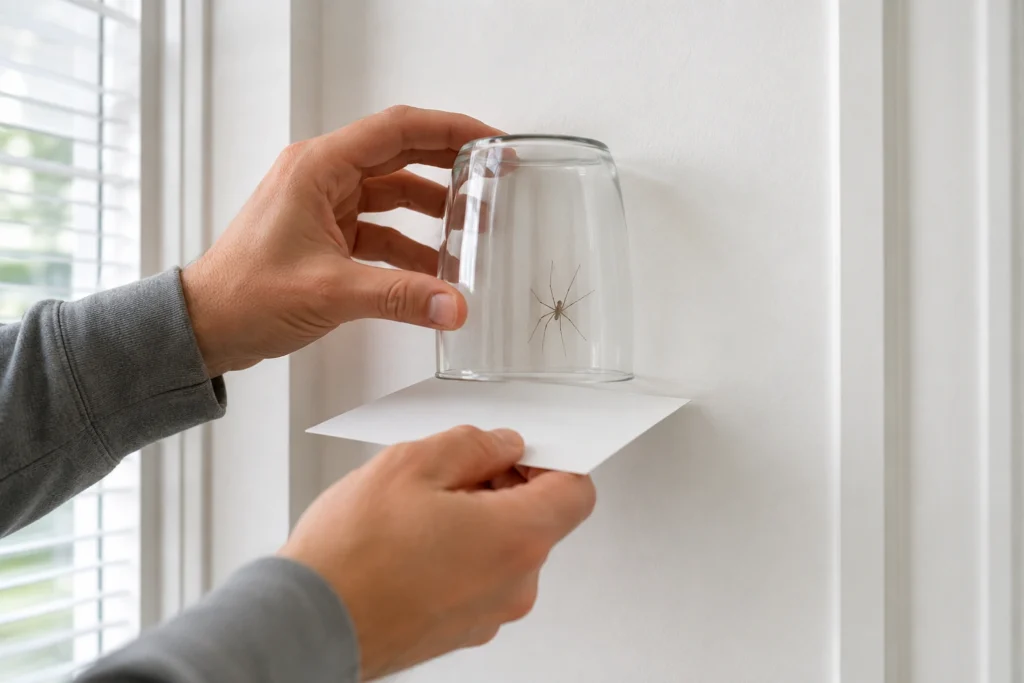
A cup and piece of cardboard handles most indoor sightings without anyone getting hurt.
How to Manage or Remove Daddy Long Legs Spiders
Most homeowners want a daddy long legs spider gone for one of two reasons: the webs look bad, or there are a lot of them in one room. Neither is dangerous, but both are addressable.
Prevention
- Seal entry points. Cracks around windows, gaps in foundation, openings around utility lines, torn weatherstripping. Spiders walk in through the same gaps as ants and roaches.
- Cut indoor insect populations. Drain flies, fruit flies, gnats, mosquitoes, and moths are the food source. Less food, fewer spiders.
- Reduce clutter in basements, garages, and storage areas. Spiders need stable, undisturbed surfaces to build webs.
- Manage humidity. Pholcidae prefer slightly damp environments. A dehumidifier in a wet basement reduces their preferred conditions.
- Move outdoor lights away from entry doors. Porch lights pull insects toward the house. Insects pull spiders.
Humane Removal
For one or two spiders, the simplest method is the cup-and-cardboard relocation. Slide a glass cup over the spider, slide cardboard underneath, carry it outside, release. Vacuum cleaner attachments work too if you’d rather not handle the spider directly. For visible webs, a long-handled duster or vacuum hose attachment clears them in seconds without harming the surrounding paint.
When Professional Help Makes Sense
Call for professional pest control if:
- You’re seeing more than 10 to 15 daddy long legs spiders in a single room consistently.
- Webs reappear within 24 to 48 hours of being cleared.
- You’re also seeing other pests (small flies, moths, mosquitoes) indoors, which means the underlying food source needs treatment.
- You want a clean exclusion plan that addresses entry points along with current activity.
(Spiders keep coming back faster than you can clear them? Request a free Northwest inspection and we’ll find the actual source.)
Daddy Long Legs Spiders vs Other Common Household Spiders
If you’re trying to figure out exactly which spider you’ve got, the most important distinction is between daddy long legs spiders (harmless, helpful) and the few spider species that actually warrant concern in the Southeast.
- Daddy long legs spider (Pholcidae) — small body, very long thin legs, tangled corner webs. Harmless.
- Cellar spider — technically the same as a daddy long legs spider in most cases. See our detailed cellar spider vs daddy long legs comparison.
- Wolf spider — large, hairy body, ground-dwelling, doesn’t make webs. Not dangerous but startling.
- Orb weaver — large symmetrical webs (the classic Halloween web shape). Outdoor species, mostly harmless.
- Brown recluse — uncommon but present in parts of the Southeast. Small brown body with a violin-shaped marking on the back. Bite is medically significant. If you’re not sure, call us.
- Black widow — jet-black body, red hourglass on the underside. Bite is medically significant. Less common indoors than outdoors.
Frequently Asked Questions About Daddy Long Legs Spiders
Do daddy long legs spiders spin webs?
Yes. Pholcidae spiders produce loose, irregular, tangled webs in ceiling corners, the angles between walls and floors, and the upper corners of basements and garages. The web is the easiest way to confirm you’re looking at a spider and not a crane fly (which has no web).
What do daddy long legs spiders eat?
They eat small flying insects (mosquitoes, fruit flies, gnats, moths) and surprisingly often, other spiders. A small population in a garage or basement is effectively free pest control for the kinds of bugs you don’t want.
Can daddy long legs spiders bite humans?
Bites are extraordinarily rare and typically only occur if the spider is trapped against skin. Symptoms are mild — usually less than a mosquito bite — and the persistent rumor that their venom is “the most dangerous in the world” is not supported by any scientific evidence.
Are daddy long legs spiders helpful?
Yes. They actively reduce other indoor pest populations, including more concerning spider species like wolf spiders. Most pest professionals (including ours) tell homeowners to leave one or two alone in the garage or basement as a form of natural pest control.
How do I get rid of daddy long legs spiders if I want them gone?
Seal entry points around windows and foundation, address the indoor insect populations they feed on, cut clutter in storage areas, and relocate visible spiders with a cup-and-cardboard method. If they keep returning quickly, there’s usually a moisture or food-source issue worth a professional inspection.
When spiders keep returning, the issue is usually whatever they’re eating.
Stop Worrying About Daddy Long Legs Spiders
If you’re seeing daddy long legs spiders and you’d rather not, the good news is they’re one of the easiest spider issues to solve. They’re harmless, they respond to environmental changes, and they’re often a signal that another (more fixable) pest issue is going on indoors. Northwest’s team has been clearing spider problems out of Georgia and Alabama homes for decades, and most of what we do for spider calls is actually addressing the food source they’re feeding on.
About the Author
Anna Vaccaro, Editorial Lead — Pest Education leads pest education content for Northwest Exterminating, working with senior technicians and service center managers across our Georgia, Alabama, Tennessee, and South Carolina service areas to translate field expertise into homeowner-friendly guides. The focus: accurate, regionally-specific answers to the pest questions Southeast homeowners are actually searching for.
Jan 5, 2024 | Pest Control
Georgia is no stranger to household pests. One common visitor that many Georgians encounter is the daddy long legs, a unique arachnid that often finds its way into homes. In this blog post, we’ll explore what attracts daddy long legs, how to identify them, reasons for a daddy long legs infestation, whether they pose a threat to humans, and effective ways to prevent and eliminate them. If you’re dealing with a daddy long legs infestation, read on for valuable insights and practical solutions.
Identifying Daddy Long Legs
Daddy long legs, scientifically known as Opiliones, are not true spiders but belong to the arachnid family. They are characterized by their long, thin legs and small, oval-shaped bodies. Unlike spiders, daddy long legs have a fused body structure and lack venom glands. Their appearance can sometimes be confused with cellar spiders, but the absence of a segmented body distinguishes them.
Why Daddy Long Legs Invade Homes
Understanding the reasons behind daddy long legs entering homes is crucial for effective control. These arachnids are attracted to damp and dark environments, making basements, crawl spaces, and garages ideal habitats. Additionally, they are opportunistic feeders, preying on small insects and other arthropods found in and around homes. The presence of abundant prey can draw daddy long legs indoors.
Are Daddy Long Legs Dangerous to Humans?
The good news is that daddy long legs are not harmful to humans. Contrary to popular myths, they do not possess venomous fangs and are not capable of biting. In fact, these arachnids play a beneficial role by feeding on other pests, helping to control insect populations around your home. While their presence may be unsettling to some, daddy long legs pose no direct threat to your health.
Preventing and Eliminating Daddy Long Legs
To keep daddy long legs at bay, consider implementing the following preventive measures:
- Seal Entry Points: Conduct a thorough inspection of your home and seal any cracks or gaps in doors, windows, and foundations.
- Reduce Moisture: Daddy long legs thrive in damp environments, so address any water leaks or humidity issues in basements and crawl spaces.
- Declutter: Keep your living spaces clutter-free to minimize hiding spots for these arachnids.
- Outdoor Maintenance: Trim vegetation around your home, keeping it away from the exterior walls to reduce the likelihood of daddy long legs entering.
- Professional Pest Control: Enlist the services of a reputable pest control company to conduct regular inspections and treatments, ensuring effective daddy long legs and spider control.
If you’re dealing with a daddy long legs invasion or any other pest issues in Georgia, don’t hesitate to reach out to our expert team. Request a free pest control quote today and let us help you create a pest-free environment in your home. Protect your family and property with our reliable pest control services.
Remember, a proactive approach to pest control is key to maintaining a comfortable and pest-free living space. Contact us now and take the first step toward a pest-free home!
Nov 30, 2023 | Florida Pest Control
If you’ve noticed an increase of spiders inside your Florida home, it can be quite alarming for most homeowners! While most spiders are not dangerous to humans and are considered a benefit to our environment, it doesn’t mean you want them inside your house. With several species found in Florida, including daddy long legs, southern house spider, black widows, and more, it’s inevitable to come across one, but it’s easy to prevent, reduce, or eliminate their presence around your home. Check out the reasons why spiders are entering your home and easy spider prevention tips to avoid them in the future.
Why Do Spiders Enter Homes?
Spiders enter homes to search for food and find a habitat to continue looking for prey to feed on. Spiders eat insects, so if you’ve found webs around your home, it’s likely that those spiders found their food source. Inspect the inside and outside of your home for spider signs, these include spider webs, egg sacs, insects they feed on, or the spiders themselves.
How Can I Stop Spiders from Invading My Home?
There are several ways you can help reduce spider activity on your property. Spiders are looking for food, so it’s important to reduce the amount available to them by removing other household pests from your property. You can reduce the insects on your property by:
- Keeping your outside garbage cans covered and sealed with a tight lid
- Keep your exterior lights off at night or replace your white lights with yellow lights
- Address any moisture problems throughout your home, including clogged gutters, leaky pipes, crawlspace issues.
- Some insects like certain vegetation, such as weeds, look to reduce some around your home.
Not only is it important to reduce the insect population to avoid spiders, but it is equally important to deter them from even entering your home. Consider these spider prevention tips to avoid them from invading indoors:
- Seal any holes or openings found in your windows, doors, and foundation.
- Repair torn screens, broken windowpanes, and damaged seals.
- Spiders can slip under doors, consider installing weatherstripping to close that gap.
- Spiders like to hide in clutter, so remove unnecessary items in your yard such as old tires, rock piles, old lumber, and even old vehicles.
- Keep a tidy home and remove old newspapers or magazines.
If you’ve noticed more spider activity than you’re used to, consider calling your local Florida pest control company for help. These professionals will provide you with a thorough inspection and recurring pest control plan to help avoid spiders and other household pests in the future.