Feb 11, 2020 | Termite Control
Termites cost homeowners billions of dollars each year in damages, treatments, and repairs. While traditional termite treatments are extremely effective at eliminating and controlling termite populations, environmentally sensitive homeowners often go in search of more green pest control options. One popular trend on the market today is orange oil treatments. Orange oil is an extract from orange rinds and is commonly used in cleaning solutions and food additives. The active ingredient in orange oil treatment is D-limonene which kills termites on contact by breaking down their exoskeleton and destroying their eggs. Orange oil treatments are the most common no-tent, no move out, organic termite control solutions.
Let’s look at some of the pros and cons of orange oil termite treatments:
Pros
- Low toxicity and more environmentally friendly than other termite control options
- Effective against drywood termites, carpenter ants, and wood-boring beetles
- No need to move out at night during treatment
- No need to remove plants or board pets during treatment
- No need to bag up food or medicinal supplies during treatment
- No potential damage from treatment to roof tiles
Cons
- Not effective against subterranean termites
- Although low toxicity, should not be ingested. Prolonged exposure to oil or fumes can cause skin and eye irritation, nausea and vomiting, lung irritation, and other symptoms
- Product is flammable and combustible once wicked into wood
- Only kills termites on contact and will not kill any undetected infestations
- Treatment requires drilling holes into your walls and other wood components of your home
- Multiple treatments are required as the entire colony is usually not exterminated during a single treatment
- Treatment of larger infestations can be more expensive than fumigation methods
- Treatment can only be applied to existing infestations; there is no residual protection against future infestations
Orange oil treatments are only effective against drywood termites because these pests live and colonize the wood they are infesting. They are not effective against subterranean termites as these pests live in the soil and only come up to feed on wood. Orange oil treatments will begin with a termite inspection to determine the type of termite and the extent of the infestation. Once the areas of termite damage and activity are identified, the technician will drill a hole into the wood and treat the infested areas. Orange oil is then injected into these drilled holes where it spreads throughout the wood beams via capillary action, passing through porous cells in all directions. This kills any termites and eggs on contact. This does not, however, kill any termites that don’t come in contact with the oil treatment. After treatment, the holes are then patched and painted.
In summary, orange oil does, in fact, kill termites but it is limited in its effectiveness. It is considered a secondary spot treatment as it is only effective when it is applied to areas with active infestations. Any termites that remain undetected and untreated will continue to eat, continuing the damage to your home. Because of this, multiple treatments are usually required. These treatments don’t eliminate the entire termite colony, leaving your home vulnerable. Whole structure treatment (fumigation) is a guaranteed method of completely exterminating termites from a structure. During fumigation, the whole house is treated at once. Fumigant gas is used to penetrate the walls, floor, lumber, and other surfaces where termites reside. If you suspect you have a termite issue, contact a professional pest control company who can help identify the type of termite you have, the scope of the infestation, and the best treatment options for your home.
You May Also Be Interested In:
How Much Does It Cost To Remove Animals From Your Attic?
Is Mosquito Control Needed in Winter?
Cold Weather Sends Roaches Indoors: 5 Tips to Prevent Them This Winter
Is Green Pest Control Worth The Investment?
Winterize Your Home With TAP Insulation

Jan 10, 2020 | DIY, DIY Wildlife Prevention, Wildlife
By Anna V., Editorial Lead — Pest Education · Last updated: May 2026
Birds are great when they’re in trees. They’re a problem when they’re nesting in your dryer vent, leaving droppings down your siding, or waking you up at 5 AM with constant chirping above your bedroom ceiling. If you’re searching for how to get rid of birds safely and effectively, you’re in the right place. At Northwest, we run bird control calls year-round across our Georgia, Alabama, Tennessee, and South Carolina service area, and the question we hear most often is some version of: I tried [home remedy]. Why are they still here?
Video Transcript
Some birds are beautiful to watch, but when they start nesting on your home, the damage and mess can add up fast.
Droppings can carry disease. Nests can clog vents and chimneys, and addicts can quickly become unwanted bird hangouts.
Here are three smart ways to keep birds from moving in. First, remove what attracts them. Birds come for easy food and water. Keep grass trimmed to reduce insects. Store pet food in sealed containers and eliminate standing water whenever possible. Second, make surfaces uncomfortable. Shiny objects like foil strips or pie plates reflect light and scare birds away.
Double-sided tape or baking soda on ledges and railings can stop perching almost immediately. Third, maintain your yard and know the rules. Trim trees and shrubs, but never remove an active nest. Laws protect many birds. When you’re ready to call a professional for a peaceful home, feel free to reach out to our team at Northwest Exterminating.
Here’s a realistic look at what works, what doesn’t, and what’s legally required when birds set up shop on your house. Plus what to do when DIY isn’t enough.
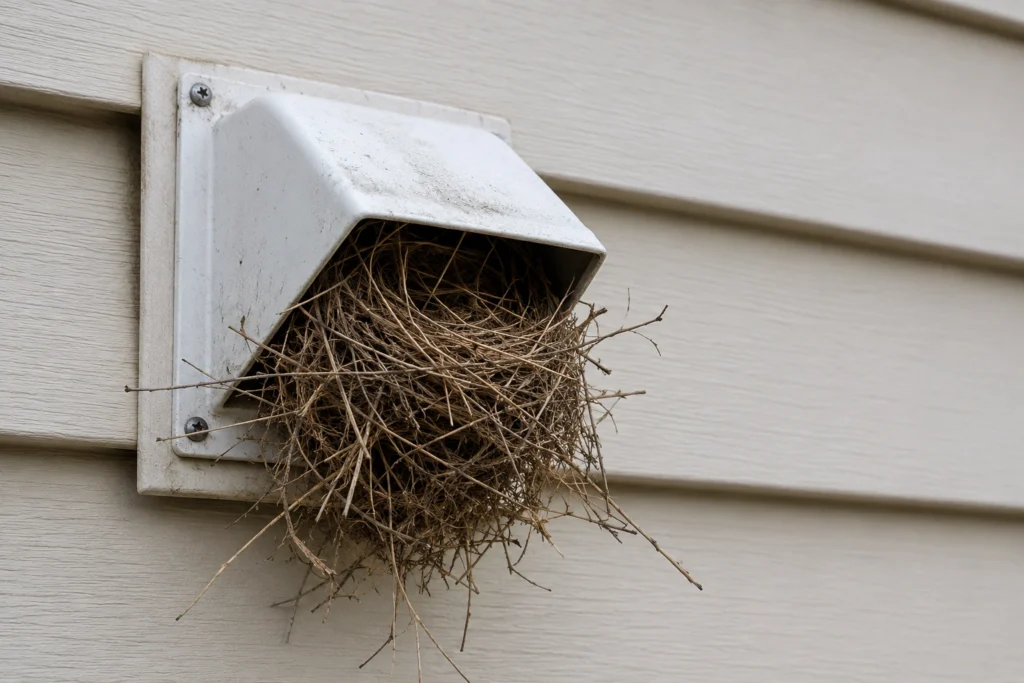
A bird nest in a dryer vent is more than a nuisance. It blocks airflow, traps lint, and creates a real fire hazard.
Why Birds Become a Problem on Homes
Birds don’t pick houses at random. They show up because the conditions are good for them, and they stay because nothing changes. Three things draw birds to a Southeast home and keep them coming back:
Shelter and nesting spots. Rooflines, gutters, eaves, attic vents, gable vents, dryer vents, soffits, and any small protected cavity make ideal nesting sites. Pigeons, sparrows, and starlings are all cavity-nesters, which is why they end up inside vents rather than building open nests in trees.
Food sources. Pet food on a porch, fallen fruit under a tree, accessible trash, breadcrumbs after outdoor meals, insects on a sunlit wall, and (less obviously) bird feeders that overflow are all reasons birds keep returning.
Warmth and safety from predators. Attics, soffits, and vents offer protection from hawks, owls, snakes, and other natural threats. From a bird’s perspective, your house is a five-star nesting hotel.
The common results homeowners deal with:
- Loud chirping and early morning noise during nesting season (March through August)
- Droppings on patios, siding, walkways, and driveways
- Clogged gutters and blocked vents
- Damage to roofing, insulation, and exterior surfaces
- Dryer vent fires (a real and dangerous risk when bird nests block airflow)
Common Birds That Cause Problems Around Southeast Homes
Across Georgia, Alabama, Tennessee, and South Carolina, the bird species we encounter most often on residential bird control calls are:
- Rock pigeons. Common on roofs, ledges, and around commercial buildings. Heavy droppings, persistent return behavior. Non-native, not protected.
- House sparrows. Small but persistent. Frequently nest in vents, eaves, and small structural openings. Aggressive about defending nest sites. Non-native, not protected.
- European starlings. Often in large flocks. Heavy nesting in cavities and vents, noisy, leave significant droppings. Non-native, not protected.
- Barn and cliff swallows. Build mud nests on the underside of eaves, porches, and overhangs. Protected by federal law — active nest disturbance requires special handling.
- Woodpeckers. Damage cedar siding and trim with drumming and excavation. Most species are federally protected.
- Robins, mockingbirds, blue jays. Less commonly nest on homes but occasionally do in shrubs against the siding. All federally protected.
Knowing the species matters because the three most common nuisance birds (pigeons, sparrows, starlings) can be handled with standard control approaches, while protected native species require a different approach.
Do Home Remedies Really Get Rid of Birds?
Short answer: sometimes, briefly. Most home remedies provide short-term relief before birds adapt and return. Birds are smart and pattern-recognize quickly. Within a few weeks of installing any single deterrent, most birds figure out it’s not actually a threat.
If you’re dealing with a recurring issue (birds nesting on your house, a bird problem on your roof, droppings that won’t quit), DIY methods alone usually won’t solve the problem long-term. The reason is structural: birds keep returning because the underlying conditions (food, water, shelter, easy access) haven’t changed.
5 Common Home Remedies to Keep Birds Away — Honest Effectiveness
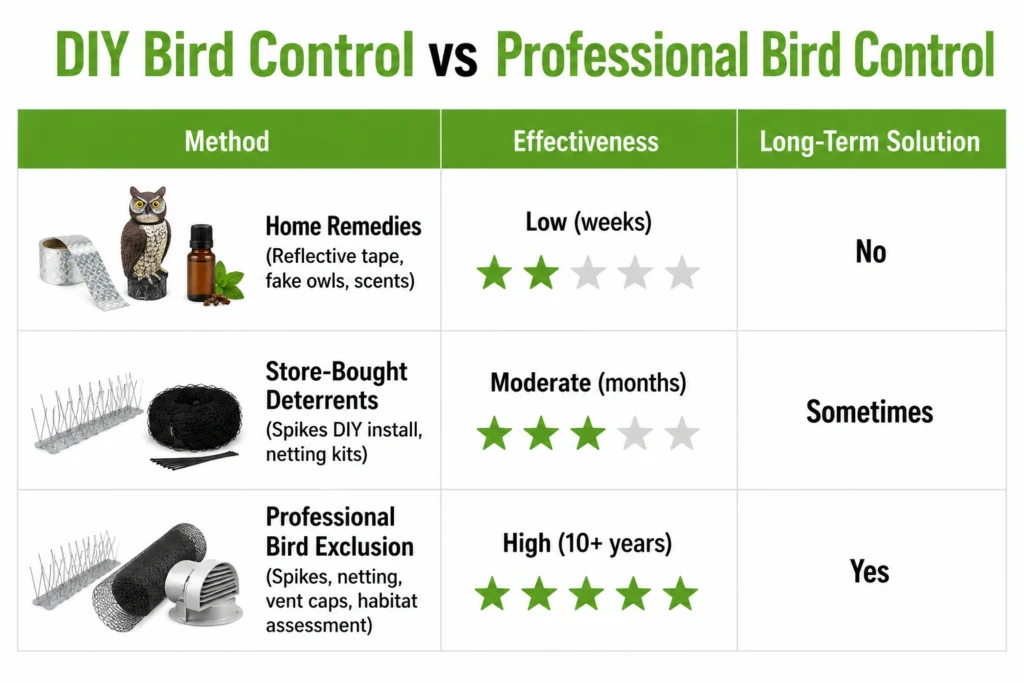
DIY methods buy you weeks. Professional exclusion buys you a decade.
Here’s a realistic look at the five home remedies most homeowners try first, with pros, cons, and effectiveness ratings.
1. Reflective Objects (Foil Strips, Old CDs, Mirrors)
How it works: Light reflection startles birds. Pros: Low cost, easy to set up. Cons: Birds habituate within two to four weeks if not rotated. Effectiveness: Low to moderate for short-term arrivals. Improves significantly if you rotate the reflective objects weekly.
2. Strong Scents (Peppermint, Vinegar, Cayenne Spray)
How it works: Strong-smelling compounds are meant to repel birds. Pros: Cheap, “natural.” Cons: Limited research support, fades within days outdoors, washes out in rain, can damage plants and paint. Effectiveness: Low. Treat as a supplement at best, not a primary method.
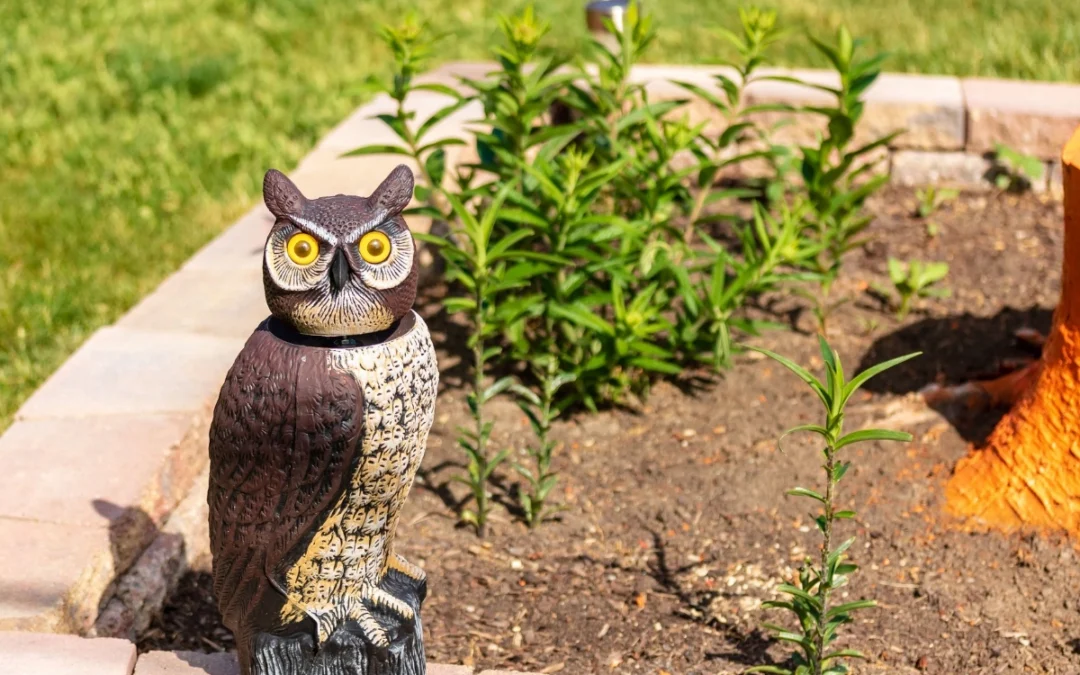
3. Fake Predators (Plastic Owls, Hawks, Snake Decoys)
How it works: Mimics natural threats. Pros: Can work briefly, especially right after installation. Cons: Birds recognize they’re not real if they don’t move. A plastic owl in the same spot for two weeks becomes a perch. Effectiveness: Low if static, moderate if moved every 3 to 5 days.
4. Wind Deterrents (Spinners, Streamers, Pinwheels)
How it works: Movement and unpredictability create discomfort. Pros: More effective than static visual deterrents because there’s actual motion. Cons: Still loses effectiveness over time as birds get used to predictable patterns. Effectiveness: Moderate. Better than static options, especially when combined with rotation.
5. Sound Deterrents (Ultrasonic Devices, Distress Calls)
How it works: Noise discomfort or simulated alarm calls. Pros: Can disrupt initial nesting attempts. Cons: Ultrasonic effectiveness is questionable in independent testing. Audible distress calls work better but disturb your neighbors. Effectiveness: Low to moderate. Better suited for commercial buildings than residential settings.
Bottom line on home remedies: they can buy you a few weeks. They rarely stop nesting attempts long-term, and they almost never address why birds came to your house in the first place.
Why DIY Bird Deterrents Often Don’t Last
Three reasons DIY bird control fails over the long term:
- Birds adapt fast. Within a week or two of any new deterrent, birds figure out it’s not actually a threat. Habituation is the biggest enemy of all DIY methods.
- Nesting instincts override discomfort. During breeding season (March through August in the Southeast), birds will tolerate significant nuisance to defend a good nesting site. Annoying them isn’t enough.
- Entry points stay open. Most DIY methods don’t seal the access points birds use. As long as the dryer vent is open, the gable vent is unscreened, or the soffit gap exists, birds keep returning.
For deeper analysis of which DIY bird deterrent methods work and how to maximize their effectiveness, see our companion guide on 5 DIY bird deterrents that actually work.
When Bird Problems Become a Bigger Issue
What starts as a few birds on the roof can escalate into serious problems if ignored.
Health Concerns
Bird droppings can carry pathogens including histoplasmosis (a respiratory illness from fungal spores in dried droppings), salmonella, and E. coli. Most healthy adults aren’t at significant risk, but people with respiratory conditions or compromised immune systems should avoid disturbing dried droppings without proper protection.
Property Damage
Bird droppings are acidic and damage paint, siding, decking, and concrete over time. Nests clog gutters, block vents, and damage roofing materials. Cumulative damage from a long-term bird problem can run into thousands of dollars in repairs.
Fire Hazards
Dry nesting materials in dryer vents are one of the more dangerous bird-related issues. Lint that can’t escape through a blocked vent builds up against hot dryer ducts, and a small spark inside the dryer can ignite the material. Dryer vent fires cause an estimated 2,900 home fires annually in the U.S. (per the National Fire Protection Association). A bird nest in the vent significantly raises that risk.
Legal Concerns
The federal Migratory Bird Treaty Act of 1918 protects more than 1,000 native bird species. It’s illegal to disturb their active nests, eggs, or young without specific permits. The penalty for violations can exceed $15,000 per offense. For the three most common Southeast nuisance species (pigeons, sparrows, starlings), this isn’t a concern. For native species (swallows, woodpeckers, robins, mockingbirds), removing an active nest without proper authorization is a federal offense.
This is one of the reasons we recommend professional bird control whenever protected species are involved. We work within the legal framework and time removals to be both effective and compliant.
The Most Effective Way to Get Rid of Birds: Humane Exclusion
The gold standard for bird control is exclusion: making your property physically unable to host birds in the spots they want to use. Exclusion includes:
- Bird spikes installed along ledges, gutter edges, rooflines, and HVAC equipment housings to prevent landing.
- Bird netting stretched across eaves, soffit openings, and under solar panels to block nesting access.
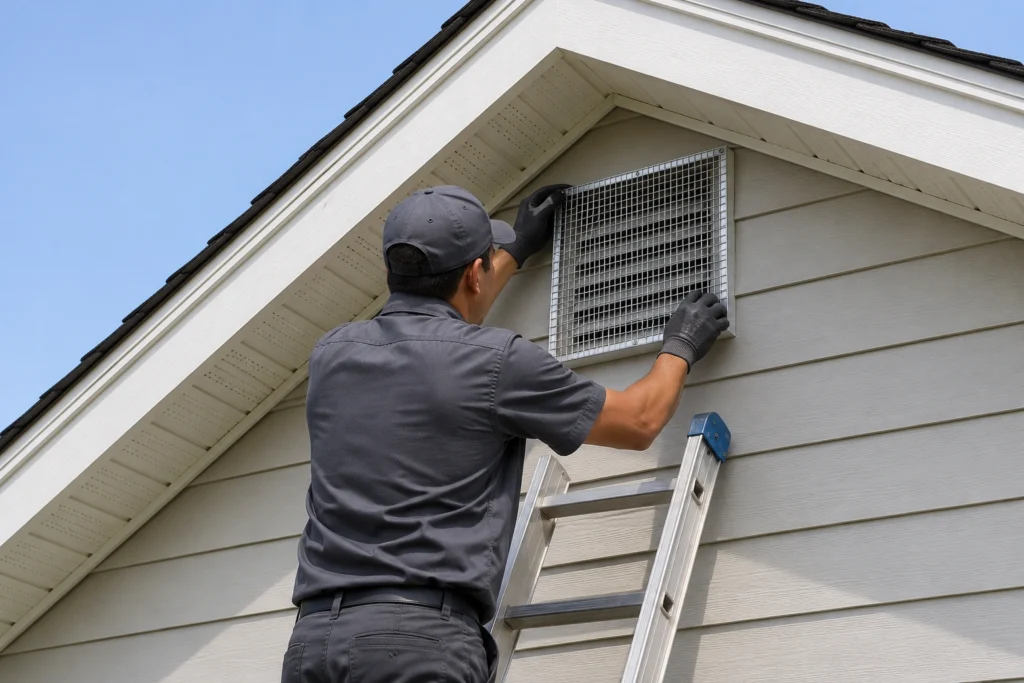
- Vent and roofline covers on dryer vents, bathroom vents, gable vents, and attic vents. Bird-proof vent covers allow normal airflow while blocking bird entry.
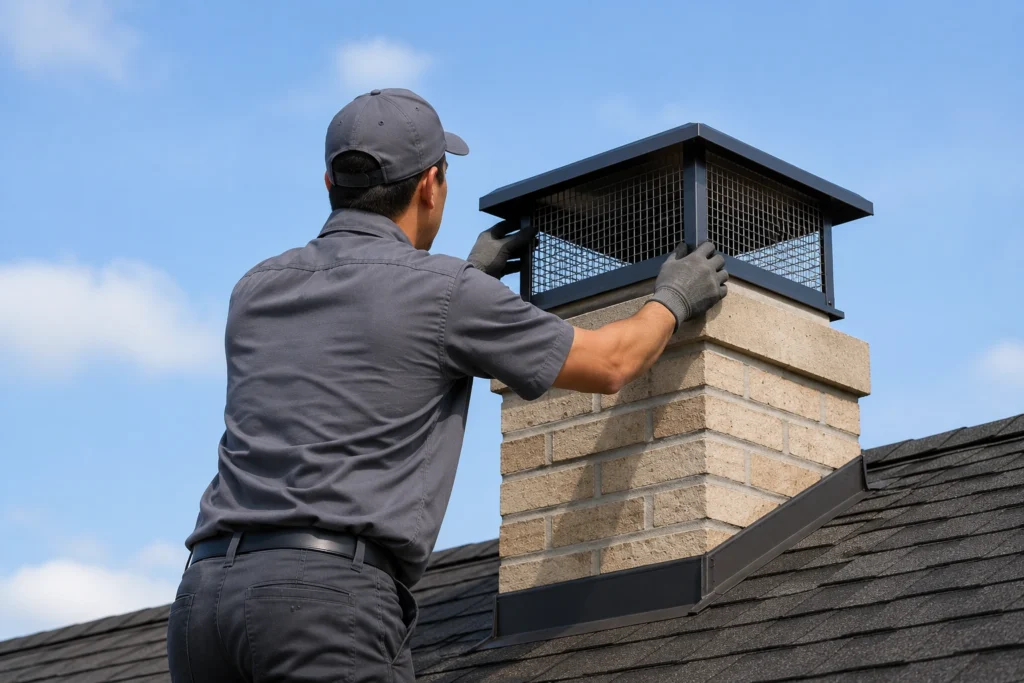
- Chimney caps with appropriate mesh to keep birds out of chimneys (also keeps out raccoons, squirrels, bats, and snakes).
- Habitat modification around the property to remove food, water, and shelter that draws birds in the first place.
- Humane nest removal when legally permitted, timed to avoid breeding season disruption.
Exclusion done right typically lasts 10+ years with minimal maintenance. It’s also the only approach that addresses the root cause rather than the symptom.
Bird-proof vent covers and roofline exclusion fix the access points DIY deterrents can’t reach.
DIY vs Professional Bird Control
The honest comparison:
DIY home remedies work well for early-stage problems — a few birds scouting, no active nests, recent arrivals. Cost is low. Effectiveness lasts weeks to a few months. Effort is ongoing (rotating deterrents, replacing materials, monitoring).
Store-bought deterrents (DIY-installed spikes, netting kits, ultrasonic devices) work better than home remedies and last longer. Cost is moderate. Installation matters significantly — poor installation creates gaps birds exploit.
Professional bird control handles established problems, protected species, large flocks, and hard-to-reach locations. Cost is higher upfront. Effectiveness lasts 10+ years with minimal follow-up. Legal compliance is built in. Northwest’s bird control service handles species identification, exclusion design and installation, habitat assessment, nest removal (when legal), and follow-up monitoring.
Bird Problems in Georgia, Alabama, Tennessee, and South Carolina
Bird pressure in the Southeast is different from cooler climates. Three regional factors increase the bird-control workload:
- Year-round resident populations. Rock pigeons and house sparrows don’t migrate. They’re a problem all 12 months, not just spring and summer.
- Long nesting season. Warm spring weather arrives early and lingers into October. House sparrows can produce three to four broods per year here vs. two in northern states.
- Open construction styles. Many older homes in Atlanta, Birmingham, Savannah, Macon, and Augusta have open soffits, gable vents, and unscreened crawl space vents. Each is a bird entry point.
The good news: the same exclusion approach that stops bird problems also helps with rodents (rats and mice often share entry points with birds), and indirectly with snakes (which follow rodents). For more on the rodent-snake-bird connection, see our snake repellent guide.
Frequently Asked Questions About Getting Rid of Birds
Are birds protected by law?
Yes. The federal Migratory Bird Treaty Act protects more than 1,000 native bird species, making it illegal to disturb their active nests, eggs, or young without specific permits. The three most common Southeast nuisance species (house sparrows, European starlings, rock pigeons) are non-native and not protected. Most native species (swallows, woodpeckers, robins, mockingbirds, blue jays) are protected.
Can I remove a bird nest myself?
It depends on the species and whether the nest is active. For non-protected species (pigeons, sparrows, starlings), you can remove inactive nests yourself, though we recommend wearing gloves and a mask to avoid contact with droppings. For protected species, active nests cannot be removed without proper authorization. The safest approach is to wait until young have fledged before removing the nest, then seal the area to prevent return nesting.
What bird deterrents work best for nesting on the house?
Physical exclusion is the only reliable long-term solution. Bird spikes on landing surfaces, bird-proof vent covers on dryer vents, gable vents, and bathroom vents, netting under solar panels and across open eaves. Visual deterrents and scent repellents can supplement but don’t replace exclusion.
How long does professional bird control take?
For most residential bird problems, professional exclusion can be designed and installed within one to two visits, with follow-up monitoring to confirm birds don’t find a new spot. The exclusion itself typically lasts 10 years or more with minimal maintenance. For larger or more complex situations (commercial properties, large flocks, protected species), the timeline can extend over a full nesting season.
Why are birds nesting in my dryer vent?
Dryer vents are protected from predators, well-insulated, and offer a small enclosed nesting space that’s ideal for house sparrows and starlings. The fix is a bird-proof dryer vent cover that allows lint and exhaust to escape but blocks birds from entering. We see dryer-vent bird nests in about 30% of the Georgia and Alabama bird-control calls we run. It’s one of the most common bird issues in the region.
Professional bird control closes the access points DIY can’t reach. That’s the difference between months and years.
Ready to Get Rid of Birds for Good?
If you’ve tried home remedies and the birds keep coming back, the problem isn’t the remedy. It’s the access points and underlying conditions that keep drawing birds to your property. Northwest’s wildlife team handles the full bird-control workflow: species identification, exclusion design and installation, habitat assessment, and legal compliance when protected species are involved.
About the Author
Anna Vaccaro, Editorial Lead — Pest Education leads pest education content for Northwest Exterminating, working with senior technicians and service center managers across our Georgia, Alabama, Tennessee, and South Carolina service areas to translate field expertise into homeowner-friendly guides. The focus: accurate, regionally-specific answers to the pest questions Southeast homeowners are actually searching for.
Dec 20, 2019 | Alabama Blogs, Georgia Blogs, Termite Control
By Anna V., Editorial Lead — Pest Education · Last updated: May 2026
Termites cause an estimated $5 billion in property damage across the U.S. every year, and the Southeast accounts for a disproportionate share because of our warm, humid climate. At Northwest, we inspect for termites year-round across Georgia, Alabama, Tennessee, and South Carolina, and the pattern we see over and over is the same: homeowners assume they’re either lucky or unlucky when it comes to termites. They’re neither. Termite damage is largely preventable, and the homes that get hit hardest almost always have one or more risk factors that could have been addressed years earlier.
Here’s the full termite prevention playbook for Southeast homes, including the conditions that attract termites, the DIY steps that actually move the needle, when professional treatment is worth it, and how often you should be inspecting.
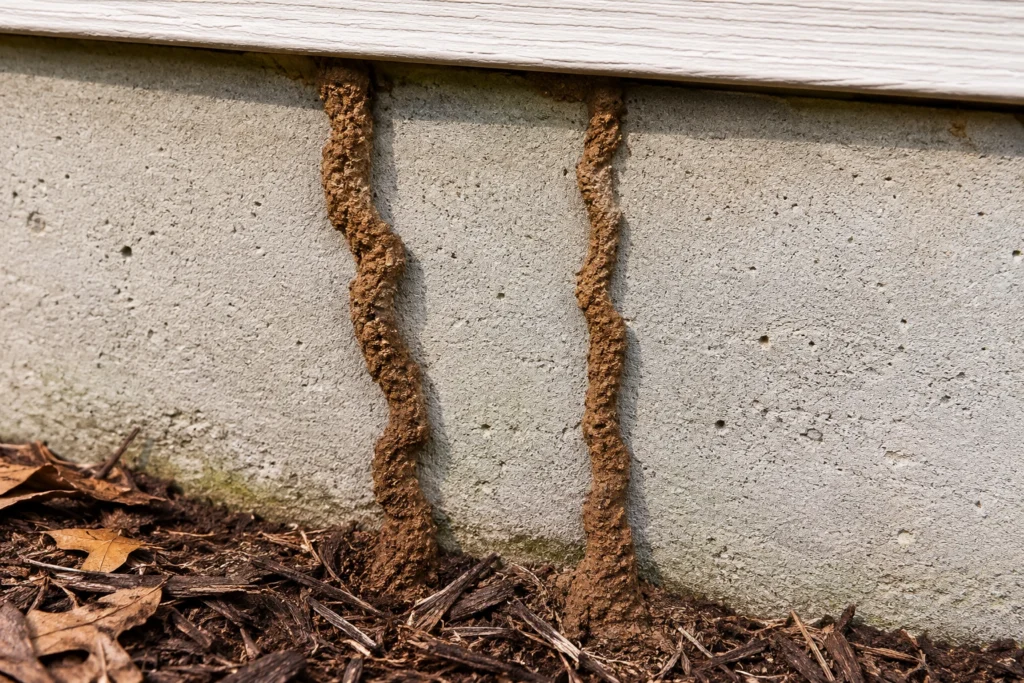
Mud tubes on a foundation wall are the most reliable early warning sign of subterranean termite activity.
Why Termite Prevention Is Essential in the Southeast
Three facts make termite prevention non-optional for Southeast homeowners:
- Eastern subterranean termites are present in every county of Georgia and Alabama. They’re not a “what if,” they’re a “when.” The question for most homes isn’t whether termites are nearby, it’s whether your house has the conditions that let them in.
- Damage is usually invisible until it’s significant. Termites work inside wood from the interior outward. By the time you can see visible damage on a wall, sub-floor, or window frame, you’re typically looking at thousands of dollars in repair on top of treatment.
- Most homeowner insurance does not cover termite damage. Repair costs come out of your pocket. Average treatment + repair for a moderate infestation in the Southeast runs $3,000 to $8,000.
Common entry points: wood-to-soil contact around the foundation, cracks in slab foundations or concrete blocks, expansion joints, leaky pipes or excessive moisture, mulch or firewood piled against exterior walls, and gaps where utility lines penetrate the foundation.
Identifying Termite Risk Factors on Your Property
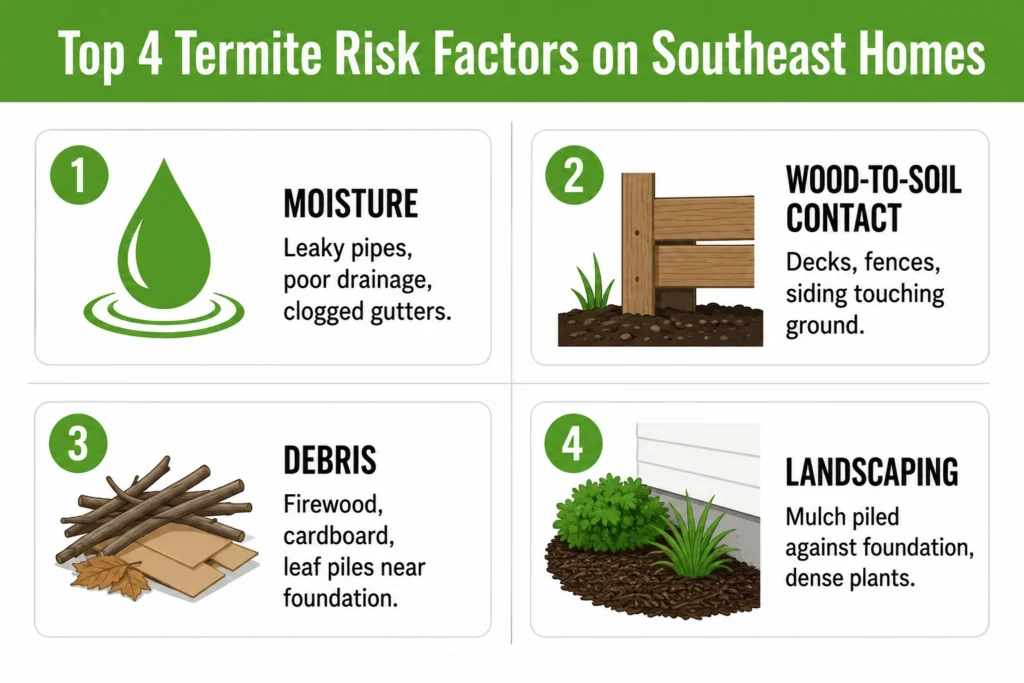
Four risk factors account for most Southeast termite calls. Fix these and you remove the conditions termites need.
Four conditions account for the majority of termite activity in Southeast homes. If you have one or more of these, you’re at elevated risk regardless of what neighbors are seeing.
1. Moisture and Water Issues
Subterranean termites need consistent moisture to survive. Anything that creates a damp microclimate near or under your home raises the risk:
- Leaky exterior faucets, hose bibs, or irrigation lines
- Clogged or missing gutters that dump water at the foundation
- Landscaping graded toward the house rather than away from it
- Air conditioner condensate lines that discharge near the foundation
- Plumbing leaks under sinks, in crawl spaces, or in slab penetrations
2. Wood-to-Soil Contact
Wherever wood touches soil directly, you’ve given termites a no-effort entry path:
- Wooden deck posts set directly in the ground without concrete footers
- Wooden fence posts touching the house
- Wood siding that extends below grade level
- Trellises or arbors attached to the house with the base in soil or mulch
- Wooden steps or porch supports without termite shields
3. Clutter and Yard Debris
Debris near the foundation provides food, shelter, and a launching point for termite colonies:
- Firewood stacked against the house or within 20 feet of the foundation
- Cardboard boxes, lumber, or pallets stored next to the house
- Leaf piles and yard waste against exterior walls
- Old tree stumps within 20 feet of the foundation (subterranean termites love decaying stumps)
4. Landscaping Decisions
Mulch is great for gardens but problematic near foundations:
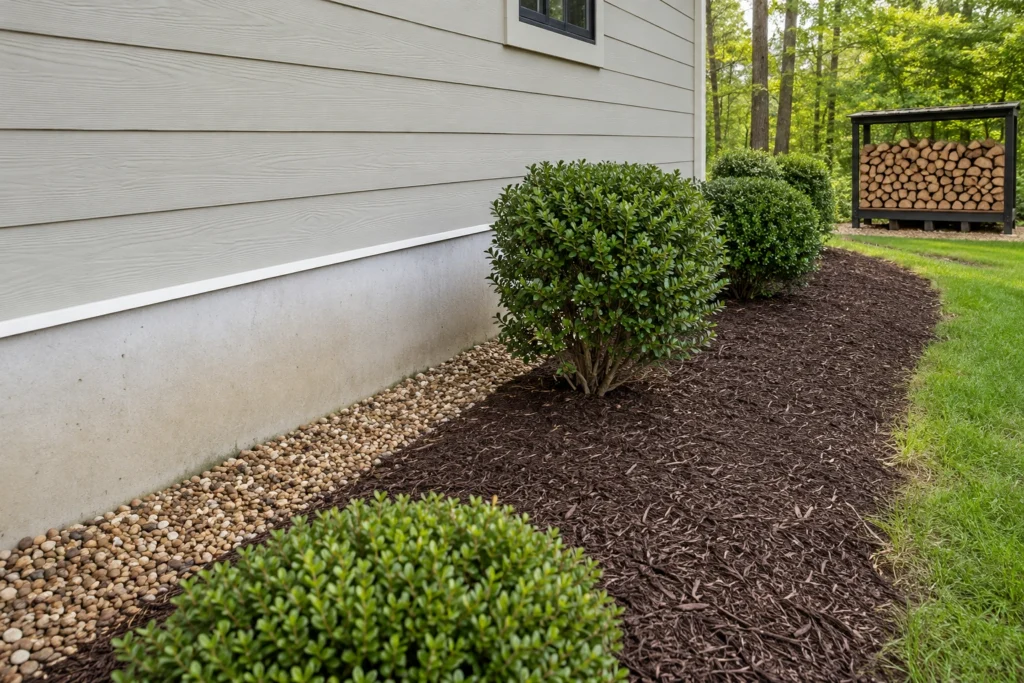
- Maintain a 2- to 3-foot gap between mulch and the foundation
- Use pea gravel or river rock in the 2-foot zone immediately adjacent to the foundation
- Trim shrubs back from exterior walls (dense vegetation traps moisture and hides mud tubes)
- Avoid heavy irrigation right at the foundation
DIY Termite Prevention Tips
Most prevention work is structural and seasonal. Done right, these steps significantly lower your risk without specialized equipment.
Regular Inspections
Walk your property twice a year (spring and fall) and look for:
- Mud tubes (pencil-thick brown tunnels) running up foundation walls or in crawl spaces
- Wood that sounds hollow when tapped or has blistering paint
- Small piles of what looks like sawdust or fine pellets near wood structures (frass from drywood termites or carpenter ants)
- Discarded wings near windows or doors after a warm rainy day (termite swarmer evidence)
- Sagging or warped flooring that wasn’t there before
Moisture Control
- Clean gutters twice a year and install gutter guards if you have heavy tree cover
- Add downspout extensions to direct water 4+ feet from the foundation
- Run a dehumidifier in basements and conditioned crawl spaces (target 50% RH or below)
- Fix any plumbing leak within 48 hours
- Re-grade landscaping if water pools near the foundation after rain
Remove Wood and Debris Near the Home
- Move firewood to a rack at least 20 feet from the house and elevated off the ground
- Remove old tree stumps within 20 feet of the foundation
- Store lumber, cardboard, and yard tools off the ground in a shed or garage
- Rake fallen leaves away from foundation walls
Natural Deterrents (Supplementary Only)
These don’t replace professional treatment for active infestations but can complement prevention:
- Orange oil or neem oil treatments on exposed exterior wood
- Diatomaceous earth along the foundation perimeter (works on a range of pests including some termites)
- Borate-based wood preservatives on accessible structural wood (decks, fences)
Professional Termite Prevention Methods
For Southeast homes, professional termite prevention is the highest-ROI structural investment most homeowners make. It’s also the only thing that meaningfully protects against a heavy subterranean termite year.
Chemical Barrier (Liquid Termiticide) Treatments
Pest control technicians trench around the foundation and apply a long-lasting termiticide (typically fipronil or imidacloprid) into the soil. This creates a continuous chemical barrier that subterranean termites can’t cross to reach the structure. Modern non-repellent termiticides are particularly effective because the termites don’t detect them and carry the active ingredient back to the colony, often eliminating it. Typical protection lasts 5 to 10 years.
Termite Bait Systems
In-ground bait stations placed around the foundation contain cellulose attractive to subterranean termites. Foraging termites find the bait, share it with the colony through grooming and food exchange, and the active ingredient (typically hexaflumuron or chlorfluazuron) disrupts molting and eliminates the colony. Sentricon and similar systems require ongoing monitoring (typically quarterly or annually) and offer long-term colony elimination rather than just a barrier.
Inspection and Monitoring Services
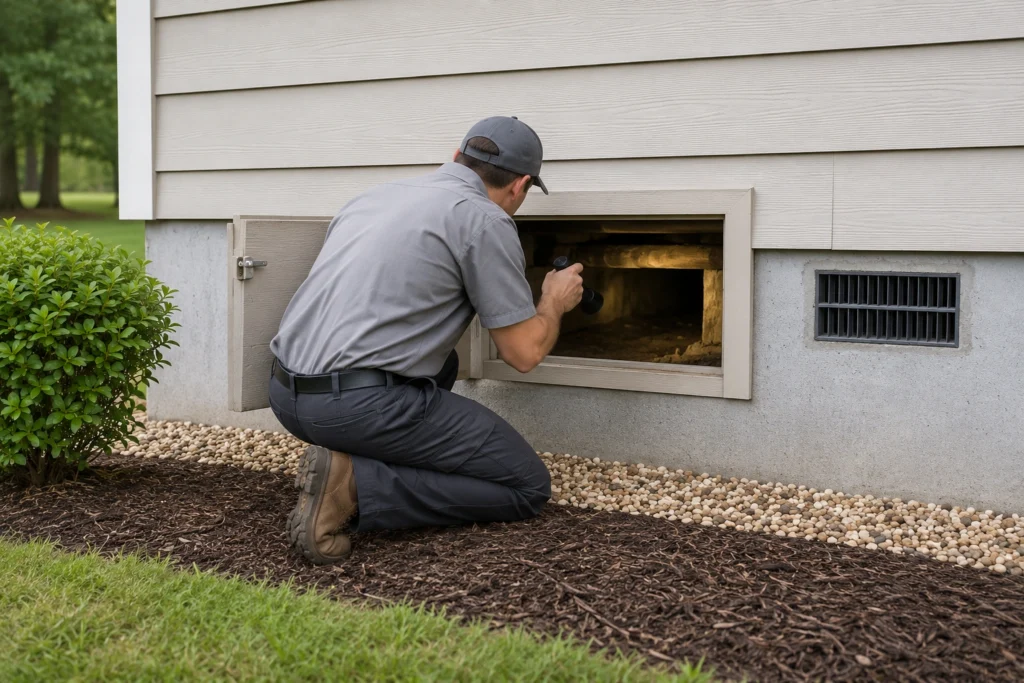
Professional inspections detect early signs homeowners miss: subterranean mud tubes in inaccessible crawl spaces, drywood damage inside wall voids, moisture issues that create termite-favorable microclimates. Annual inspections are the minimum recommendation for Southeast homes. Twice yearly is more appropriate for homes with risk factors or in heavily wooded areas.
When to Call a Professional Immediately
- Mud tubes on the foundation, in crawl spaces, or inside the home
- Discarded swarmer wings near windows or doors
- Hollow-sounding or visibly damaged wood
- Frass (fine wood-colored pellets) near wood structures
- Sagging floors or doors that suddenly don’t close properly
- You’re buying a home in the Southeast (a pre-purchase termite inspection is essentially required by every reputable lender)
Carpenter Ants vs Termites: Don’t Confuse Them
Carpenter ants and termites both damage wood, but they’re different pests with different treatments. Homeowners often confuse the two:
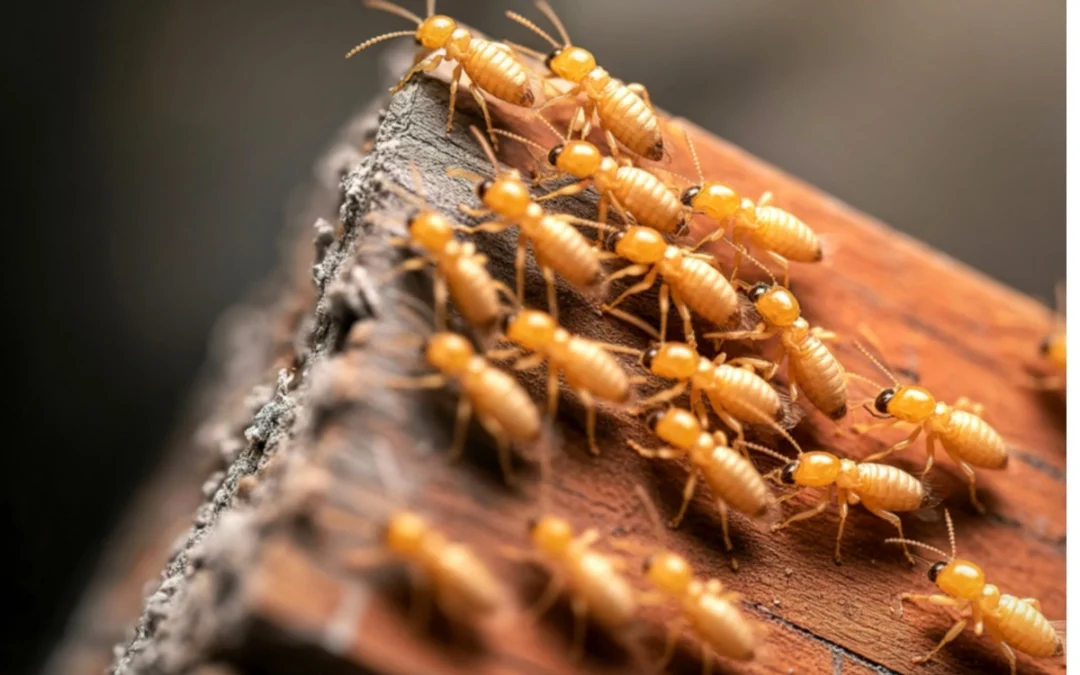
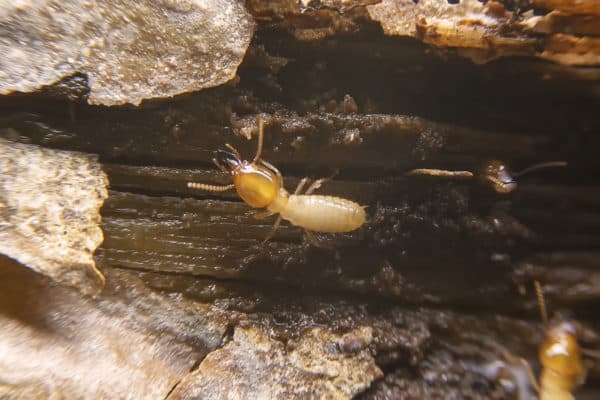
- Termites eat wood for nutrition. Damage looks smooth and follows the wood grain. Bodies are pale/cream-colored with straight antennae and equal-length wings (in swarmers). They build mud tubes.
- Carpenter ants excavate wood for nesting (they don’t eat it). Damage looks like clean tunnels with sawdust-like frass nearby. Bodies are dark, segmented, with bent antennae and wings of unequal length. No mud tubes.
Both warrant professional treatment, but the methods differ. If you’re unsure which you’re dealing with, see our ants in the kitchen guide for carpenter ant identification details.
Seasonal and Regional Considerations
A foundation with proper drainage, mulch clearance, and no wood-to-soil contact is the structural baseline for termite prevention.
Termite activity follows distinct seasonal patterns in the Southeast:
- Late winter through spring (February-May): Peak swarming season. Subterranean termite swarmers emerge after warm rains, mate, and start new colonies. Most homeowner discoveries happen during this window.
- Summer (June-August): Colonies are at maximum foraging activity. Damage progresses fastest during these months.
- Fall (September-November): Reduced swarming but continued foraging. Good time for prevention work because next year’s swarmers haven’t emerged yet.
- Winter (December-February): Slowed but not dormant in the deep South. Indoor heated environments can keep populations active year-round.
Schedule professional inspections in late winter (January-February) so you catch any new activity before peak swarming season.
Termite Prevention Cost vs Damage Cost
A perspective on the math:
- Annual termite inspection: $75 to $200
- Initial liquid termiticide treatment (typical Southeast home): $1,200 to $2,500
- Bait system installation: $1,500 to $3,000, plus $300 to $600 annual monitoring
- Average damage repair from moderate infestation: $3,000 to $8,000
- Severe damage repair (structural beams, sub-floors): $10,000 to $25,000+
Prevention almost always costs less than treatment + repair, often by a factor of 5 to 10x. For a deeper authoritative reference, UGA Extension’s subterranean termite management guide covers the biology and treatment options in technical detail.
(Worried about termites or due for an inspection? Schedule a free Northwest inspection and we’ll assess your risk factors and recommend the right protection level.)
Frequently Asked Questions About Termite Prevention
Can termites be prevented entirely?
No method is 100% foolproof, but the combination of structural prevention (sealing entry points, controlling moisture, maintaining wood-to-soil separation), professional barrier or bait treatment, and regular inspections reduces risk by an enormous margin. Properly protected Southeast homes are very rarely the ones we see with serious termite damage.
How often should I have a termite inspection?
Annual inspections are the minimum for Southeast homes. Twice yearly (spring and fall) is more appropriate for homes with elevated risk factors (heavily wooded lots, moisture issues, older construction, history of prior termite activity). Pre-purchase termite inspections are essentially required when buying or selling a home in our region.
Are DIY prevention methods effective?
Yes for risk reduction, no as a complete substitute for professional treatment. DIY moisture control, debris removal, wood-to-soil separation, and structural maintenance significantly lower the conditions termites need to establish. Professional treatment (liquid barrier or bait system) is what actually protects against active subterranean colonies that exist in your soil regardless of what you do at the surface.
What’s the best way to protect a new home?
New construction in the Southeast benefits enormously from pre-construction termiticide application (the slab and footings are treated before concrete is poured) or physical barrier installation. Ongoing annual inspections and proper landscaping maintenance preserve that protection. Many Southeast builders include the initial treatment, but the long-term maintenance is on the homeowner.
What does a termite inspection actually involve?
A thorough inspection covers the foundation perimeter (interior and exterior), crawl spaces, basements, accessible attic space, plumbing penetrations, exterior wood structures (decks, porches, fences attached to the home), and any moisture issues. Inspectors look for active mud tubes, damaged wood, frass, discarded wings, and conducive conditions. A typical inspection takes 45 to 90 minutes depending on home size.
Most termite damage starts in places homeowners can’t easily see.
Schedule a Termite Inspection Today
If you haven’t had a termite inspection in over a year, you’re seeing any of the warning signs above, or you’re buying a home in the Southeast, Northwest’s team handles the full termite workflow: inspection, treatment selection, application, and ongoing monitoring. Most termite protection programs pay for themselves many times over in avoided damage.
About the Author
Anna V., Editorial Lead — Pest Education leads pest education content for Northwest Exterminating, working with senior technicians and service center managers across our Georgia, Alabama, Tennessee, and South Carolina service areas to translate field expertise into homeowner-friendly guides. The focus: accurate, regionally-specific answers to the pest questions Southeast homeowners are actually searching for.
Nov 28, 2019 | Pest Control
Thanksgiving is a time to reflect on the things we are thankful for. Many people are thankful for life, health, family, and friends. Whatever you are thankful for this season, pest control probably isn’t very high on the list. What you may not realize is that there are several very important reasons to be thankful for this service. Here are five reasons to be thankful for pest control this holiday season.
Cost Savings
Routine pest control provides scheduled service throughout the year. This allows your service technician the opportunity to provide ongoing treatment for existing issues and regular inspections to help catch new problems early, before they manifest to serious infestations. This helps shift the focus of your pest control service from treatment to prevention, helping to save you from costly treatments and repairs in the future.
Improved Health
Routine pest control provides many opportunities to improve the health of both your family and your home. Pests offer a wide range of hazards to your family’s health and safety. Venomous spiders and ants can cause painful bites; rodents and other wildlife can leave droppings that can contaminate your food and household surfaces; cockroaches can exacerbate allergies and asthma. Routine pest control can help eliminate all of these threats, as well as provide you with stress and anxiety relief knowing that your home is protected.
Protecting the Value/Integrity of Your Home
Pests can cause serious damage to the structure of your home, decreasing its value and costing significant amounts of money in repairs and treatments. Rodents and other wildlife can chew through walls, wires, drywall, and even roofs, damaging them and increasing the risk of fires. Termites can eat through wood undetected for years before their damage is realized. Rodents and roaches can contaminate food, costing you money by having to throw it out and replace it. A routine pest control program can help catch these pest issues early and keep them from getting out of control.
Eco-Friendly Options
Pest control used to mean harsh chemicals that were dangerous for your small children or pets. Nowadays there are green pest control options that are eco-friendly and safe for use anywhere in and around your home while still remaining effective against pests. The active ingredients in a green pest control service are derived from flowers, plants, and other natural elements from the earth and are safe for both children and pets.
Service Guarantee
Most pest control programs offer a service guarantee. Routine pest control visits are scheduled so that problems can be identified and remedied at that time. The service guarantee allows the technician to come back in between scheduled visits for any issues that arise at no additional cost to you.
As you can see, there are many reasons to be thankful for pest control. If you suspect you have a pest problem or you want to stay ahead of the pests before they take over, contact a professional pest control company who can thoroughly evaluate your home and provide you with the treatment and prevention options needed to make you thankful this season.
You May Also Be Interested In:
Bed Bug Holiday Surprise
Cold Weather Sends Roaches Indoors: 5 Tips to Prevent Them This Winter
Late Fall Pests
Why Are There So Many Millipedes in My House?
Are Termites Active In Fall and Winter?
Oct 12, 2019 | Pest Control
Business owners have a laundry list of priorities when it comes to running their companies effectively – competitive pricing, keeping both customers and employees happy, maintaining their bottom line while generating profit. One of the most important aspects of running a business is making sure the customers, employees, and the building itself are safe and healthy. For this reason, commercial pest control should be included on the top priorities list. Pests are not only a serious health hazard to both employees and customers, they can also cause significant structural damage to buildings and property. Their presence alone is enough to taint the reputation of a business, often causing irreparable damage and loss of business.
Commercial pest control offers many benefits to business owners:
Year Round Protection
Pests are active year-round. Whether it’s termites swarming in the spring or spiders in the fall, customers don’t want to see pests in your business during any season. Partnering with a commercial pest control company offers the benefit of year-round pest protection regardless of the type of seasonal pest you have.
Multi-Faceted Approach
Different pests can plague a business at different times throughout the year. Commercial pest problems can range from roaches in the kitchen of a restaurant to bed bugs in the guest room of a hotel and any variety of problems in between. A professional pest control company can provide service for any type of pest you encounter, providing the latest and most innovative techniques and treatment options for a variety of pests.
Service Satisfaction
Most pest control companies offer a service guarantee meaning if you encounter a pest problem between scheduled visits or if you continue to have a recurrent problem after they have treated, they will come back and retreat at no additional cost to you.
Customization
A commercial pest control company can thoroughly evaluate your company to assess any pest issues you may have, as well as any areas of concern that may lead to future pest problems and provide you with a customized program tailored specifically to your company’s needs.
Commercial pest control provides many benefits to business owners and services including schools and daycares, hospitals, restaurants, offices, apartments, and more. Pest problems can be detrimental not only to a company’s reputation but also to the health and safety of their employees and customers and even the structure of the property itself. Consider implementing a commercial pest control program for your business today.
You May Also Be Interested In:
for Your New Home
Is Sentricon Termite Protection Right for Your Home?
Things That Go Bump in Your Crawlspace
How Do You Know If You Have A Rat or A Mouse?
Avoiding Bed Bugs While Traveling