Dec 4, 2020 | Pest Control
You’ve found all the signs and you’ve confirmed it – there’s a rodent in your house. But is it a rat or a mouse? Does it really matter? How can you tell? Although there are significant differences in rat vs mouse, it can be hard for the average homeowner to distinguish between the two. The behavior, diet, and habitat of each of these pests affects how they are eliminated and prevented. Proper identification is essential for effective rodent control.
There are over 70 species of mice and rats in the United States. The most common are the Norway rat, the roof rat, and the house mouse. Let’s take a look at the difference between rats and mice and why it matters.
Behavior:
Mice are curious and will investigate anything new they come across. Because of this, you can put set mouse traps directly in their path. Mice can stand on their hind legs when they are supported by their tails. They are excellent jumpers, swimmers and climbers and are extremely fast runners. Mice are nocturnal and most active from dusk until dawn. They do not like bright lights.
Rats are more cautious than mice. They will avoid new things until they get used to them being there. Because of this, unset traps should be placed in their path first to let them get used to them and then replaced with set traps later. Rats are strong swimmers and will often live in sewers, allowing them to enter buildings through broken drains and toilets. They will climb to get to food, water, and shelter. They follow regular routines and paths each day.
Appearance:
House mice are much smaller than their rat cousins. They have small heads, small feet, pointed snouts, and large ears with some hair on them. They are usually light brown in color with some gray shading and dark tails. Their droppings are shaped like small rods.
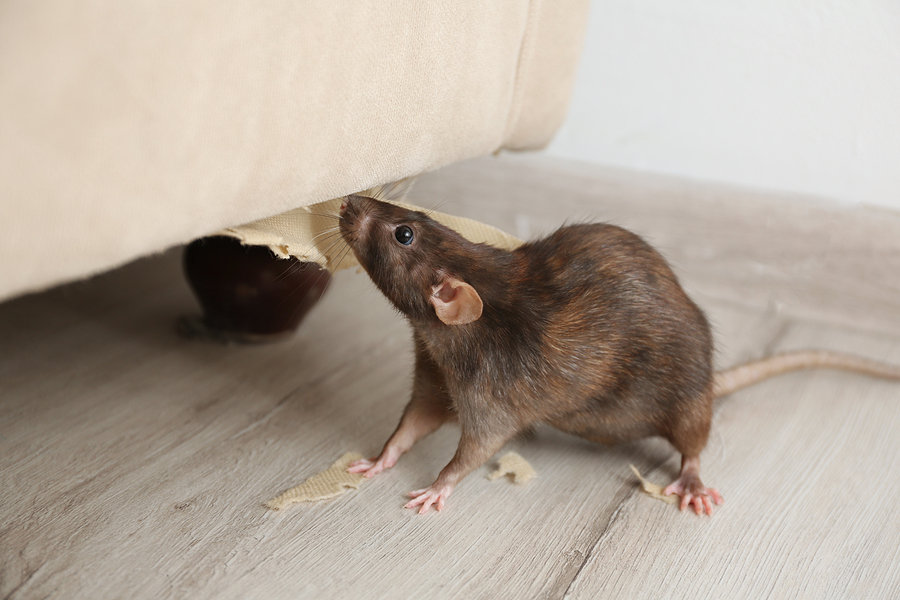
Norway rats have heavy, thick bodies. They are the largest of the three common rodent species. They have blunt snouts and short ears with dark hair. They are usually brown with black shading and shaggy coats. Their tails are dark on top and pale underneath. Their droppings are shaped like capsules.
Roof rats have light slender bodies. They have pointed snouts and long ears with no hair. They are usually gray in color with black shading and smooth coats. Their tails are dark. They have droppings shaped like spindles.
Diet:
Mice prefer cereal grains and plants but they will feed on almost anything.
Rats will eat nearly anything, as well, but prefer fresh grain and meat. Rats also need 1/2 to 1 ounce of water a day to survive.
Habitat:
Mice prefer to nest near their food sources. They will use any soft material or shredded paper to build their nests.
Rats will burrow under buildings, along fences, and under plants or debris. Norway rats typically live in these burrows while roof rats prefer to nest in walls, attics, and trees.
Breeding:
Mice will have up to 10 litters per year and typically live from about 9 to 12 months.
Norway rats will have up to 6 litters per year and live 12 to 18 months.
Roof rats will have up to 8 litters per year but have fewer babies in their litters than Norway rats do.
Fun Facts:
The house mouse is considered one of the top 100 world’s worst invaders. They are afraid of rats because rats will eat them. Mice are also color blind.
Rats are nocturnal and have poor eyesight. Norway rats and roof rats do not get along and will actually fight each other to the death. Norway rats tend to live on the lower floors of buildings while roof rats will live on the upper floors.
Why Does It Matter?
Why does it matter whether you have a rat or a mouse? Both rat and mice droppings contain pathogens that are dangerous to humans. Both are also very good at breeding and increase their populations quickly, making them harder to control. The significance in properly identifying rats vs mice affects how they are controlled and eliminated. Because they each have such different diets, habitats, and behaviors, different methods are employed when it comes to getting rid of them. What may work for house mice might not be effective in controlling rats and vice versa.
If you have an issue with rodents or any other pests, contact a professional pest control company who can not only properly identify the nuisance pest, but also set you up with the appropriate treatment and ongoing prevention plans.
You May Also Be Interested In:
Crawly Winter Insects
What Attracts Moles to Your Yard?
Holiday Pantry Pests
13 Energy Saving Tips For Winter
Is Mosquito Control Needed in Winter?

Mar 20, 2020 | Alabama Blogs, Georgia Blogs, Pest Control, Wildlife
By Anna V., Editorial Lead — Pest Education · Last updated: May 2026
When a homeowner in Georgia or Alabama calls Northwest about a rodent problem, our first question is almost always: mouse or rat? The two get lumped together in everyday conversation, but they behave differently, leave behind very different evidence, and require different treatment approaches. Misidentifying which species you have is one of the most common reasons DIY rodent control fails. A trap baited and placed for a mouse will sit untouched while a rat sniffs it and moves on. A rat-sized opening sealed against mice still lets the much smaller mice walk right in.
Here’s how to tell a mouse from a rat at a glance, what each one’s droppings, gnaw marks, and behavior look like in a Southeast home, and when the difference between them changes how you treat the problem.
Size is the fastest clue. A mouse fits in a tablespoon. A rat doesn’t.
What’s the Difference Between a Mouse and a Rat?
The physical differences between a mouse and a rat are obvious once you’ve seen them side by side. The challenge is that most homeowners only see one of them, briefly, in low light, before it disappears behind the refrigerator. Here’s what to look for if you only get a glimpse.
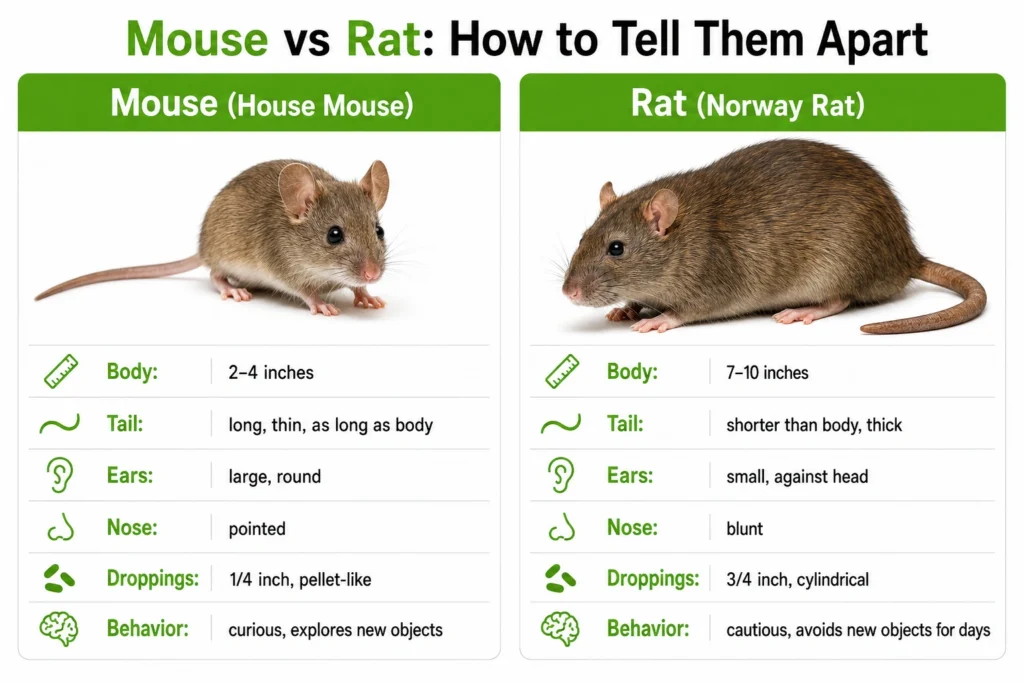
Mice (house mouse, deer mouse) are small. Adult body length is typically 2 to 4 inches, not counting the tail, which is about as long as the body. They have slender bodies, pointed noses, and large round ears that look oversized for their head. Their fur is usually light brown or gray. They’re curious by nature and tend to explore new objects in their territory within hours.
Rats (Norway rat, roof rat) are substantially larger. Adult body length runs 7 to 10 inches, with a tail that’s shorter than the body. They have thicker, heavier bodies, blunt noses, and proportionally smaller ears tucked against the head. Norway rats (the most common in Georgia and Alabama) are brown or gray with shaggier fur. Roof rats are darker, sleeker, and more agile climbers. Both are cautious by nature and will avoid new objects in their territory for days before approaching — a behavior pest pros call “neophobia.”
That neophobia is the single biggest reason rat traps fail when homeowners set them. Mice walk into traps within hours. Rats will avoid them for a week.
Mouse vs Rat Identification Guide
Size, tail, and droppings are the three identifiers most homeowners can use without seeing the rodent itself.
Quick Comparison Table
| Feature |
Mouse |
Rat |
| Body length |
2 to 4 inches |
7 to 10 inches |
| Tail |
Long and thin, about as long as body |
Shorter than body, thick and scaly |
| Ears |
Large and rounded, look oversized |
Small, held closer to the head |
| Nose |
Pointed, narrow |
Blunt, broader |
| Droppings |
1/8 to 1/4 inch, pellet-like |
1/2 to 3/4 inch, cylindrical |
| Behavior |
Curious, investigates new objects |
Cautious, avoids new objects for days |
| Where they nest |
Indoors, in walls, cabinets, attics |
Outdoors in burrows; indoors in basements, crawl spaces |
| Reproduction |
5 to 10 litters per year, faster cycle |
2 to 5 litters per year, larger litters |
Common Species in the Southeast
In Georgia, Alabama, Tennessee, and South Carolina, the rodents you’re most likely to encounter inside a home are:
- House mouse (Mus musculus) — the most common indoor rodent across the entire Southeast.
- Deer mouse (Peromyscus maniculatus) — more common in rural and wooded areas. Notable because it’s a primary carrier of hantavirus.
- Norway rat (Rattus norvegicus) — also called the brown rat or sewer rat. Common in older urban neighborhoods of Atlanta, Birmingham, Savannah, and Macon.
- Roof rat (Rattus rattus) — also called the black rat. More common along the coast and in warmer parts of the service area. Strong climber, often found in attics.
Signs You Have a Mouse or a Rat
If you haven’t actually seen the rodent yet, the signs they leave behind will tell you which species you’re dealing with. Here’s what to look for and how to read it.
Droppings (the most reliable indicator)
Mouse droppings are tiny, dark, and shaped like grains of rice with pointed ends. They’re typically 1/8 to 1/4 inch long. A single mouse can leave 50 to 75 droppings a day, so you’ll find them scattered widely — along baseboards, inside cabinets, in pantry corners, on the back of countertops.
Rat droppings are much larger, 1/2 to 3/4 inch long, dark, and shaped like a thick capsule with blunt or pointed ends (depending on species). You’ll find them in concentrated piles near nesting sites or along regular travel paths — usually in basements, crawl spaces, near food storage, or along walls.
Size alone is the easiest tell. If the droppings are smaller than a grain of rice, you have mice. If they’re larger than a coffee bean, you have rats.
Gnaw Marks
Mice leave small, scratchy bite marks on food packaging, the corners of cardboard boxes, and the edges of wooden trim. The marks are usually clean and close together, made by their tiny incisors.
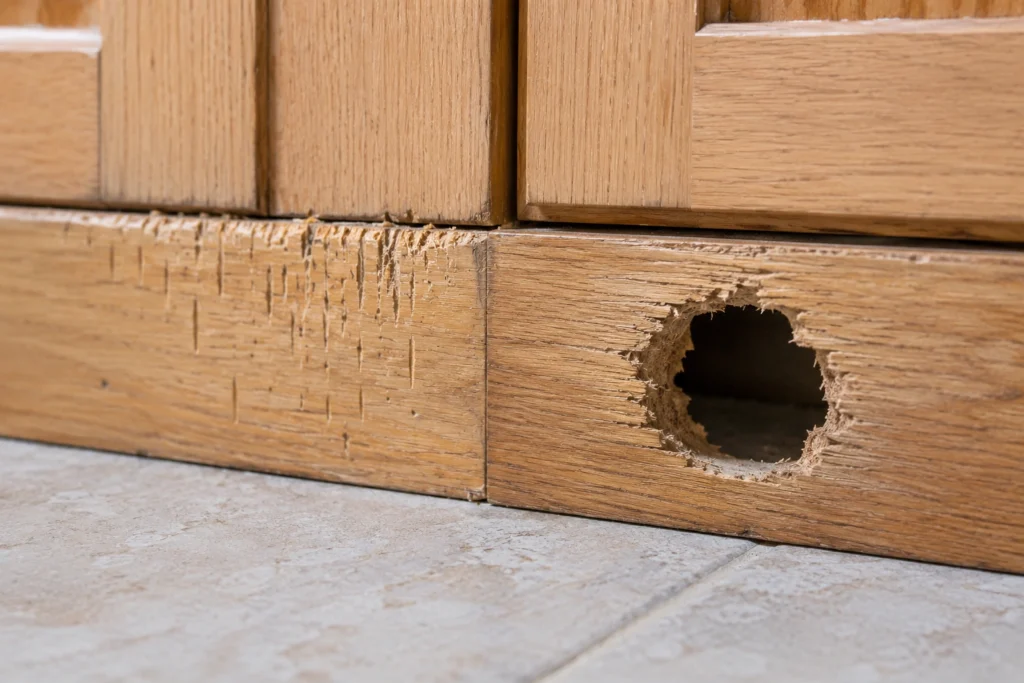
Rats chew through harder materials and leave much larger, rougher marks. Rats can chew through soft wood, insulation, drywall, lead pipes, aluminum siding, and most plastic. Damaged electrical wiring, holes the size of a quarter or larger in baseboards or insulation, and torn-open food storage containers all suggest rats rather than mice.
Mouse damage looks like fine scratches. Rat damage looks like something chewed a hole.
Nesting Material
Mice build small, well-organized nests using shredded paper, fabric, insulation, and dryer lint. Nests are typically hidden in wall voids, behind appliances, inside cabinets, in attic insulation, or in stored boxes. Each nest is the size of a softball or smaller.
Rats build larger, messier nests using similar materials but on a different scale. Norway rat nests are often outdoors in burrows under decks, sheds, or vegetation. Roof rat nests are usually in attics or upper wall voids. Both species’ indoor nests are noticeably larger than a mouse’s, ranging from softball-sized to football-sized.
Sounds and Smells
Mice make light scurrying and scratching sounds, often heard at night in walls or above ceilings. Rats make heavier, slower, more obvious sounds, sometimes including thumps as they jump between surfaces. Both species produce a musky urine smell when populations grow, with rats producing a much stronger odor due to their larger body size and concentrated activity.
Damage Caused by Mice vs Rats
The damage pattern in your home is a strong species indicator and an important factor in how urgent treatment is.
Mice cause modest structural damage in most situations. They chew through food packaging, gnaw on baseboards and wooden trim, and damage stored items. The biggest mouse risk is food contamination and the secondary pest problem of indoor flea or mite populations that can travel with them.
Rats cause significant structural damage when populations establish. They chew through electrical wiring (creating real fire risk), tear through insulation, gnaw on plumbing, and damage HVAC ductwork. The repair costs for rat damage routinely run into thousands of dollars. Rats also pose more serious disease transmission risk than mice.
Health Risks: Mouse vs Rat
Both species carry diseases, but rats present a broader and more severe health risk profile. The CDC’s rodent disease guidance documents both species as vectors for pathogens.
Diseases associated with mice include hantavirus (especially from deer mice), salmonella contamination of food surfaces, and allergens that trigger asthma in sensitive individuals.
Diseases associated with rats include leptospirosis (transmitted through contact with rat urine), rat-bite fever, salmonella, and historically the bubonic plague (still present at low levels in some U.S. populations). Rats also carry fleas that can transmit additional pathogens.
The practical takeaway: any rodent presence indoors warrants attention, but a confirmed rat sighting is more urgent than a mouse sighting from a health-risk standpoint.
Behavior & Habitat Differences in Southeast Homes
Where each species nests in a Georgia or Alabama home tells you a lot about how they got in and how to address them.
Mice nest indoors year-round. They prefer wall voids, attic insulation, behind appliances, inside stored boxes, and in cluttered storage spaces. A mouse only needs a hole the diameter of a dime to get inside, which means tiny gaps around utility line penetrations, foundation cracks, and worn weatherstripping are all entry points.
Rats typically nest outdoors and travel indoors for food. Norway rats burrow in yards, under decks and sheds, and along foundations. Roof rats nest in attics, palm trees (in coastal areas), and shed rafters. A rat needs a hole the diameter of a quarter to get inside. Larger entry points, garage door gaps, and unsealed crawl space access doors are the typical routes.
Seasonal pattern in the Southeast: rodent indoor activity peaks from late October through March, as outdoor food sources dwindle and rodents seek warmth and shelter. Mice are active year-round indoors; rats become more visible in cooler months.
Mouse vs Rat Control & Prevention
Once you know which species you’re dealing with, the treatment approach changes meaningfully.
DIY Prevention (works for both)
- Seal all entry points larger than 1/4 inch with steel wool and caulk (mice can’t gnaw through steel wool).
- Store food in airtight containers (glass or hard plastic, not bags).
- Take out trash daily, especially in warm months.
- Eliminate clutter in basements, attics, and garages.
- Fix any water leaks; rodents need water too.
- Trim vegetation back from the foundation and roofline.
Treatment That Actually Works
For mice, snap traps baited with peanut butter and placed perpendicular to walls catch most populations within a few days. Mice walk into them readily because of their curiosity.
For rats, the approach is slower and more deliberate. Set traps but don’t bait them for the first 5 to 7 days. Let rats get used to the new object in their environment first, then bait. Place traps along walls where droppings show heavy activity. This works around their neophobia.
For both species, bait stations with rodenticide can be effective but introduce risks: dead rodents in wall voids cause severe odor problems, secondary poisoning of pets and wildlife is a real concern, and rats often die in inaccessible spots. We generally recommend trapping over baiting for residential rodent control.
When to Call a Professional
Call Northwest for professional rodent control if:
- You’ve identified rats specifically (not just mice). Rats benefit from professional trapping experience.
- Sightings have continued for more than two weeks despite DIY traps.
- You’ve found droppings in multiple rooms or on multiple floors, suggesting an established population.
- You’re seeing rodents during the day, which often indicates a large hidden population.
- You want a full entry-point seal-up, not just trapping.
(Not sure if you have mice or rats? Request a free Northwest inspection and we’ll identify the species, locate entry points, and lay out the right treatment plan.)
One Last Thing: Rodents Drive Other Pest Problems
A mouse or rat problem rarely stays a mouse or rat problem for long. Rodents bring fleas and mites indoors, draw snakes that hunt them (a major reason snake sightings spike when rodent populations are high; see our snake repellent guide for more), and create the kind of warm, food-rich environments other pests follow. Rodent control is often the first step in solving secondary pest problems too.
For more on what happens when you have both species at once, see our companion guide on whether rats and mice can infest your home at the same time.
Frequently Asked Questions About Mouse vs Rat Identification
How can I tell if I have a mouse or a rat?
The fastest tell is droppings size. Mouse droppings are tiny (1/8 to 1/4 inch) and rice-shaped. Rat droppings are much larger (1/2 to 3/4 inch) and capsule-shaped. Gnaw marks are also a strong indicator: small scratchy marks suggest mice, while larger chewed holes suggest rats.
Are rats more dangerous than mice?
Generally yes. Rats cause more structural damage (chewed wiring, plumbing, insulation), carry a broader range of diseases, and produce stronger health-risk concerns through their droppings, urine, and the fleas they often carry. Both species warrant treatment, but rat problems should be addressed faster.
Do mice or rats spread disease?
Both spread disease, but rats are vectors for more pathogens. Mice can transmit hantavirus (especially deer mice), salmonella, and allergens that trigger asthma. Rats can transmit leptospirosis, rat-bite fever, salmonella, and several pathogens carried by the fleas that often travel with them.
What time of year are rodents most active in the Southeast?
Indoor rodent activity in Georgia, Alabama, Tennessee, and South Carolina peaks from late October through March as outdoor food sources dwindle and rodents seek warmth indoors. Mice are active year-round indoors. Rats become noticeably more visible in cooler months.
Can mice and rats live in the same house at the same time?
Yes, but they typically don’t share the same nesting space. Rats generally exclude mice from areas where rat populations are dense. In homes large enough or with enough resources, you can find both species in different parts of the structure. For a deeper look at co-infestation, see our companion guide on rats and mice infesting the same home.
Identifying the species is the first step. Sealing the entry points is what keeps them out long term.
Schedule a Rodent Inspection
If you’ve found droppings, heard scratching in the walls, or actually seen something dart across the floor, the smart move is to identify the species and seal the entry points before the population grows. Northwest’s team has been clearing rodent problems out of Georgia, Alabama, Tennessee, and South Carolina homes for decades, and most of what we do for rodent calls is finding the entry points homeowners missed and treating the species that’s actually present.
About the Author
Anna V., Editorial Lead — Pest Education leads pest education content for Northwest Exterminating, working with senior technicians and service center managers across our Georgia, Alabama, Tennessee, and South Carolina service areas to translate field expertise into homeowner-friendly guides. The focus: accurate, regionally-specific answers to the pest questions Southeast homeowners are actually searching for.