Jul 19, 2019 | Pest Control
One of the most common questions that arises when a spider is found in a home is “is that spider poisonous?” That’s a trick question. Most spiders are poisonous, yet only a handful are venomous. Poisonous spiders release their toxins when they are inhaled, ingested or absorbed through the tissue or skin; in other words, they’re only harmful if you eat them. Venomous spiders, on the other hand, inject their toxin with a fang-like apparatus known as a chelicerae. These are the spiders you should be worried about and avoid contact with.
While there are more than 20 species of spiders in Georgia, there are only 2 that are known to be dangerous to humans: the black widow and the brown recluse. Like most common spiders, biting humans is a last line of defense. They are more likely to flee, hide, or even play dead rather than bite a human. It takes a long time for a spider to replenish his supply of venom after he injects it. Most will only use this defense mechanism if they have no other choice. Wasting venom on a human can even cause the spider to starve to death before his supply is replenished as he will have no means to kill any prey he catches.
Let’s take a closer look at each of the venomous spider species in Georgia, as well as some general tips to prevent spiders from getting into your home.
Black Widow

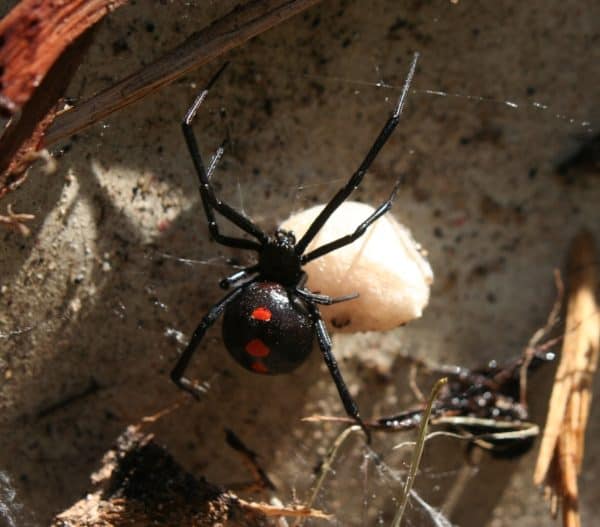
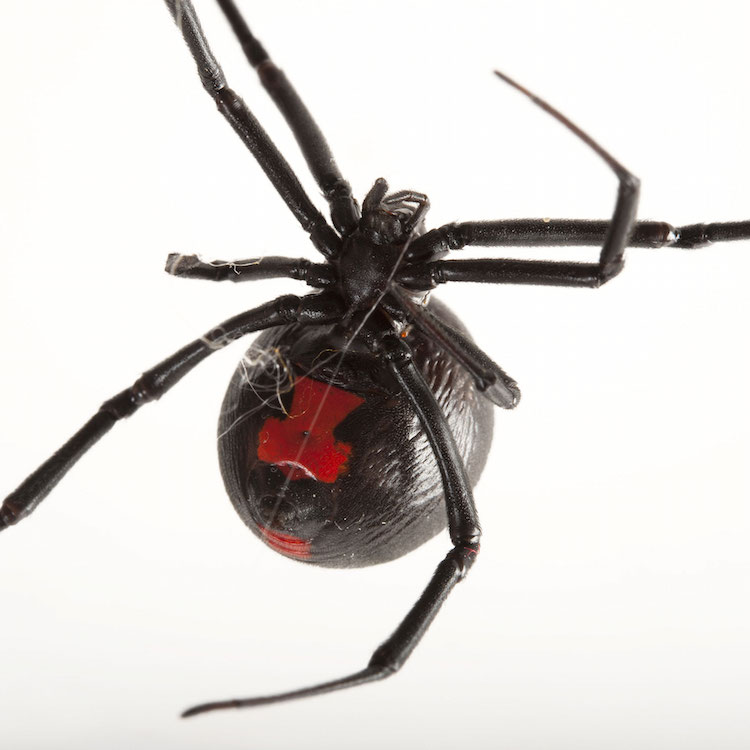
The black widow spider is considered to be the most venomous spider in North America. It is only the female black widow, however, that is dangerous to humans. Black widows are a red and black spider that is usually about 1.5 inches long with a shiny, globular abdomen and a reddish hourglass shape on its underside. While they are mostly black in color, they can sometimes be brown. The venom of a black widow spider is reportedly 15 times stronger than that of a rattlesnake. While black widow bites can be fatal to the young, the elderly, and those with compromised immune systems, most victims suffer no serious or long term damage from the bite. Black widows are not aggressive and bites commonly occur as a result of accidental contact. Common symptoms from a black widow bite include redness, swelling and tenderness at the site of the bite, muscle aches, nausea, and sometimes paralysis of the diaphragm which can cause difficulty breathing.
Brown Recluse
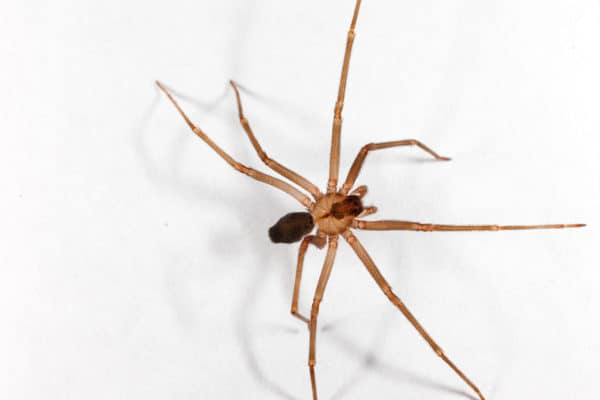
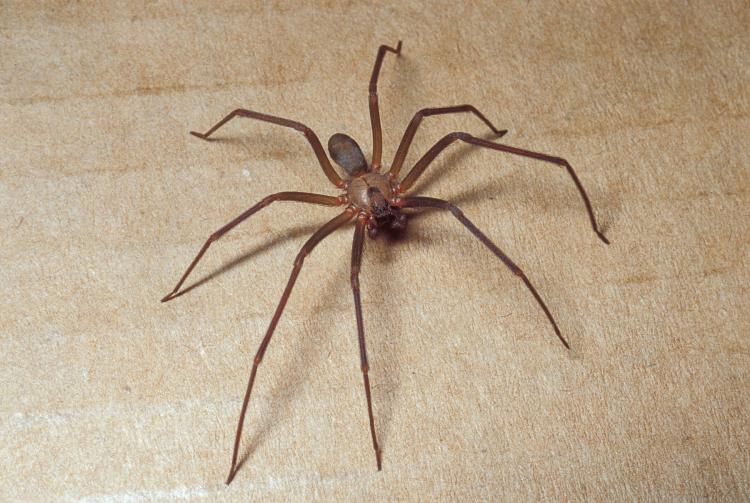
The brown recluse spider is also known as the violin spider or the fiddleback spider. The brown recluse is a light brown spider with a dark, violin-shaped marking on its back with the neck of the violin pointing toward the rear of the spider. They also have a very distinctive eye pattern with a semi-circular arrangement of 6 eyes (3 sets of 2) while most spider species have 8 eyes. Adult brown recluses are about the size of a quarter. They usually live outdoors under rocks, woodpiles, logs, etc. but are also well adapted to living indoors with humans. Once inside they are commonly found in attics, garages, basements, and are even known to wander into shoes, clothing, and bedding. They hunt at night and retreat to dark, secluded places in the daytime. The brown recluse is typically not aggressive and usually only bite when they are inadvertently trapped against human skin (rolling over on them in the bed or slipping your foot into a shoe they have crawled into for hiding). While bites are rare they can cause serious wounds and infections. The majority of bites remain localized, becoming red, swollen and tender at the site of the bite. If left untreated, a necrotic lesion may develop, usually accompanied by a central blister.
Prevention
Keep your garages, attics, sheds, basements, and other areas that aren’t utilized often clean and clear of clutter. Try to avoid leaving clothing and shoes on the floor and store them in plastic bins if possible. Shake out any clothing that has been left on the floor or in a hamper before wearing or washing.
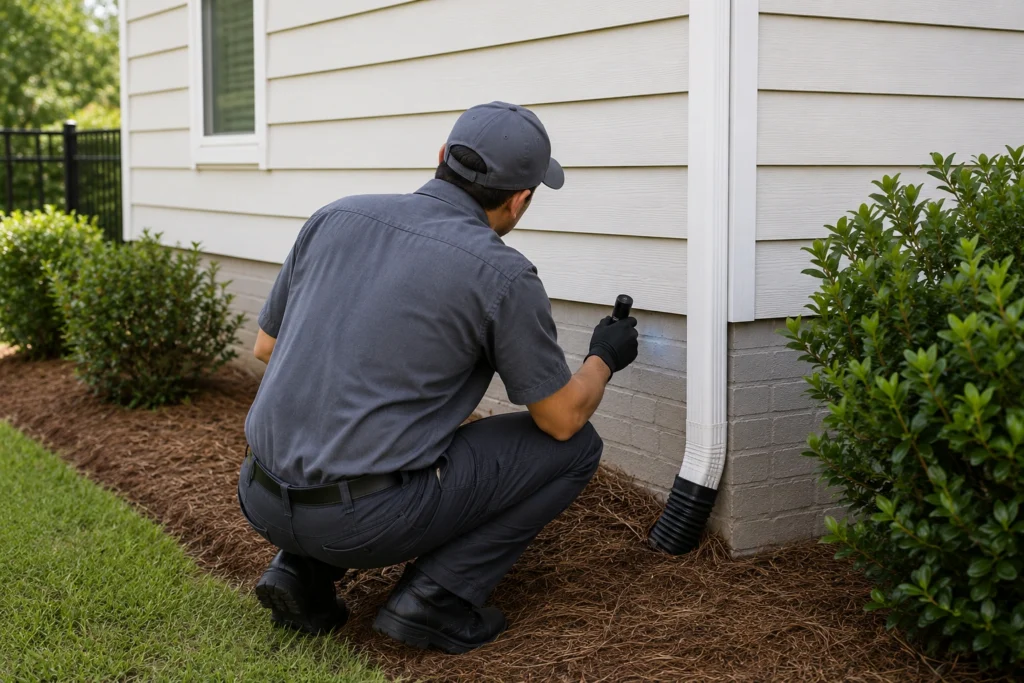
Seal any cracks and crevices around your home. Spiders can get in through damaged window screens or cracks in your siding. Inspect the outside of your home seasonally and make any repairs necessary.
Inspect any items that are brought from outdoors into your home. This includes any packages delivered to your porch or steps, groceries that may be placed on the driveway or porch as you are unloading, boxes of decorations being brought in from storage, or used appliances that are bought secondhand.
Contact a licensed pest control company if you suspect you have a spider problem. A professional pest control technician can inspect the exterior and interior of your home to help identify any possible entry points, identify the type of spiders and other pests you may be having issues with, and properly, safely, and effectively treat any pest problems they may encounter.
Request a Free Estimate to Get Started.
You May Also Be Interested In:
Avoid Bites and Stings This Summer
Is Pest Control Worth It?
The Summer Big Three: Roaches, Mosquitoes, & Termites
Granddaddy Longlegs Aren’t Spiders
5 Ways to Prevent A Millipede Invasion
Mar 8, 2019 | Georgia Blogs, Pest Control
By Anna V., Editorial Lead — Pest Education · Last updated: May 2026
Georgia’s hot, humid climate is excellent for almost everything, including the dozens of spider species that live here. At Northwest, we run spider control calls year-round across our Georgia and Alabama service area, but they spike sharply from April through October as outdoor temperatures rise and spider populations boom. The good news for homeowners: the vast majority of the spiders in Georgia are harmless. Only a handful are medically significant, and even those are uncommon to encounter indoors.
Here are the 10 spiders you’re most likely to see around a Southeast home, how to identify each, which ones warrant caution, and what to do when you find one.
Most spiders in Georgia are outdoor garden spiders that quietly handle the local insect population.
Why Understanding Spiders in Georgia Matters
Spiders play an important role in controlling insect populations. The yellow garden spider you find in your shrubs eats hundreds of mosquitoes, gnats, and flies over a summer. The cellar spider in your basement is quietly catching the small flies you don’t want around. Most spiders in Georgia are doing free pest control on your behalf.
That said, two facts make spider identification matter for homeowners:
- A small number of species are medically significant. Three to four species in the Southeast can deliver bites that require medical attention. Identifying them quickly matters.
- Most “scary-looking” spiders are completely harmless. Wolf spiders, orb weavers, jumping spiders, and the famous Joro spider all look intimidating but pose no real threat. Knowing which is which prevents unnecessary panic and unnecessary pesticide use.
Georgia’s climate produces spider activity peaks in spring (April through May), late summer (August), and early fall (September through October). Most encounters are outdoors.
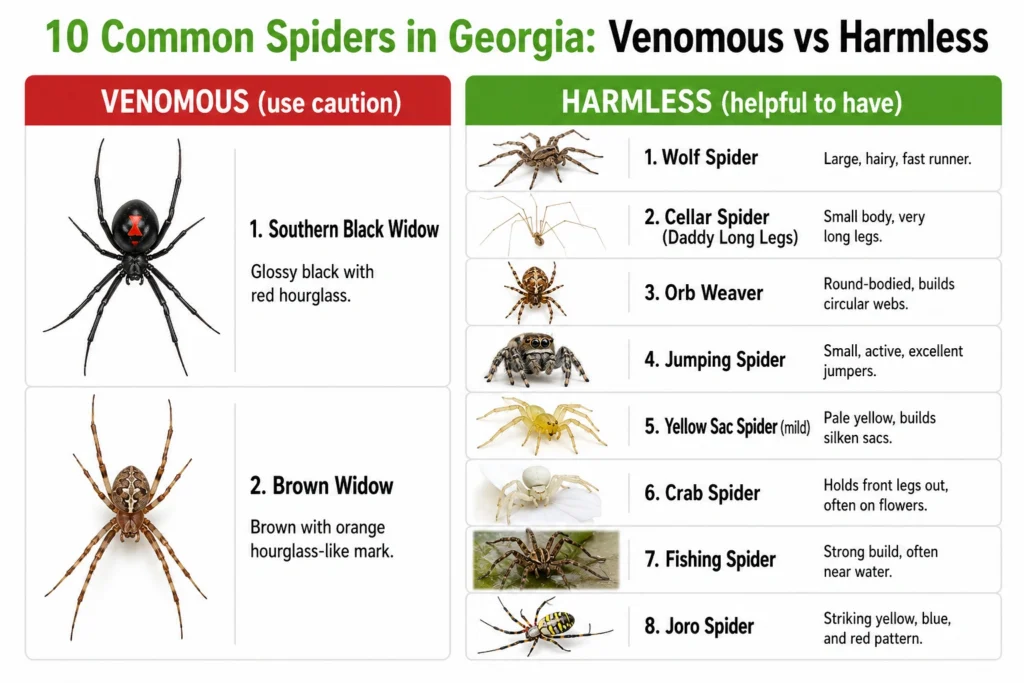
10 Common Spiders in Georgia
Two species require caution. The other eight are quiet helpers around Southeast homes.
1. Southern Black Widow (Latrodectus mactans)
- Status: Venomous. Bite requires medical attention.
- Appearance: Glossy black body with the distinctive red hourglass marking on the underside of the abdomen. Adult females are about 1/2 inch (legs spread to 1.5 inches). Males are much smaller and not medically significant.
- Habitat: Dark, undisturbed areas. Sheds, garages, crawl spaces, woodpiles, basement corners, under outdoor furniture. Common in rural and suburban Georgia.
- Action: If you find one in or around your home, call professional pest control. Do not attempt to capture or kill without protection. Bites cause severe muscle pain, abdominal cramping, and sometimes systemic reactions.
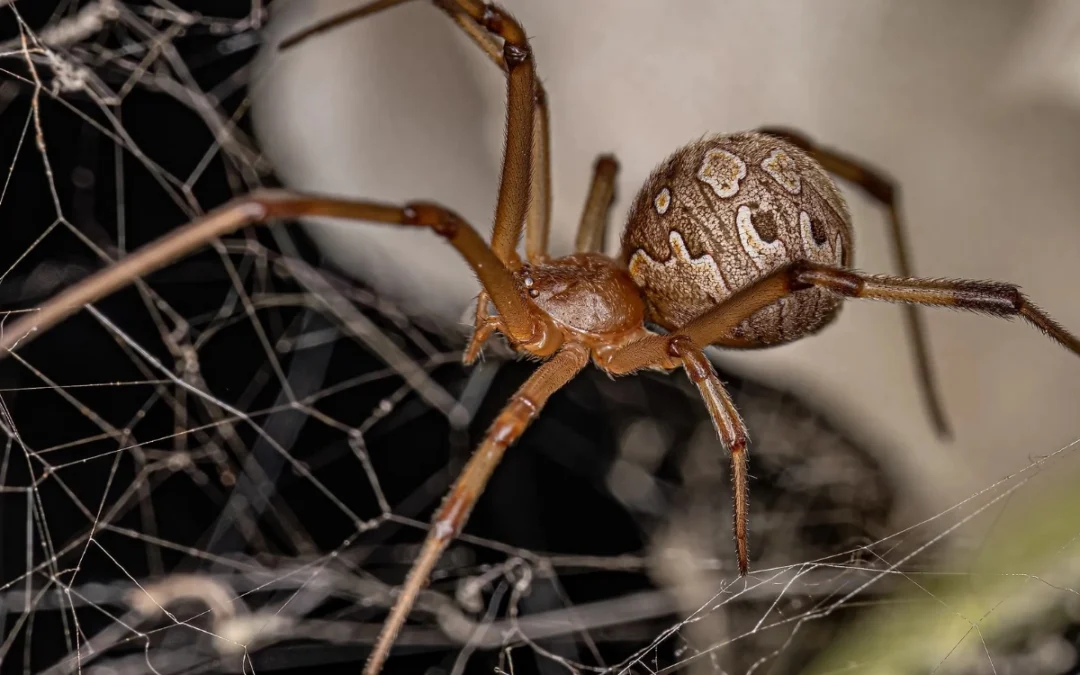
2. Brown Widow (Latrodectus geometricus)
- Status: Venomous, but less potent than the black widow
- Appearance: Tan to brown body with darker mottled markings. Distinctive orange hourglass marking on the underside (similar shape to black widow’s, but orange instead of red). Egg sacs have a spiky, golf-ball-like appearance.
- Habitat: Outdoor structures, under patio furniture, in eaves, around mailboxes, under flower pots. More common in suburban and urban Georgia than rural areas.
- Action: Bites are usually less severe than black widow bites but still warrant medical attention. Treat with the same caution and call professional control.
3. Wolf Spider
- Status: Non-venomous to humans (bite is mild, comparable to a bee sting at worst)
- Appearance: Large, hairy, brown to gray with darker markings. Body can be 1 to 2 inches with a 3-inch leg span. Eight eyes arranged in three rows.
- Habitat: Ground dwellers. They don’t build webs. They hunt. Often enter homes accidentally chasing prey. Common in basements, garages, and ground-floor rooms.
- Action: Harmless but startling. Trap with a cup and release outside.
4. Cellar Spider / Daddy Long Legs (Pholcidae)
- Status: Harmless
- Appearance: Small slender body (under 1/2 inch) with extremely long thin legs. Light tan to gray.
- Habitat: Indoor ceiling corners, basements, garages, crawl spaces. Builds messy tangled webs.
- Action: Leave them alone if you can. They eat mosquitoes, fruit flies, and other indoor pests. For a deeper dive, see our cellar spider vs daddy long legs guide.
5. Orb Weaver Spiders
- Status: Venomous to prey, harmless to humans
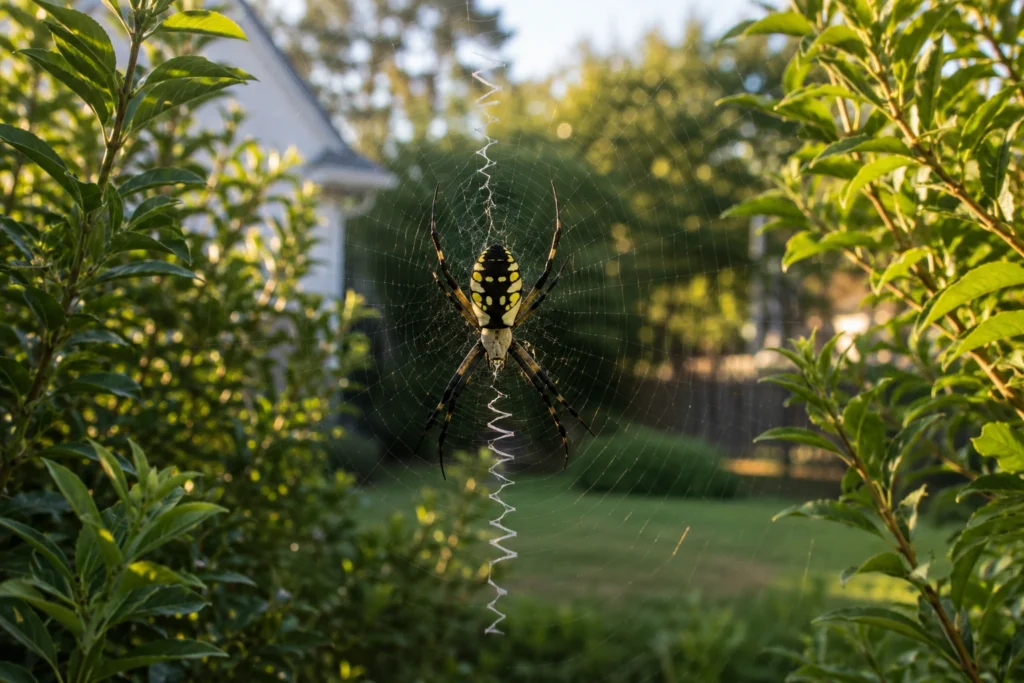
- Appearance: Vary widely in color and size. Many species have rounded abdomens with bright patterns (yellow, black, brown, orange). Common Georgia species include the yellow garden spider, garden orb weaver, and the spinybacked orb weaver.
- Habitat: Outdoor gardens, shrubs, between fence posts, under eaves. Builds the classic large circular web.
- Action: Leave them alone. They’re significant outdoor pest controllers. For more on whether their venom matters, see our orb weaver spider guide.
6. Jumping Spiders
- Status: Harmless
- Appearance: Small (1/4 to 3/4 inch), compact, fuzzy body. Often striking patterns and large forward-facing eyes that give them an almost cute appearance. Move in distinct jumps rather than walking smoothly.
- Habitat: Active hunters that don’t build webs. Common indoors and outdoors. Often spotted on walls, window frames, and porches during the day.
- Action: Among the most charming spiders you’ll meet. Harmless and useful.
7. Yellow Sac Spider
- Status: Mildly venomous. Bites possible but rarely serious.
- Appearance: Pale yellow to cream-colored, small (1/4 inch body). Slim legs.
- Habitat: Corners of ceilings, window sills, under loose bark, in folded leaves outdoors. Builds small silken retreats rather than full webs.
- Action: One of the few spiders that may bite without obvious provocation. Bites cause localized pain, redness, and itching that resolves in a few days. Vacuum sightings; call professionals for recurring activity.
8. Crab Spiders
- Status: Non-venomous to humans
- Appearance: Crab-like stance (front legs held out to the sides). Often brightly colored to match flowers (white, yellow, pink). Small body, usually under 1/2 inch.
- Habitat: Gardens, flowers, and shrubs. Ambush predators that wait on blooms to catch pollinators.
- Action: Beneficial outdoors. Leave them alone.
9. Hobo Spider
- Status: Low-risk venom (medical significance has been re-evaluated and downgraded in recent CDC guidance)
- Appearance: Medium-sized brown body with chevron patterns on the abdomen. Long legs. Often confused with wolf spiders.
- Habitat: Basements, dark corners, ground-level spaces. Builds funnel-shaped webs.
- Action: Less common in Georgia than in the Pacific Northwest. Treat as you would a wolf spider: trap and release, or call professionals for recurring activity.
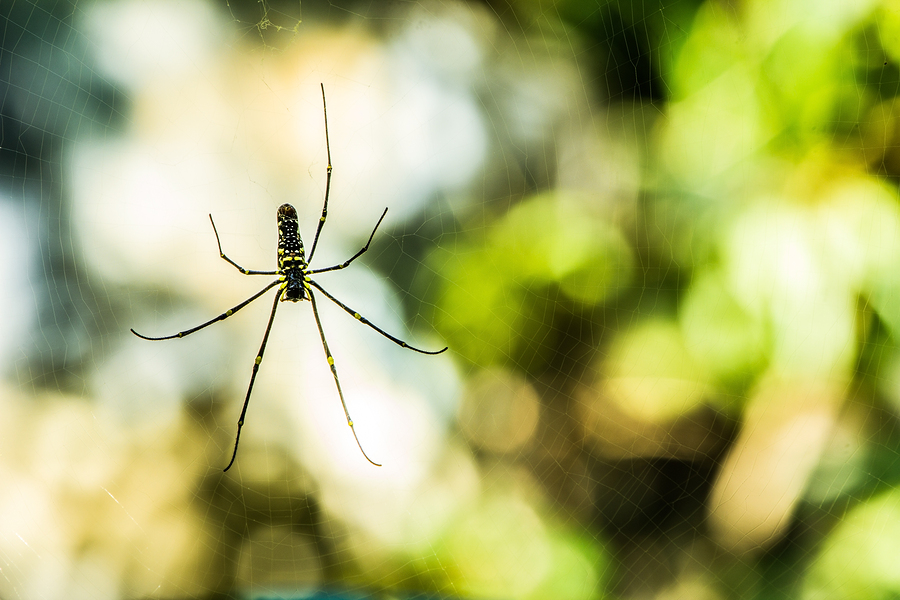
10. Joro Spider (Trichonephila clavata) — The New Arrival
- Status: Harmless to humans and pets
- Appearance: Large, striking. Females have bright yellow and gray-blue striped legs with a yellow abdomen marked with grayish-blue lines and red markings underneath. Leg span up to 4 inches.
- Habitat: Introduced from East Asia, first confirmed in Georgia in 2014. Now established statewide. Builds huge multi-layered golden webs in trees, between buildings, on power lines, across porches.
- Action: Despite their alarming size, Joros are docile and rarely bite. Their fangs are too small to penetrate most human skin. They’re effective predators of other pest insects. Most Georgia residents have started simply leaving them alone.
Venomous vs Harmless Spiders in Georgia
Of the 10 species above, only two are considered medically significant in the Southeast:
- Southern Black Widow: severe neurotoxic venom. Bites require medical attention.
- Brown Widow: less potent than black widow but still warrants medical attention.
Two more deliver bites that can cause discomfort but rarely require medical care:
- Yellow Sac Spider: mild localized reaction.
- Hobo Spider: low-risk; previously thought to be more medically significant.
The other six species are functionally harmless to humans.
What to Do If You’re Bitten
For any suspected spider bite:
- Wash the bite area with soap and warm water.
- Apply a cold compress to reduce swelling.
- Take an over-the-counter pain reliever if needed.
- Watch for severe symptoms: rapidly spreading redness, severe pain, fever, muscle cramping, abdominal pain, difficulty breathing, or any systemic reaction.
- Seek medical attention immediately for any severe symptoms or for any bite from a confirmed widow species.
If possible (and only if safe), capture or photograph the spider for identification. Medical providers handle treatment differently depending on the species.
Spider Identification Tips
Three quick markers help with on-the-spot identification:
- Size and color: Note the body size (excluding legs), overall color, and any distinctive markings (hourglasses, stripes, bright patches).
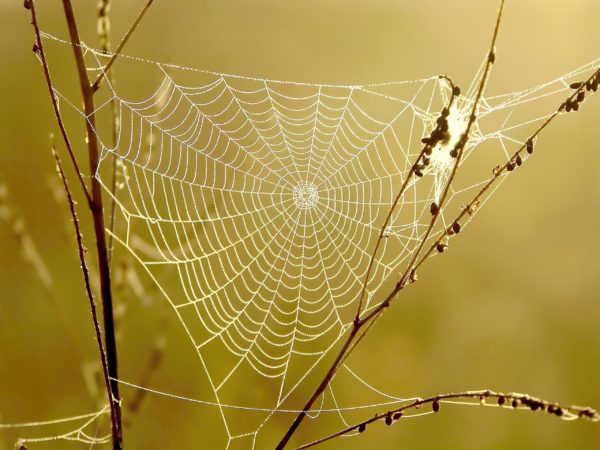
- Web type: A circular symmetrical web means orb weaver. A messy tangled corner web means cellar spider. A funnel-shaped web means hobo spider or grass spider. No web at all (spider on the floor or wall) often means wolf spider, jumping spider, or one of the widow species (which build messy three-dimensional cobwebs in hidden spots).
- Behavior: Fast movement on the ground suggests wolf spider. Quick jumps suggest jumping spider. Sitting motionless on a flower suggests crab spider. Hanging upside down in a corner web suggests cellar spider.
For authoritative species identification, UGA Extension’s guide to insect and arthropod pests of southeastern neighborhoods covers the common spider species in our region in detail.
How to Prevent Spiders in Your Georgia Home
Spider prevention is straightforward and overlaps with prevention for the insects spiders eat (which is the underlying reason spiders show up in the first place).
Spider prevention is mostly about sealing entry points and reducing the indoor insect population that draws them.
- Sanitation. Remove indoor clutter, especially in basements, attics, garages, and storage spaces. Spiders need stable hiding places.
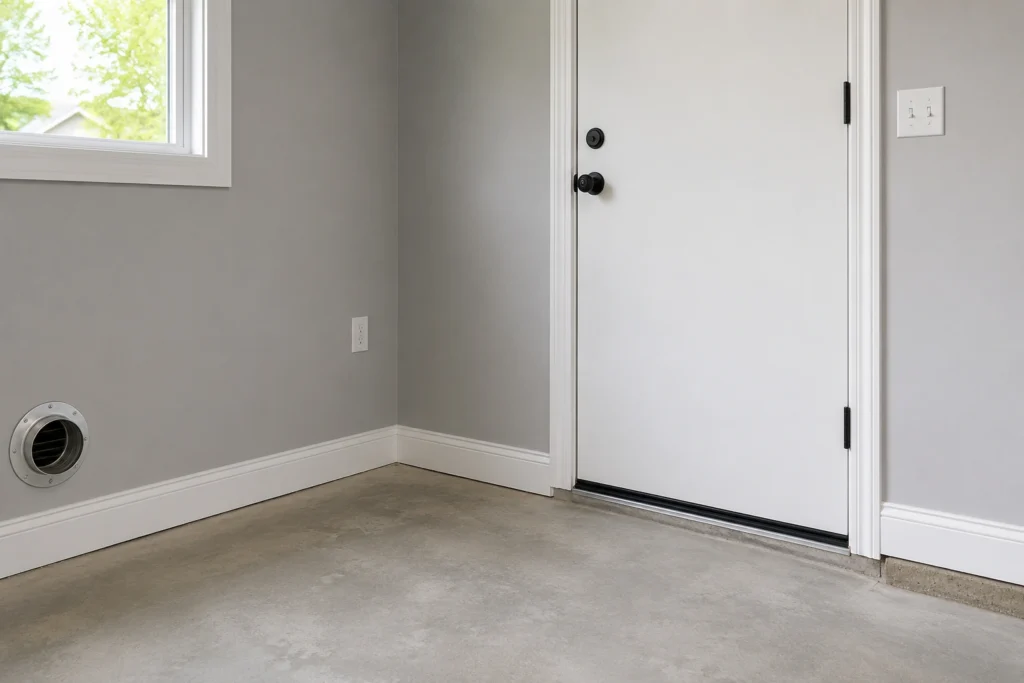
- Seal entry points. Caulk foundation cracks, install or replace door sweeps and weatherstripping, screen crawl space vents with 1/4-inch hardware cloth, seal gaps around utility line penetrations.
- Yard maintenance. Trim shrubs and tree branches back from the foundation. Remove leaf litter, woodpiles, and debris within 20 feet of the house. Outdoor harborages give spider populations a launching pad.
- Control outdoor lighting. Bright porch lights attract flying insects, which attract spiders. Switch to yellow-tone or warm-LED bulbs to reduce insect attraction.
- Humidity control. Many indoor spiders prefer slightly damp environments. Run dehumidifiers in basements; fix leaks promptly.
For active spider prevention strategies including DIY natural methods, see our natural spider repellent guide.
When to Call Professional Spider Control
Most spider sightings in a Georgia home don’t warrant professional intervention. Call Northwest if:
- You’ve found a confirmed black widow or brown widow on the property.
- You’re seeing recurring spider sightings in living spaces (bedrooms, kitchens, kids’ rooms).
- Population appears large (visible webs in multiple rooms, multiple sightings per week).
- You’re noticing other pest activity at the same time. Spiders are usually a downstream effect of an indoor insect problem.
- Anxiety or safety concerns make a professional inspection worth the peace of mind.
Professional spider control typically combines targeted treatment at active harborage spots, exclusion work to seal entry points, and addressing the underlying insect issue that drew the spiders indoors.
(Spider activity beyond what you want to handle yourself? Schedule a free Northwest spider inspection and we’ll identify what’s around, find the entry points, and lay out a treatment plan.)
Frequently Asked Questions About Spiders in Georgia
Are spiders in Georgia dangerous?
Most are harmless. Only two species in the Southeast pose real medical risk: the Southern black widow and the brown widow. The yellow sac spider and hobo spider can deliver uncomfortable bites but rarely require medical attention. The other common spiders in Georgia (wolf, cellar, orb weaver, jumping, crab, fishing, Joro) are functionally harmless to humans.
What do spider bites look like?
Symptoms vary by species. Most bites cause mild localized redness, swelling, and itching that resolves in a few days. Black widow bites cause severe muscle pain, abdominal cramping, sweating, and sometimes systemic reactions. Brown recluse bites (uncommon in Georgia) can cause a slow-healing necrotic wound. Any bite with severe pain, rapidly spreading redness, or systemic symptoms warrants medical attention.
How common are venomous spiders in Georgia?
Black widows are present statewide but uncommon to encounter indoors. Brown widows are more common around buildings, especially in coastal and urban areas. Brown recluse spiders are rare in Georgia but not impossible (they’re more common further west). Most homeowners go years between spotting a medically significant spider.
Do spiders help control other pests?
Yes, significantly. Spiders are predators of flies, mosquitoes, gnats, moths, and other household insects. A small spider presence indoors is functionally free pest control. This is one reason most pest professionals (including ours) encourage homeowners to leave individual spiders alone when possible.
What’s the Joro spider and should I worry about it?
The Joro spider (Trichonephila clavata) is an invasive species first confirmed in Georgia in 2014. It’s now established statewide and continues to spread. Despite their alarming size (leg span up to 4 inches) and bright coloring, Joros are docile and rarely bite. Their fangs are typically too small to penetrate human skin. They’re effective predators of pest insects and aren’t considered dangerous.
Most spider problems get solved by sealing entry points and treating the insects they’re feeding on.
Ready for a Professional Spider Inspection?
If you’ve spotted a widow species, you’re seeing recurring indoor sightings, or you just want a professional to identify what’s around your home, Northwest’s team handles the full spider control workflow: species identification, exclusion, targeted treatment, and addressing the underlying insect issues that draw spiders indoors. Most spider problems clear up faster than homeowners expect.
About the Author
Anna V., Editorial Lead — Pest Education leads pest education content for Northwest Exterminating, working with senior technicians and service center managers across our Georgia, Alabama, Tennessee, and South Carolina service areas to translate field expertise into homeowner-friendly guides. The focus: accurate, regionally-specific answers to the pest questions Southeast homeowners are actually searching for.
May 18, 2015 | Pest Control
Are the spiders you commonly encounter around your home harmful or harmless? Keep reading to find out which ones you should avoid.
Brown Recluse Spider
Venom toxicity – the brown recluse venom can cause significant injury with tissue loss and necrosis.
Habitat – brown recluse is found in the United States from the east to the west coast, with predominance in the south.
Spider Identification – an adult spider is 1/4 to 3/4 inch in body – a dark violin shape is located on the top of the leg attachment region with the neck of the violin pointing backward toward the abdomen. Unlike most spiders that have 8 eyes, the brown recluse has 6 eyes arranged in pairs – one pair in front and a pair on either side.
Black Widow Spider
Venom toxicity – the Back Widow Spider can inflict a painful bite which can be fatal, especially to the young and elderly. An effective anti-venom was developed in 1956. Only a small amount of venom can cause serious illness, as the poison attacks the nervous system. Systemic envenomisation usually results in headache, nausea, vomiting, abdominal pain, pyrexia and hypertension. The pain around the bite area can be excruciating or it may go unnoticed. First aid and medical attention should be sought as soon as possible, if bitten. If you have heart condition or other heart problem, you may need hospitalization.
Habitat – prefers woodpiles, rubble piles, under stones, in hollow stumps, sheds and garages. Indoors it can be found in undisturbed, cluttered areas in basements and crawl spaces.
Spider Identification – the body of an adult black widow is about 1/2 inch long. The female black widow is normally shiny black, with a red hourglass marking on the underside of the abdomen. The marking may range in color from yellowish orange to red and its shape may range from an hourglass to a dot.
Hobo Spider
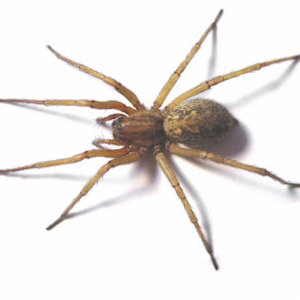
Venom toxicity – although the bite of the hobo spider is initially painless, the bite can be serious. After 24 hours, the bite develops into a blister and after 24-36 hours, the blister breaks open, leaving an open, oozing ulceration. Typically when the venom is injected, the victim will experience an immediate redness, which develops around the bite. The most common reported symptom is severe headache. Other symptoms can include nausea, weakness, fatigue, temporary memory loss and vision impairment. In any case, first aid and medical attention should be sought, if bitten, as and when any adverse health effects are observed.
Habitat – they can be found anywhere in Washington, Oregon, Idaho, Montana, Wyoming, Utah and Colorado. They rarely climb vertical surfaces and are uncommon above basements or ground level.
Spider Identification – they are brown in color and the adults measure roughly 1/3 to 2/3 inch in body length and 2/3 to 2 inches in leg span. Their abdomens have several chevron shaped markings. Males are distinctively different from females in that they have two large palpi (mouth parts) that look like boxing gloves. Females tend to have a larger and rounder abdomen when compared to males.
Funnel Web Spider
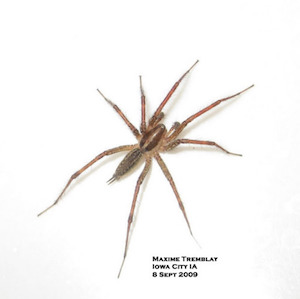
Venom toxicity – the bite of these spiders is of low risk to humans.
Habitat – These spiders are often called grass spiders because they construct their webs in tall grass, heavy ground cover and the branches of thick shrubs. Rarely will a funnel web spider be seen indoors, except for an occasional wandering male. They are found mostly in the Pacific Northwest states.
Spider Identification – are common outdoors and are occasionally found indoors. They are generally brownish or grayish with light and dark stripes near the head. They have long spinnerets and are moderate-sized (3/4 inch long). Grass spiders construct a large sheet web with a funnel they use as a retreat. These webs are commonly built on the ground, around steps, window wells, foundations, and low shrubs.
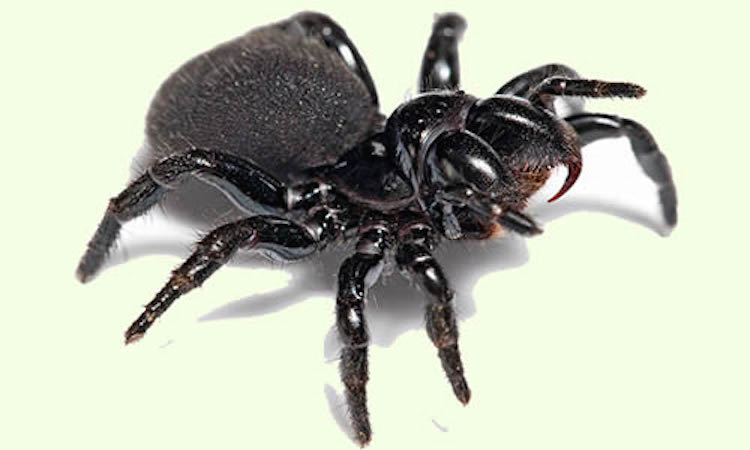
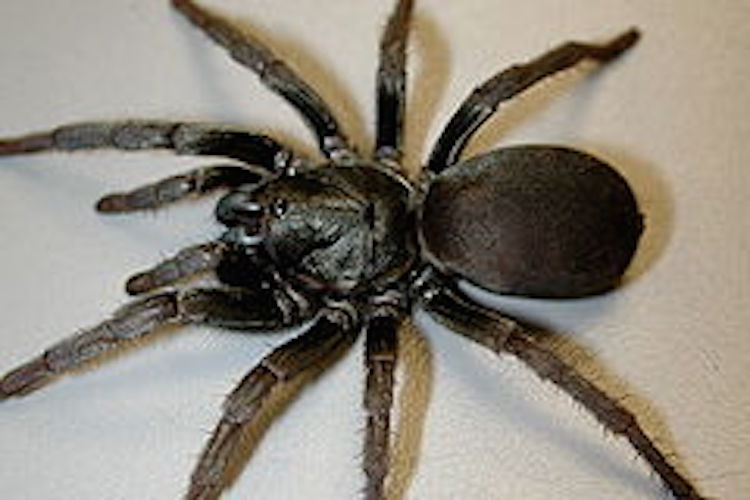
Mouse Spider
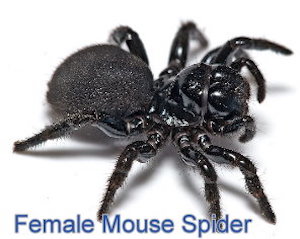
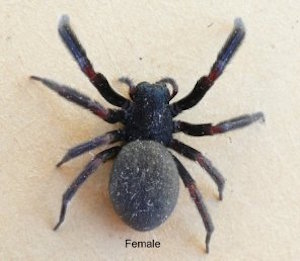
Venom toxicity – known to cause severe illness, especially to young children – similar to Red-Back Spider. Although normally not aggressive, the male mouse spider will bite if provoked, and should be considered dangerous to humans. It has large hard fangs which can cause a deep painful bite. First aid and medical attention (ambulance) should be sought as soon as possible.
Habitat – Mouse spiders are ground dwellers with burrows of more than 3 feet deep. The male often wanders about during the day on open ground, especially after rain, in search of females.
Spider Identification – a medium to large spider of up to 1 and 1/2 inches in body length. The male Mouse Spider often has a bright red head and elongated fangs.
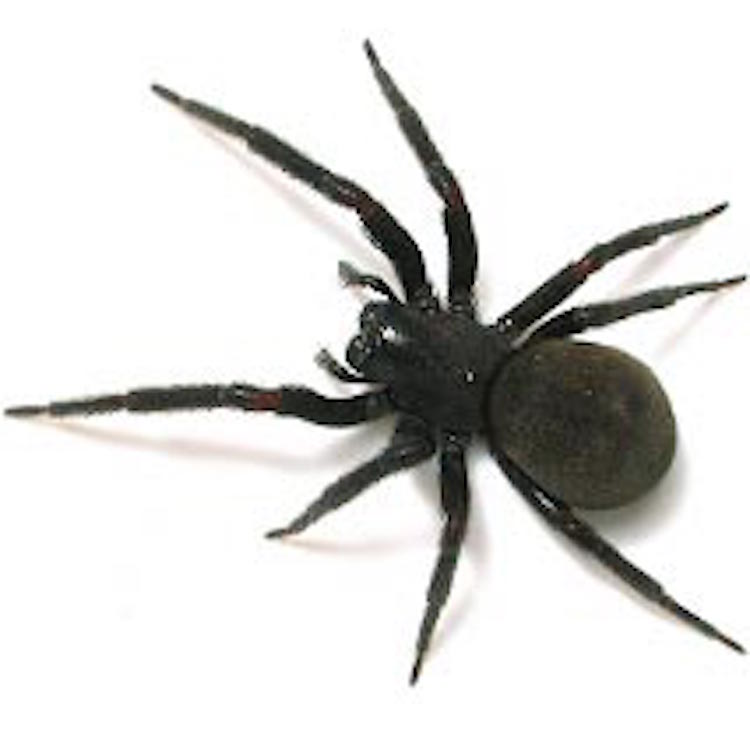
Black House Spider
Venom toxicity – the bite of the Black House Spider is poisonous but not lethal. Certain people bitten experience severe pain around the bite site, heavy sweating, muscular pains, vomiting, headaches and giddiness. First aid and medical attention (ambulance) should be sought as soon as possible.
Habitat – this spider spins a lacy, messy web and is prefers dry habitats in secluded locations. It is commonly found in window framing, under eaves, gutters, in brickwork, sheds, toilets and among rocks and bark. Electric lights attract their prey – moths, flies, mosquitoes and other insects.
Spider Identification – adults are about 1/2 inch in body length and of a dark brown to black velvet textured appearance.
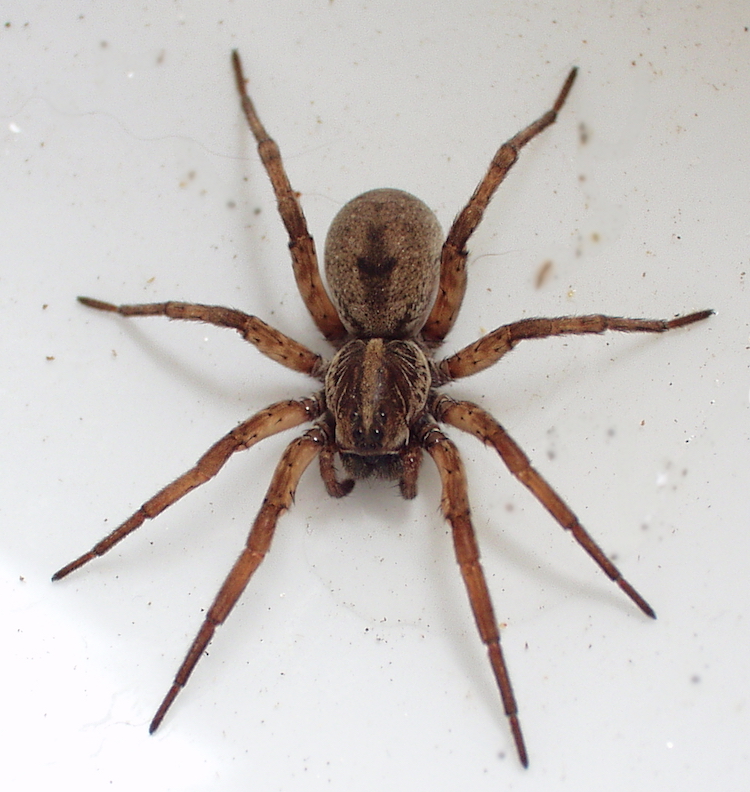
Wolf Spider
Venom toxicity – the bite of the Wolf Spider is poisonous but not lethal. Although non-aggressive, they bite freely if provoked and should be considered dangerous to humans. The bite may be very painful. First aid and medical attention should be sought as soon as possible, particularly as to children or the elderly.
Habitat – this spider is a ground dweller, with a burrow retreat. It has a roving nocturnal lifestyle to hunt their prey and can move very rapidly when disturbed. Commonly found around the home, in garden areas with a silk lined burrow, sometimes with a lid or covered by leaf litter or grass woven with silk as a little fence around the rim of the burrow.
Spider Identification – an adult is 1/2 inch to more than 1 inch in body length – mottled gray to brown in color, with a distinct Union Jack impression on its back. The female carries it’s young on its back.
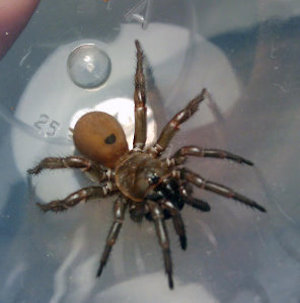
Trap-door Spider
Venom toxicity – the bite of the Trap-Door Spider is of low risk (non toxic) to humans. It is a non-aggressive spider – usually timid but may stand up and present it’s fangs if harassed. Rarely bites – but if so it can be painful.
Habitat – this spider is a ground dweller, with a burrow retreat lined with silk of up to 10 inches in depth and around 1 inch in width – prefers nesting in drier exposed locations – often has a wafer-like lid on the burrow entrance. Trap-Door Spiders are commonly found in the drier open ground areas around the home.
Spider Identification – an adult is about 1 and 1/2 inches in body length – brown to dark brown in color – heavily covered with fine hairs. The male has distinct boxing glove-shaped palps, that is, the two “sensory feelers” at front of its head.
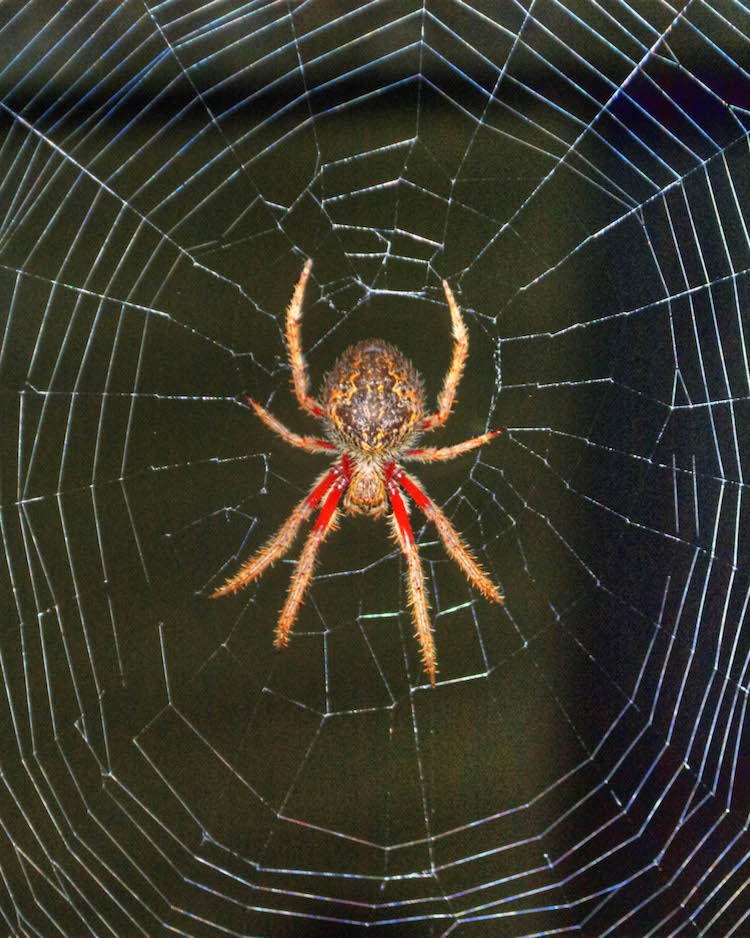
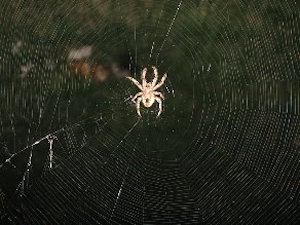
Orb Weaver Spider
Venom toxicity – the bite of Orb-Weaving Spiders is of low risk (not toxic) to humans. They are a non-aggressive group of spiders. Seldom bite. Be careful not to walk into their webs at night – the fright of this spider crawling over one’s face can be terrifying and may cause a heart attack, particularly to the susceptible over 40 year olds.
Habitat – often found in summer in garden areas around the home – they spin a large circular web of 6 feet or more, often between buildings and shrubs, to snare flying insects, such as, flies and mosquitoes.
Spider Identification – an adult is about 2/3 to more than 1 inch in body length – has a bulbous abdomen – often colorful – dark to light brown pattern. The common Golden Orb-Weaver Spider has a purplish bulbous abdomen with fine hairs.
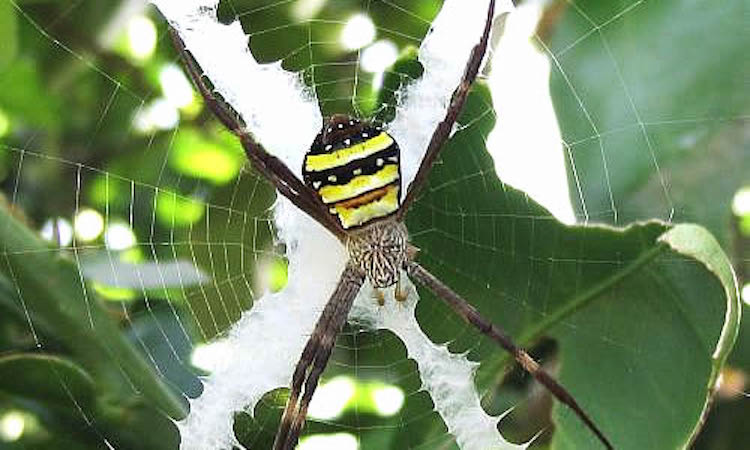
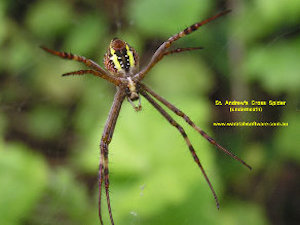
St Andrews Cross Spider
Venom toxicity – the bite of the St Andrews Cross is of low risk (non-toxic) to humans. They are a non-aggressive group of spiders.
Habitat – this spider is a web-weaver usually found in summer in garden areas around the home. It is considered beneficial as it spins a large web to snare flying insects, such as flies and mosquitoes.
Spider Identification – adult 1/4″ to 1/2″ in body length – abdomen striped yellow and brown – as illustrated. The St Andrews Cross Spider usually sits, upside down, in the middle of its web forming a cross.
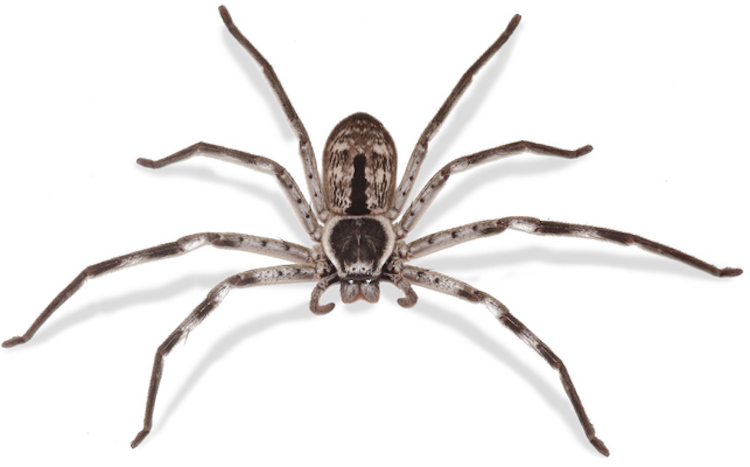
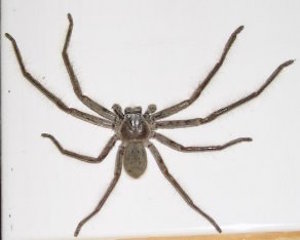
Huntsman Spider
Venom toxicity – the bite of Huntsman Spiders is of low risk (non toxic) to humans. They are a non-aggressive group of spiders. However, a large individual can give a painful bite. Beware in summer when the female Huntsman Spider is guarding her egg sacs or young.
Habitat – a hunter that prefers to live under the flaking bark of trees, under flat rocks and under eaves or within roof spaces of buildings. The Huntsman Spider often wanders into homes and is found perched on a wall. It is a shy, timid spider that can move sideways at lighting-fast speed when disturbed.
Spider Identification – an adult varies greatly around 1/2″ in body length – has long legs – the diameter of an adult including legs may reach 2″ – the first 2 pairs of legs are longer than rear two – it is hairy – buff to beige brown in color, with dark patches on the body.