Feb 2, 2021 | Pest Control
To most homeowners, cockroaches are all the same. They can sneak into homes, contaminate food, and be a nuisance to your entire household. While we tend to lump all cockroaches into one category, it’s essential to recognize that there are many different species of roaches around the world. Cockroach control methods depend on which species you are dealing with. Two popular roaches in southeastern states that get easily confused with one another are the Oriental cockroach and the American cockroach.
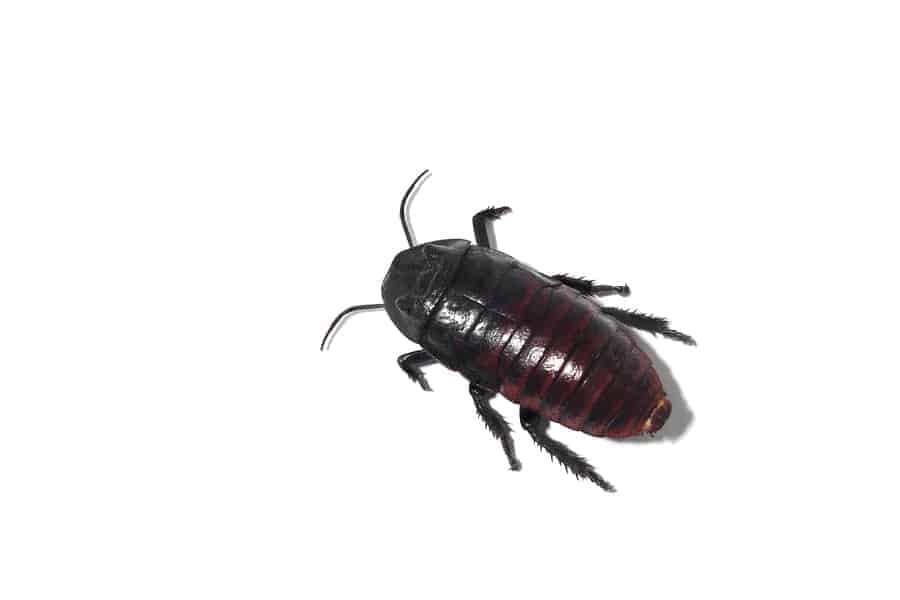
The oriental cockroach is a common species in the South. With a glossy body and cherry to black coloring, these roaches measure 1 to 1.25 inches in length. While they can cohabitate with American roaches, they usually prefer the outdoors rather than the indoors. Oriental roaches cannot live without water for more than two weeks, which means they are on a constant search for both a water and a food source. They often feed on decaying organic matter, starchy foods, and garbage.
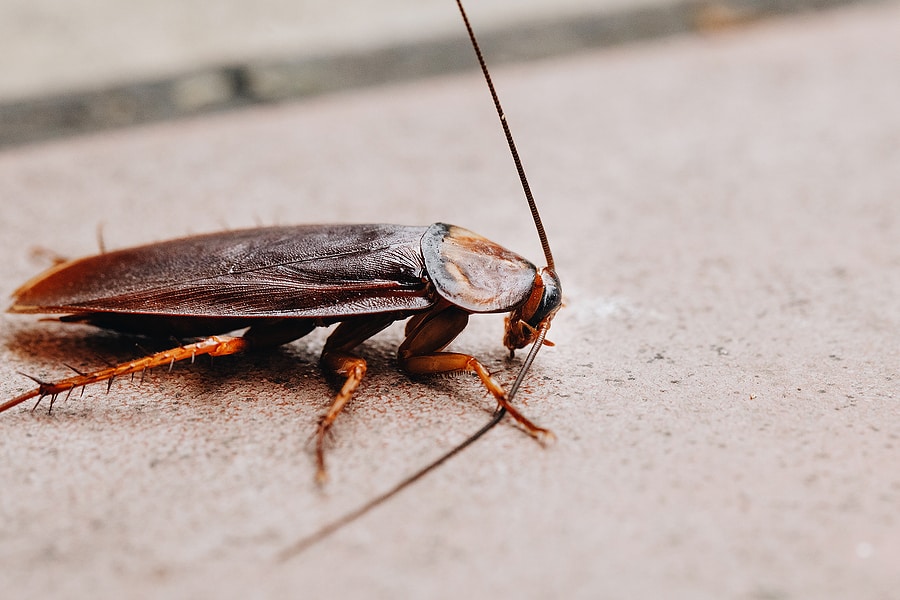
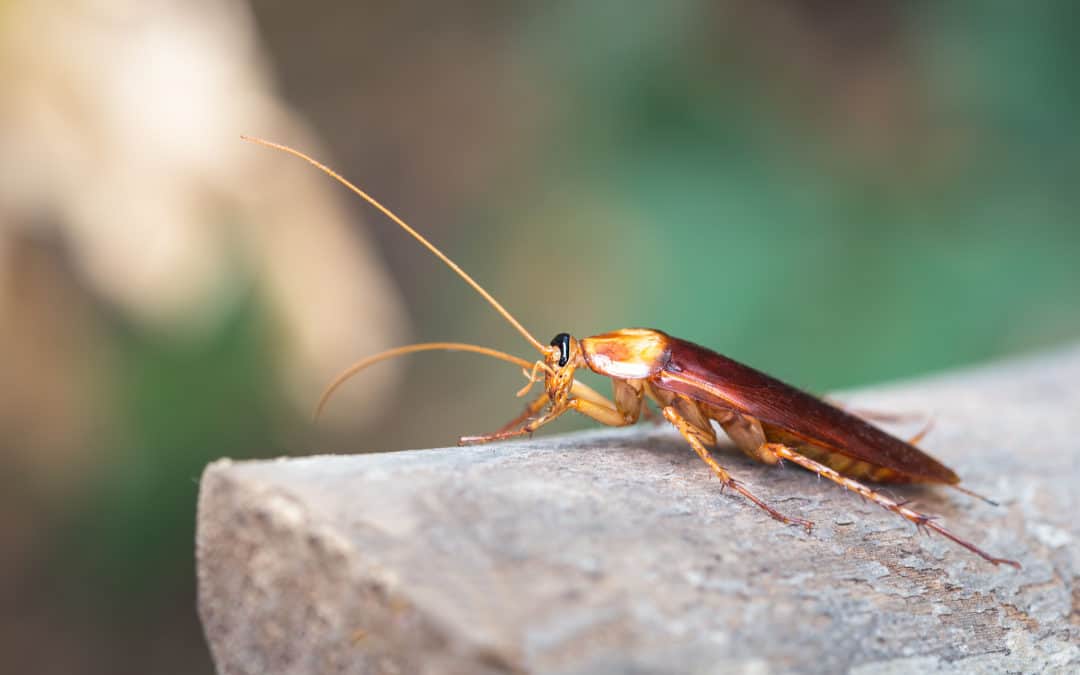
The American cockroach is quite a common species, especially in the state of Georgia. These roaches are chestnut to light brown color with a light-yellow band around the back of their head. Adults can get up to 2 inches in length and can live up to two years! Like the oriental cockroach, American roaches are in constant search of a water source and you will often find them near pipes, sewers, and basements. While they will feed on most foods, they particularly like fermenting material such as small insects, fungi, and algae. If they find themselves indoors, they will eat any crumbs or food found in appliances, kitchen cabinets, and floors.

Prevention is the key to keeping these pests from entering your house. Help prevent cockroaches by using these tips:
– Thoroughly clean your home each week.
– Store all food in tightly sealed containers.
– Clean up yard debris such as leaves or fallen tree limbs.
– Don’t let shrubs, trees, or woodpiles touch your home.
– Don’t forget to clean under forgotten spaces such as under the fridge, stove, and inside cabinets.
If you’ve done all the preparation you can but are still seeing roaches, consider contacting your local pest control company where they will help identify the roach, eliminate them, and keep them from coming back.
Jul 23, 2020 | Pest Control
German roaches are the most common species of cockroach worldwide. They can be found infesting just about anywhere that humans occupy. How do you know if you have German cockroaches? What do they look like? Are these roaches dangerous to humans? Get the answers to these questions and more with our 411 on German cockroaches.
What do they look like?
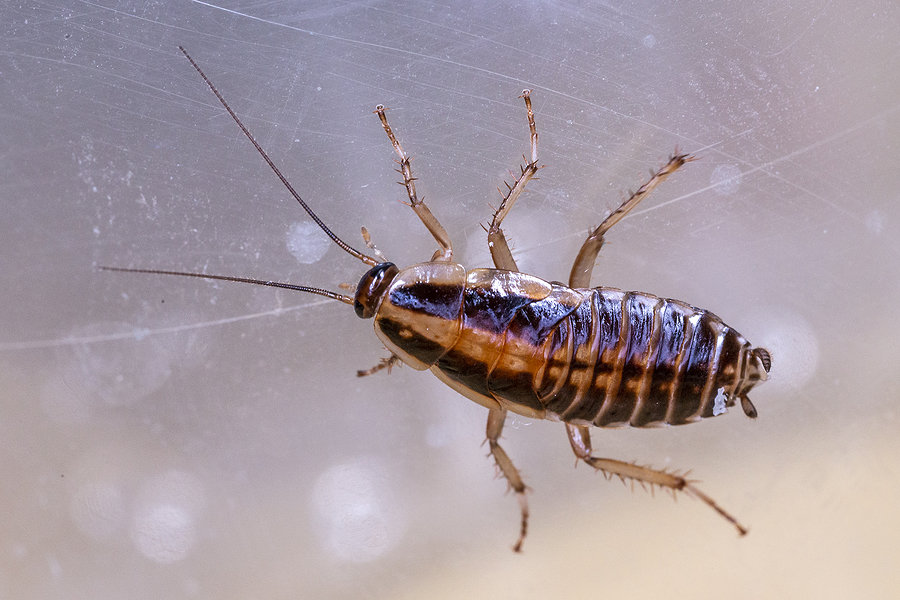
German roaches are flat and oval-shaped with 6 legs and a pair of antennae. They are smaller than other species of cockroaches, measuring between 1/2″ and 5/8″ in length. They are light brown to tan in color with 2 dark parallel stripes on their backs, just behind their heads. Females are darker than males. This species has wings but rarely fly; they prefer to run instead.
Where do they live?
German cockroaches are an indoor pest, preferring warm, humid environments. They prefer temperatures between 85 and 95 degrees Fahrenheit with 90 to 95% humidity. They make their way indoors by hitchhiking on grocery bags, cardboard boxes, and used appliances. They are often found above refrigerators or other heat producing appliances, under sinks, and around water pipes in kitchens and bathrooms so they can be near food and water sources. They are found throughout the United States.
What do they eat?
German roaches will eat almost anything. This includes soap, glue, toothpaste, food crumbs, and bindings of books.
Are they dangerous to humans?
German cockroaches have been linked to disease transmission in humans. As they crawl across fecal matter and other areas, they pick up germs on the spines of their legs and then transfer them to food and other surfaces. It has been proven that German cockroaches spread 33 different bacteria, 6 parasitic worms, and 7 other human pathogens. Their saliva, droppings, and even their dead bodies have proteins that can trigger allergies and increase asthma symptoms, especially in children.
How fast do they reproduce?
If you spot one German roach in your home, it is highly likely that there are many more hiding in cracks and crevices. Females can lay up to 40 eggs at a time which then mature within about 2 months. The female carries the egg case for up to a month and drops it right before it hatches. They can breed up to 6 generations per year. Adult German roaches can live up to 200 days. This quick reproductive rate combined with their lack of natural predators makes a German cockroach infestation difficult to control.
What are the signs of German cockroaches?
German cockroaches aggregate in groups when they infest your home. You are likely to find their droppings in areas that they frequent. These droppings appear as small, dark, pepper-like material that is often found on counters and in drawers. Their feces can also stain, leaving dark spots and smears in the corners of rooms, along the tops of doors, and around small cracks and openings in walls. When these roaches infest in large numbers, they can also give off a mild, musty odor.
How can you prevent them?
The first step in preventing a german cockroach infestation is practicing good hygiene. Keep your kitchen and bathroom clean, cleaning up crumbs and spills quickly. Sweep, mop, and vacuum often. Don’t leave any dirty dishes in the sink. Don’t leave pet food and water bowls out overnight. Seal all the openings in the exterior of your home, especially around utility pipes. Ventilate or consider enclosing your crawlspace.
If you suspect you have a cockroach infestation of any species, contact a professional pest control company who can provide you with an in-depth inspection and set you up with an appropriate treatment and prevention plan.
You May Also Be Interested In:
What You Can Expect from Service
What You Need to Know About Millipede Control
Watch out for the Stinging Pests!
Which Season is Worst for Bed Bugs?
10 Common Spiders in Georgia
Jun 4, 2020 | Pest Control
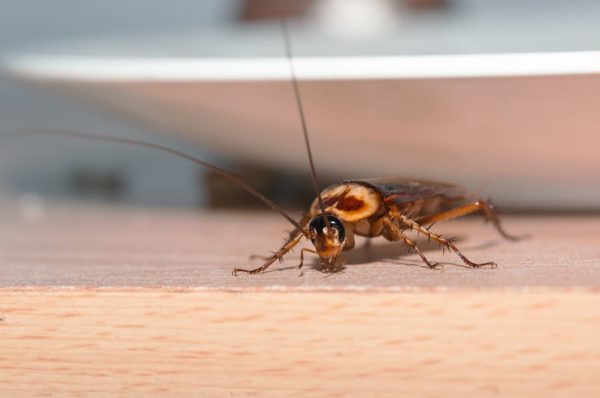
Cockroaches have been around for over 300 million years – even longer than the dinosaurs! These pests are resilient and adaptive with odd behaviors and survival tactics which have helped them survive for so long. While most homeowners are aware of the health risks associated with roaches, including allergies, asthma, and the spread of germs and bacteria, there are lots of interesting facts about cockroaches you might not realize. Here are 7 things you might not know about cockroaches.
- They’re everywhere! There are almost 4500 species of cockroaches worldwide with new species still being discovered. German cockroaches are the most common species. The largest species is found in South America. This cockroach averages 6 inches in length with an impressive 1 foot wingspan! The average cockroach is only 1/2″ to 2″ in length.
- They like their beauty sleep. Roaches spend 75% of their time resting. They are also not morning people. When roaches awaken they are unable to form new memories. It takes them time to become functional and they don’t start to retain new information until later in the day.
- They are flexible. Roaches can squeeze through a gap as small as 1/4 of their body length. They accomplish this feat by flattening their bodies and turning their legs to the side.
- They are speed demons. Roaches are fast movers reaching speeds of up to 3 mph. Even babies can move at these rapid speeds. This not only allows them to quickly invade new spaces but also allows them to spread bacteria and germs at a much faster pace.
- They can go without food, water, and their heads. Roaches can go up to a month without food and up to a week without water or their heads. They could actually live longer without their heads but the absence of their mouth leaves them unable to eat or drink. Roaches will eat anything from dead insects to soap, cloth, and glue. They have even been known to eat other roaches when food supplies are low or the infestation gets so large in an effort to reduce the population.
- They can hold their breath. Roaches are master breath holders. They can submerge in water for up to 1/2 an hour and hold their breath for up to 40 minutes. This is mostly due to their efficient breathing system that allows them to breathe through holes in their body segments rather than their mouths. Holding their breath also helps regulate their loss of water.
- Roaches are found in chocolate. Yes, you read that right! There are an average of 8 insect parts in each bar of chocolate you consume.The FDA has deemed this a safe amount for consumption. The solution to this dilemma is to apply more pesticides which would be more harmful than actually consuming the insects. These parts can also trigger allergic reactions when they are consumed. That chocolate allergy might, in fact, be a cockroach allergy instead. This can lead to rash, itching, respiratory problems, and even migraines.
Cockroaches are one of the most highly adaptable pests on earth which makes them extremely difficult to control or eliminate. To prevent cockroaches keep food sealed and stored properly; clean your kitchen daily; don’t leave food or pet food out overnight; dispose of garbage regularly and use cans with sealing and locking lids; identify any small cracks or holes around your home and seal them; and make sure basements and crawlspaces are kept dry and well ventilated. If you suspect you have a cockroach infestation, contact a professional pest control company who can provide you with a thorough evaluation and appropriate treatment and prevention plan.
You May Also Be Interested In:
How Much Does A Mosquito Treatment Cost?
Protecting Your Garden From Birds
Summertime Pest: Ants
Summer Without Bed Bug Worry
Can Termites Be Prevented or Is It Just Luck?
Mar 27, 2020 | Pest Control
By Anna V., Editorial Lead — Pest Education · Last updated: April 2026
If you’ve spotted a small, light-brown cockroach with two distinct dark stripes across its wings (and you didn’t find it in the kitchen), you’re probably looking at a brown banded cockroach. They’re one of the trickiest cockroach species we deal with at Northwest, not because they’re harder to kill, but because they nest in places homeowners rarely check. Most homeowners spend weeks treating the kitchen for German cockroaches before realizing the brown bandeds in their bedroom or living room are a different species needing a different approach.
Here’s how to identify a brown banded cockroach, what an infestation actually looks like, and the removal and prevention plan that works in Georgia and Alabama homes.
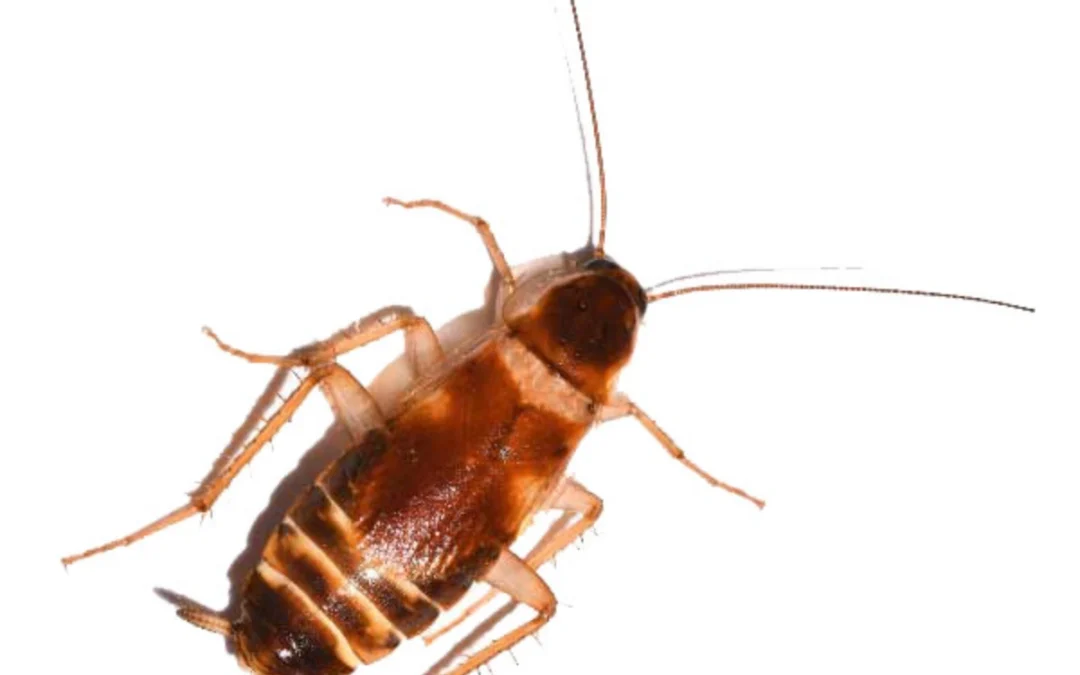
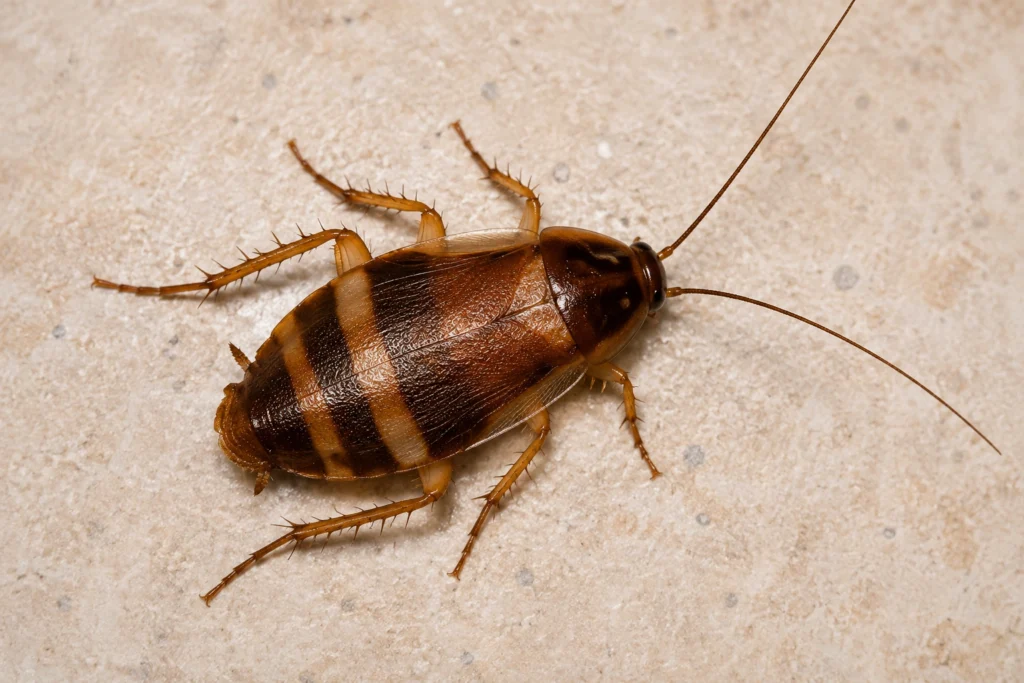
The two horizontal bands across the wings are the easiest way to ID a brown banded cockroach.
What Is a Brown Banded Cockroach?
The brown banded cockroach (Supella longipalpa) is one of three cockroach species commonly found indoors in Southeast homes, alongside the German cockroach and the American cockroach (the “palmetto bug”). It’s the smallest and most distinctively marked of the three.
Appearance
Adults are roughly half an inch long, light brown to tan, with two clear dark bands running across the back. Males have full wings that extend past their body and can fly short distances. Females have shorter wings and don’t fly. Nymphs are smaller and darker than adults but still show the banding pattern faintly.
If you flip a brown banded cockroach over and look at the underside, the bands are visible there too, which is useful for confirming the species when the wing markings are hard to see.
Behavior — and Why They’re Different from German Roaches
This is the part that surprises homeowners. Brown banded cockroaches don’t behave like German cockroaches. The biggest differences:
- They prefer warm, dry areas. German roaches need humidity and stay near water sources (kitchens, bathrooms). Brown bandeds avoid moisture and prefer rooms that stay 80°F or warmer.
- They nest away from food. Inside televisions, behind picture frames, in furniture upholstery, in light fixtures, in closets, and behind wall clocks. Anywhere warm and undisturbed.
- They spread vertically through a home. Brown bandeds tend to nest higher in rooms (upper cabinets, ceiling-mounted fixtures, the top shelf of a closet) more often than other species.
- They’re often found in bedrooms and living rooms, not just kitchens.
This is why brown banded infestations get missed. Homeowners search the kitchen, find nothing, and conclude they don’t have a roach problem, while a population is quietly growing inside a TV cabinet two rooms away.
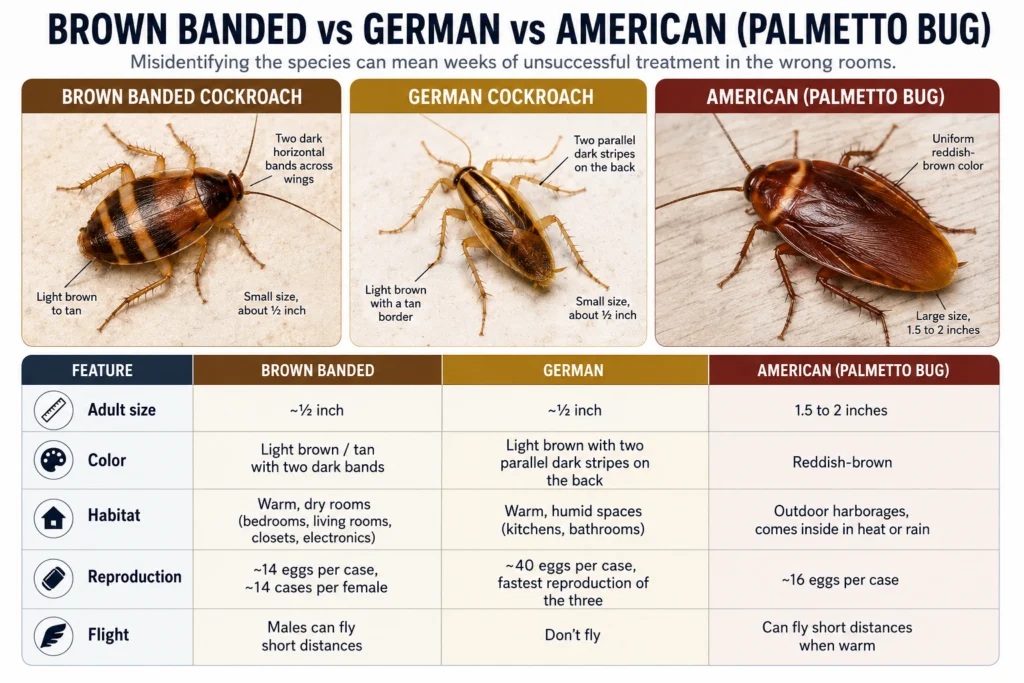
Brown Banded Cockroach vs. Other Species
| Feature |
Brown Banded |
German |
American (Palmetto Bug) |
| Adult size |
~½ inch |
~½ inch |
1.5 to 2 inches |
| Color |
Light brown / tan with two dark bands |
Light brown with two parallel dark stripes on the back |
Reddish-brown |
| Habitat |
Warm, dry rooms (bedrooms, living rooms, closets, electronics) |
Warm, humid spaces (kitchens, bathrooms) |
Outdoor harborages, comes inside in heat or rain |
| Reproduction |
~14 eggs per case, ~14 cases per female |
~40 eggs per case, fastest reproduction of the three |
~16 eggs per case |
| Flight |
Males can fly short distances |
Don’t fly |
Can fly short distances when warm |
If you’re not sure which species you’re seeing, the UGA Extension Bulletin B 1412 has detailed identification guidance for all the household cockroaches commonly found in Southeastern neighborhoods. For the broader signs of an active infestation regardless of species, see our guide on whether one cockroach means a roach infestation.
Signs of a Brown Banded Cockroach Infestation
Because brown bandeds nest away from kitchens, the signs show up in unexpected places. What to look for:
Droppings in High Spots
Tiny dark specks (similar to coffee grounds or black pepper) accumulating on the tops of bookshelves, inside light fixtures, behind picture frames, or on the upper shelf of a closet. Brown banded droppings often appear higher in a room than other species’ droppings.
Egg Cases (Oothecae)
Small, brown, pill-shaped capsules. Females often glue them to undersides of furniture, the back of a TV, the inside of an appliance housing, or into the seams of upholstered furniture. Each case holds about 14 eggs and hatches in roughly 50 to 75 days.
Damage to Paper, Cardboard, and Glue
Brown bandeds gnaw on paper, cardboard, postage stamp glue, and book bindings. Damaged storage boxes in a closet or chewed paper in a desk drawer can be a sign, especially if there’s no obvious moisture issue (which would suggest German roaches instead).
Live Sightings in Unusual Rooms
If you’re seeing cockroaches in bedrooms, living rooms, or home offices rather than the kitchen, the species is almost certainly brown banded. They prefer the same temperature range humans do, which is why they end up in living spaces.
(Found droppings or egg cases somewhere unusual? Request a free Northwest inspection and we’ll identify the species and locate the nesting site.)
How to Get Rid of Brown Banded Cockroaches
Because brown bandeds nest in dry, dispersed locations rather than concentrated kitchen harborages, the treatment approach is different from a typical German cockroach plan.
Step 1: Find the Nesting Sites
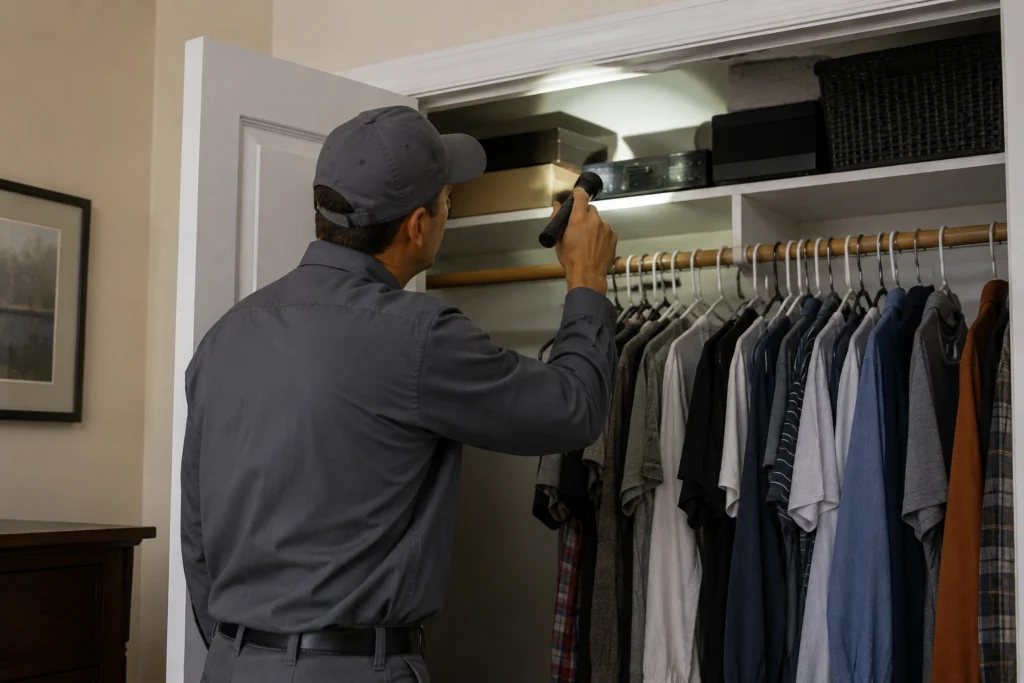
Inspect upper-room locations: top shelves of closets, behind picture frames, inside electronics housings (TVs, computers, gaming consoles), inside light fixtures, behind wall clocks, in the seams of upholstered furniture, in dresser drawers, and behind loose wallpaper. Brown bandeds also like the void spaces inside hollow-core doors.
Step 2: Place Targeted Baits
Brown bandeds respond well to gel bait, but placement matters. Standard kitchen-focused bait placement misses them entirely. Effective placements:
- Behind televisions and computer monitors
- Inside the empty space behind dressers and bookshelves
- On the top shelf of closets (where they often nest)
- Inside the recessed corners of light fixtures (with caution near hot bulbs)
- Underneath upholstered furniture
Step 3: Use Insect Growth Regulators (IGRs)
IGRs interrupt the molting cycle so nymphs can’t reach adulthood. Combined with bait, this is what breaks the egg-laying cycle. Most over-the-counter products don’t include effective IGRs at the right concentrations. That’s one of the bigger advantages of professional treatment for brown bandeds specifically.
Step 4: Reduce Hiding Spots
Cut clutter in the rooms where you found droppings. Move stored items off the floor and out of sealed cardboard boxes. Vacuum the seams of upholstered furniture. Empty closets and inspect the high shelves. Brown bandeds need stable, undisturbed locations, and disturbance forces them out of preferred harborages and into bait pickup.
What Not to Do
Skip the over-the-counter bug bombs and broad-spectrum repellent sprays. They scatter brown bandeds deeper into wall voids and across the home, which spreads the infestation rather than controlling it. This is a common and expensive mistake we see homeowners make before calling.
Preventing Future Brown Banded Cockroach Infestations
Once an active infestation is cleared, prevention focuses on the conditions brown bandeds need: warm, dry, undisturbed harborages.
- Cut clutter in bedrooms, living rooms, and home offices. Especially cardboard storage. Plastic bins are far less attractive.
- Inspect new furniture before bringing it inside, especially used or thrifted upholstered pieces. Brown bandeds frequently hitchhike in furniture seams.
- Check electronics being moved into the home (used TVs, secondhand computers, hand-me-down kitchen appliances).
- Vacuum baseboards and upholstery seams regularly in living spaces, not just the kitchen.
- Maintain quarterly pest control for ongoing prevention. Brown banded populations rebound from any survivors faster than annual treatment can keep up.
When to Call Northwest for Brown Banded Cockroach Control
Brown banded infestations are one of the species we strongly recommend professional treatment for, and not because they’re particularly dangerous. They’re not aggressive, they don’t bite, and the health risks are similar to other roach species: allergens, asthma triggers, food contamination. (See what really attracts cockroaches into clean homes for more on the health-risk side.) The reason for professional involvement is location: nesting sites are dispersed across multiple rooms, often in places homeowners can’t access (inside electronics, sealed wall voids), and DIY bait placement misses too many of them. We’ve seen brown banded infestations stretch six months of unsuccessful homeowner treatment before a one-month professional plan clears them.
Frequently Asked Questions About Brown Banded Cockroaches
How do I identify a brown banded cockroach?
Look for a small (about half-inch), light brown to tan cockroach with two distinct dark bands running across the wings. The bands are visible from above and below. Adult males have full wings that extend past the body; females have shorter wings.
Are brown banded cockroaches dangerous?
They don’t bite or sting, but like all cockroaches they can contaminate food, spread bacteria across surfaces, and trigger asthma and allergy symptoms through droppings, shed skins, and saliva. Children and people with respiratory conditions are most at risk.
Where do brown banded cockroaches hide?
Unlike kitchen-bound German cockroaches, brown bandeds prefer warm, dry rooms. Common hiding spots include inside electronics, behind picture frames, in light fixtures, on the upper shelves of closets, inside furniture upholstery, and behind hollow-core doors. They often nest higher in a room than other species.
Can I get rid of brown banded cockroaches without chemicals?
Small early infestations can sometimes be cleared with thorough vacuuming, clutter reduction, and sealing entry points. Larger or established infestations almost always require targeted gel bait and an insect growth regulator to break the breeding cycle. Pure-natural approaches rarely succeed against an active brown banded population.
How long does it take to eliminate a brown banded cockroach infestation?
A small early-stage infestation can clear in two to four weeks with targeted bait. Heavy or long-standing infestations typically require two to three months of monthly treatments to break the egg-laying cycle completely. Brown banded oothecae take 50 to 75 days to hatch, so successful treatment must outlast at least one egg-hatching cycle.
Brown banded nests live in places homeowners never think to check. That’s why DIY often misses them.
Schedule a Brown Banded Cockroach Inspection
If you’ve found cockroaches in places that don’t match the typical “kitchen problem” pattern, it’s worth a professional look. Brown bandeds are tricky to find but very treatable once located. Our team has been clearing brown banded infestations out of Georgia and Alabama homes for decades.
About the Author
Anna V., Editorial Lead — Pest Education leads pest education content for Northwest Exterminating, working with senior technicians and service center managers across our Georgia, Alabama, Tennessee, and South Carolina service areas to translate field expertise into homeowner-friendly guides. The focus: accurate, regionally-specific answers to the pest questions Southeast homeowners are actually searching for.
Jan 6, 2016 | Pest Control
Apartment living often comes with its own pest control challenges. Here are 5 ways you prevent pests from entering or infesting your apartment.
1. Eliminate Food Sources
Pests will continue to thrive in areas where food is readily available (especially roaches and ants, common in apartment buildings). Store food in sealed containers, clear dirty dishes, keep counters, appliances, and floors clean, and take out garbage daily.
2. Eliminate Moisture
Like food, most common household pests need moisture to survive. Routinely check for leaks around your home and notify management so they can correct any issues.
3. Remove Clutter
Some pests, like spiders, like to hide it dark, undisturbed areas. Eliminating clutter reduces pest harborage sites and prevent reproduction. Keep pantries, cabinets and closets organized, avoid accumulating piles of clothing by using baskets and hampers, and remove any magazines, newspapers, stacks of paper, and boxes from your home when you’re done with them.
4. Seal Cracks & Crevices
If you see gaps, holes, or cracks around windows, doors, or plumbing pipes, contact management to repair them. These make excellent entry points for pests.
5. Professional Pest Control
Even if you’re taking all of the preventative measures above, you may still see pests in your apartment since your home’s walls are shared with other residents. Request pest control from management; most likely they have an exterminator on call that services the community. It’s also a good idea to have the apartment homes around you treated to ensure the pests don’t move to a nearby location.